What's new

MD = Looting

surprman

Jr. Member
Joined
Apr 12, 2008
Messages
42
Reaction score
0
Golden Thread
0
Detector(s) used
Whites Prism III
All,

I thought this was pretty interesting. In this past month's National Geographic there was an article regarding people using metal detectors to find buried items of historical significance:

http://ngm.nationalgeographic.com/2008/12/palestine-antiquities/lange-text

Note the fact that he is hiding his face in much the same way we see terrorists in news reports!
Does Whites make a line of weapons also ??? ?

What I found most interesting was not just how National Geographic writers relate this activity to looting (and terrorism thought the visuals), but the fact that less than 20 page before this article was a full page advertisement hawking silver coins found as part of a cache, supposedly from Jerusalem! Talk about hypocritical!

I guess it is ok to benefit financially from advertisements to help the bottom line of your magazine, but not to help feed your family like the folks who are "looting".

Later!
 
Yes,
an interesting article
8) :icon_pirat: :-X :wink:


all have a good un.......
SHERMANVILLE
 
You can put a bad spin on anything.
 
you relate terrorists with white's, but you use a white's yourself
that's hypocritical
 
thanx for the link. Looks like fun to me! :thumbsup: I'd love to "loot" if I lived there too :-*

The odd thing is, although they're talking about coins and stuff that are thousands of years old, there's nothing to stop the "logic" of it from applying to 50 to 150 yrs. old coins here. Heck, even NEW coins. Afterall, a "new" coin will be the archaeological "treasures" of the future.

I read a true story where a nosy archaeologist lady tried to tell a guy md'ing on an east coast beach, that he couldn't be doing that there (I don't know what entity of beach it was, ie.: state, fed, county, or whatever). When the confused md'r said "why not?", the archie said "because it's forbidden to take historic archaeological items from this public land." The md'r showed her that he only had modern coins, and was only angling for modern jewelry. Ie.: nothing historic. The archie was taken back by this answer, and appeared to have lost the argument. So she thinks for a minute, and retorts: "well you shouldn't be bothering modern items either. Afterall, in 100 years they will be archaeological context for FUTURE generations". True story!
 
Morning Tom: She is now most likely in the unemployment line.

Gotta get rid of those nasty salvors, of course who will now employ me, since the various state govt's have no money in the treasury, and no salvors are being allowed permits?.

Don Jose de La Mancha

"I exist to LIVE, not live to exist"
 
Sniffer said:
you relate terrorists with white's, but you use a white's yourself
that's hypocritical

Sniffer,

- ahhh, I didn't make the reference - the picture in the National Geographic did. That is the brand metal detector the guy is holding in the leading image in the article. I don't think what I wrote is in any way hypocritical, since I was not saying anything under pretense. Here is the definition of the word hypocritical (which I do think applies to NG by the way)

http://dictionary.reference.com/browse/hypocritical

My reference to Whites making weapons was an attempt at humor thought dramatic irony at National Geographic's expense. I am sorry you did not comprehend the intent - maybe you were attempting Socratic irony in your response?

Yes, that was a dig for calling me a hypocrite. Look it up: http://dictionary.reference.com/browse/irony
 
wasn't attempting a dig, it just had to be a white's the guy is holding. I'd like to know how he got it and who financed the sale.
I don't purchase NG or Readers Digest anymore, too many ads for garbage and prescription drugs
sorry
Sniffer
 
All silly quibbling aside, many people DO equate detecting with looting, poaching and robbery.

In the eyes of many, only certified and credentialed scholars should be allowed to access actual historic artifacts. There is no good reason, in their view, for some non-descript yahoo with a detector to be spiriting off with the heritage that by rights belongs to all. Call it elitist if you like, but after all, such yahoos haven't spent years learning and piling up degrees. All they've done is plunked down a little cash to buy a burglary tool.

Since many detectorists equate success in the field with financial gain, these elitist folks are actually right, at least some of time. There aren't many of us who would pass up the chance to uncover a really noteworthy and valuable artifact, so that some scholar or archy could do it for us.

How many of you, in fact, are out there as often as possible, hoping to beat others to the punch so you can get it before they do?

Don't be too hard on the straight people of the world who don't understand you. They don't much buy into your line that you are "saving history." How can they, when the "history" you claim to be saving goes into your hands alone, into storage in your basement or fattens your wallet when and if that history gets sold.

I personally agree with the folks here that artifacts are better out of the ground in my posession, than rotting away deep within it. But I can assure you, we are in the minority.
 
http://www.nps.gov/history/archeology/sites/antiquities/index.htm

antiquities act, 1906.

i learned that anything on/or in the ground, that had been there 50 years, was to be left in place, under pains of arrest.(federal)

as a child i entered white house ruins, pots, bowls, cups, corn in the cribs, sandals ...it was all there...now go pay the navajo to 'tour' the site...it is all gone.
and not in museums. not on public display. not shared. unknown provenance.

i have to admit i am a bit loco on the subject.
i love to search, but i leave 99.9 behind when i go.
 
I consider them grave robbers of the lowest order!
 
All of you are bad,stop this practice immediately. Cept, for me of course. But I can live with myself.
John
 
A case where perception is reality.

I doubt there are many among us who would condone someone entering a historic National Park, such as Manassas, Fort McHenry, Jamestown, Williamsburg etc., and digging all we could, leaving the holes, and selling their finds. Same with digging up graves to harvest buttons, buckles and other artifacts.

I also doubt there are many who would find it preferable to leave the relics of the past in the ground so they could be covered by a Wal-Mart parking lot.

There are plenty of folks who make their living with their detectors. I can't fault them for finding something they enjoy, that turns a profit. Personally, I've never sold anything that I've dug, but recently dug a modern gold ring that I have no use for, or attachment to, and may sell. Sure, in 100-200 years, it may prove to be a valuable artifact, but today it is jewelry.

After the Civil War, thousands (probably hundreds of thousands) of "worthless/obselete" muskets were cut down, and turned into shotguns, or sold off to foreign governments, or destroyed. Today they are prized collectables.

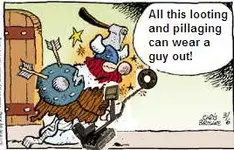
"Looting" is in the eye of the beholder, and the intent of the digger.
 
:-X
 

Attachments

  • hagar1.webp
    hagar1.webp
    13.7 KB · Views: 1,724
Dahut, you say:

"There is no good reason, in their view, for some non-descript yahoo with a detector to be spiriting off with the heritage that by rights belongs to all."


and

"..........the "history" you claim to be saving goes into your hands alone, into storage in your basement or fattens your wallet when and if that history gets sold."

Durnit, I've decided you're RIGHT! History belongs for EVERYONE to enjoy, not just detectorists. So from now on, they're welcome to come enjoy it while looking at it on MY mantle place. ;D

The private sector has done more to preserve and research historic items than the archie sector. The archie's quite frequently need to turn to US to learn more about their finds. A friend of mine found a rare button, and posted it on a forum with a little dossier he'd come up with. A few months later, he got an email from an archie who was doing research on the locations these buttons had been circulated to, and any other info. my friend could give him. Apparently the archie had googled the button, and got a hit on my friend. We had a chuckle as to how we knew more about this button, their circulation, their use after a battle, etc... than the archie did.

With that said, I'd say as dcinffxva said, that none of us condones detecting historic archaeological sites. THAT was the thrust of the Nat. Geo. article, if I understood it correctly. Or, if they were saying the whole country was off-limits, then the point still remains: detectorists in THAT country were breaking their law. When we hunt a park, beach, demo. site, country-side ruins, etc... HERE, the same sets of points don't apply. The similarities would only be true if we were snooping around Ghettysburg, Bodie, or in some other such off-limits site.
 
For the average man on the street, looting may be in the eye of the beholder. But, it becomes a different thing in the eye of jurisprudence.

It's unlikely anyone would quibble over a ring or even an old coin, found on open ground. "Finders keepers," and all that. Recover them on private property without permission, however, and it becomes both deliberate and felonious tresspass. In other words, robbery. Such cases have been lost by detectorists on those grounds.

For most of us, this is just a talking point. That is, until we discover something, somewhere, that others can attribute serious monetary or historic value to. Then you will see them come out of the woodwork for a piece of you. You will be called avaricious, selfish, a looter, a robber, cad, charlatan and any other epithet they can hurl at you. The mob will rise against you, spurred on by the legal eagles and you shall be made to pay! Imagine the torch-bearing rabble, chasing after Frankensteins monster and you get the idea.

We, the detectorists do this because of the value in the things we find, either monetary or historical. We equate our success that way and pat ourselves on the back because of it. We need some scale by which to judge our efforts, after all.
We are the ones who have gone to great lengths to become experts about these matters, whatever they may be, often living and breathing this stuff. We have taken the pains and expense to go about recovering it. We reckon that we may as well get it, otherwise it will lie there and erode into dust. We like to shout to the rafters that without us, many things would merely be lost forever. And we are right on all counts.

However, others don't often share our fervor. So, to lend an air of respectability, we have learned to be altruistic about it. We say we're "saving history for future generations," or we're into it for the exercise or interesting diversion from the everyday humdrum, etc.
But if we're to be honest about it, given a choice of "saving" an exceedingly rare and/or valuable item or a wad of canslaw... well, the choice is easy. We'd stampede one another for a chance at the former.

Much as we hate to admit it, most people outside our own circle are not stupid. They only buy into our altruistic oatmeal on the surface. This is evidenced by the first question they always ask: "What's the most valuable thing you've found?"

They know what detectors do, too. Oh, you can try to run a smoke screen of beneficence around them, and it may work when little is at at stake. But when they feel - or learn, in fact - that you are getting over on them with your activities, either individually or collectively, then you are a robber and robbers must be made to pay.

Now matter how inconvenient that truth is, it remains the truth.
 
Tom_in_CA said:
thanx for the link. Looks like fun to me! :thumbsup: I'd love to "loot" if I lived there too :-*

The odd thing is, although they're talking about coins and stuff that are thousands of years old, there's nothing to stop the "logic" of it from applying to 50 to 150 yrs. old coins here. Heck, even NEW coins. Afterall, a "new" coin will be the archaeological "treasures" of the future.

I read a true story where a nosy archaeologist lady tried to tell a guy md'ing on an east coast beach, that he couldn't be doing that there (I don't know what entity of beach it was, ie.: state, fed, county, or whatever). When the confused md'r said "why not?", the archie said "because it's forbidden to take historic archaeological items from this public land." The md'r showed her that he only had modern coins, and was only angling for modern jewelry. Ie.: nothing historic. The archie was taken back by this answer, and appeared to have lost the argument. So she thinks for a minute, and retorts: "well you shouldn't be bothering modern items either. Afterall, in 100 years they will be archaeological context for FUTURE generations". True story!

Guess she has never seen a clad or especially a Zlincoln that has been in the surf for a month or 2
 
In Harris County TX. metal detecting is forbidden in all the Precinct 4 County Parks thanks to some over zelious Archeologist that claimed we were defiling historical sites " the county parks". Went to the Commissioners court and got us banned. If you are cought they take your equipment and levey a fine on you. There are no warnings. Now the Precinct 4 Commisioner is up on fraud charges and reelection. Don't think I'll be voting for him. :P :P :P :angry4: :angry4: :angry5: :angry5: :angry7: :angry7:
 
First off--Well Said, dahut.   :)

I agree with you about the "altruistic oatmeal."  I have a strong conscience and even stronger convictions when it comes to MDing...and I recall that when I started it was about the history for me, but it was never about "saving" anything.  It was about Discovering something in the ground that was Lost before I did what it took to find it--and it was about Discovering something in myself as well...  Of course, I was 13 then and things are a little more complicated now.

I think back then I could've said "saving history" and believed it.  But now, there is a nagging suspicion that it isn't true.  It has bothered me and eaten at me for a long time now, and you touched on it in your reply above.  This is part of the reason I don't sell finds but once in a blue moon--I feel that when money is involved, part of the Good things in the hobby fade (and at that point, I'd know that the Altruism would be more than an exaggeration--it'd be Fake).  If it is Hoarded, is it "saved"?  If it is Sold, is it any more, or less "saved"?  Good questions!  I have hunted with folks that dug just with the intent of selling, and it is not an experience that I enjoyed, and they were folks that I knew would, as you put it, stampede over me in a heartbeat to get at something of value. 

You're right.  We do need a measuring stick for how well we're doing.  Since the internet, my ideas about what was a good hunt have changed--but I've also had many benefits in terms of information, techniques, and identification of finds.  But that is a topic for ten pages of replies at some point in the future...

Value.  Quantity.  Quality.  Most of us set personal goals to recover something Valuable, to find More of X or Y than we found last year, or to find a higher grade item than the one we already have.  And while these are all good for bragging rights, they are external values.  And I can say without any of the Oatmeal that part of the value of a hunt comes from an Internal scale of worth for me.  Not all relics and coins can be found in places where I can see Beauty in the location around me--so I treasure items that were found in a beautiful spot.  Not many of my recoveries can be made with my father anymore, so I value items found on hunts with him highly.  These are just two examples of internal "worth."  To corroborate my claims, I will say that I have sensed this value system on TreasureNet as well--when someone hunts with their family, or parents, there are frequently as many or more replies to their post as there are when that person finds an object of great monetary or historical value.  I would personally like to see one of Those posts make the Banner sometime!

So the "value"  (what a problematic word for the Philosophers as well as us everyday Joes)...the "value" of an item is hard to gauge.  And unless folks can communicate in writing the value they place on the hunt, the scenery, an easy (or difficult) recovery, good companionship, family, or tradition...this sense of Value goes unnoticed in posts on this and other Internet Forums.

The Law is blind to value like this.  Try to insure a watch given to you by your grandfather.  How much is it worth?  And quite possibly, we detectorists (some, but not all) use a different system of value from the system used by Archaeologists, State and Local Governments, etc.  What is of Historical Value?  I keep a LARGE display of suspender clips.  What are those worth?  Will they clad me in irons and take me away for having them?

I regularly do presentations at local schools on "Life in the 1800s" and talk about MDing and show items I have found that have a story to tell.  I figure that the way to counter Negative publicity is with Positive publicity.  And every time I show that display case of suspender clips, and see the smiles and wide-eyed expressions on the kids' faces, those clips get More "Valuable."  :wink:  So I figure if history cannot be "saved," it can at least be Shared.


So before I get totally off-base here... back to our situation in the West Bank.

Sounds like the problem is the fact that the government there can't put any "teeth" behind the laws that are in place--in terms of both punishment for offenders and police force itself. 

A law is worthless unless it is enforced.


It is almost funny--and scary as well--the lead photo.  I agree with you that the implications of the photo psychologically are worse than any negative publicity in print in the article itself.  This is in light of the last eight years, especially. 


We do not have such laws here for the most part, excepting areas that are nationally or locally protected.  And on those protected areas, night hawking is still a problem here--but folks here do not use bulldozers to accomplish it!  Sometimes it is even the park rangers themselves that illegally recover.  (Oops.  Did I say that out loud?) 

I do agree that the tendrils of such an article touch on all of us, since detectors are mentioned in a negative way--but we're talking about areas there of World Cultural Heritage and Significance--not parks, beaches, and yards like we hunt here.  So I think it comes to this:  Can the general public who read this article make the distinction?  Probably not.  And that is the problem. 


Best Wishes,


Buckleboy
 
excellent post Buckle Boy
 

Users who are viewing this thread

Back
Top Bottom