What's new

Musisians reed but to what ?

DirtyMike

Hero Member
Joined
Feb 10, 2009
Messages
898
Reaction score
106
Golden Thread
1
Location
West Virginia
🥇 Banner finds
1
Detector(s) used
Teknetics T2, MXT, TDI, Tejon, AT Pro
Primary Interest:
All Treasure Hunting
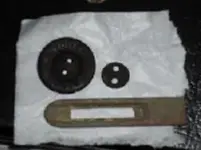
I have found these at old home sites and at cw camp sites. I have been told they were a musical instrument reed but what instrument? I always find one and its broken until today and in one hole i pulled out 93 and there were more but I had to leave. I will go back and get the rest to see how many total there are. And that's another question. How many should there be? The ones that were dug today are all sizes from about an inch up to a few inches. Most have the note stamped on them.
 

Attachments

  • addon.webp
    addon.webp
    4 KB · Views: 680
It may be too many for one reed organ and there may be more.
 
Upvote 0
RPG, you mentioned accordians don't have that many reeds. Are you sure? I was just reading that some of the accordianxs have as many as nine "reed ranks", and if I understand correctly, each rank is composed of a full range of single notes? Is that correct?
 
Upvote 0
johnnyi said:
RPG, you mentioned accordians don't have that many reeds. Are you sure? I was just reading that some of the accordianxs have as many as nine "reed ranks", and if I understand correctly, each rank is composed of a full range of single notes? Is that correct?

When I made that post I was only using common sense. I once held an accordian and it was fairly light. I would think that many reeds, being made of copper or brass, would be kinda heavy. :dontknow:
 
Upvote 0
I think this one is solved. I've done some research, and learned quite a bit about old pump organs.


http://www.pumporganrestorations.com/restoration_picture_tour.htm


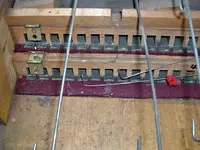
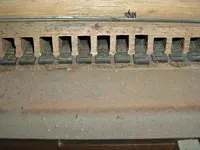
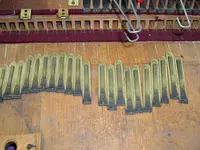
Start at Slide #30 and go forward for the photo restoration tour of a pump organ. You can SEE the reeds in place in rows. They were all marked so that they could be removed and be replaced if needed. The finder of the reeds should see a pitch name in the brass reed near the squared-off end.


1TheReedBanks.webp


2InNeedOfRestoration.webp


3VariousSizesOfReeds.webp


"Typically there are 61 keys on a pump organ and about 122 reeds. However, there can be a much greater number of reeds. The more banks of reeds you have the more sound variations you can produce." (Because even though there is one reed for each note, the organist can pull a "stop" to add another sound to the mix. Another sound is produced by a second reed of a different type that plays the same note.) This would also explain so many organ reeds being found on the same site.


Regards,


Buckles
 
Upvote 0
Great research BB. I think that explains the large amount of reeds. The rest of the organ is mostly organic.
 
Upvote 0
I agree that this one is solved. Reed Organ. Accordion reeds are steel but are
always mounted on a wooden base. They are arranged in blocks, not singly.
Don't underestimate the number of reeds in an accordion. A fairly basic 140 bass
piano accordion will have 366 reeds in it. The most basic button accordion with a
single row of 10 buttons, as used in Cajun music will have 80 treble reeds alone.
These 'simple' accordions play 4 reeds for each note and they play a different note
if you push the bellows than if you pull the bellows. Plus there will be 4 more reeds
played with the bass and chord buttons.
 
Upvote 0
Buckles, thanks for your patience with someone as musically declined as me! :) What has been bothering me here is the shape of Dirty mikes reed for one thing, as second , the exclusion of early accordians. From what I've read kiwijon, the early accordian banks consited of individual reeds (notes) mounted on a bank, not simply a brass plate with many reeds riveted on to it? Also many of them were not steel reeded, for example the Wheatstone, George case treble, Solomon, etc. which used brass reeds? I'm not arguing here, I'm asking, did not the early banks have removable single note reeds which were fitted within the banks?

Regarding the organ you mentioned buckles, I guess that is a good guess, but perhaps the reed is not from the kind of organ you pictured (which has the wide base to the reed, ones we also occasionally find.) If it was a kind of organ, would it not seem more likely this was from an old harmodium? (which has a reed such as is in the following picture?) Again, not arguing, just want to learn! :D
http://images.google.com/imgres?img...rmonium+reed&ndsp=21&hl=en&sa=N&start=21&um=1
 
Upvote 0
johnnyi said:
Buckles, thanks for your patience with someone as musically declined as me! :) What has been bothering me here is the shape of Dirty mikes reed for one thing, as second , the exclusion of early accordians. From what I've read kiwijon, the early accordian banks consited of individual reeds (notes) mounted on a bank, not simply a brass plate with many reeds riveted on to it? Also many of them were not steel reeded, for example the Wheatstone, George case treble, Solomon, etc. which used brass reeds? I'm not arguing here, I'm asking, did not the early banks have removable single note reeds which were fitted within the banks?

Regarding the organ you mentioned buckles, I guess that is a good guess, but perhaps the reed is not from the kind of organ you pictured (which has the wide base to the reed, ones we also occasionally find.) If it was a kind of organ, would it not seem more likely this was from an old harmodium? (which has a reed such as is in the following picture?) Again, not arguing, just want to learn! :D
http://images.google.com/imgres?img...rmonium+reed&ndsp=21&hl=en&sa=N&start=21&um=1


John,

Your link shows an early accordion reed, and it is a double reed within one metal frame, unlike these single reeds.


Do you want to know the difference between a harmonium and a parlor organ or "pump organ"?


Harmoniums blow and parlor organs suck. Seriously, that's the difference. :-*


Also, if this were found in Europe I'd say "harmonium reed" but since it is the U.S. it is likely a parlor organ reed. (If we want to split hairs.)
 
Upvote 0
Ha! thanks buckleboy. Again, just asking about the accordian reed so I can learn. This has been yet another education and again, thank you.
 
Upvote 0
johnnyi said:
Ha! thanks buckleboy. Again, just asking about the accordian reed so I can learn. This has been yet another education and again, thank you.

No problem, my friend. I'm always learning too. I just wanted to See photos and read a lot about these reeds which I have many of...just to try and figure it out. It was the same way with the parasol clips that we always find. I kept hearing "parasol clip" for the ID for the item, so I searched and searched--and finally found the patent for the piece.


Best Wishes,


Buckles
 
Upvote 0
Here is something of interest about reeds.

Many reed organs were shipped overseas to support missionary efforts, though they remain common (though often disused) in both private and ecclesiastical ownership. Reed organs (as with true harmoniums) were prefferable to pianos in tropical climates and regions of the world with poor transport infrastructure. As well as being cheaper to purchase, reed organs kept their tune regardless of temperature or humidity. They lacked the fragile strings, hammers and sounding boards found in pianos and so stood up much more easily to being shipped long distances, even on poor roads. Portable foot-pumped reed organs remained in use in the U.S. armed forces until the end of World War II, where they were used by chaplains to lead worship services aboard ships and in remote locations
 
Upvote 0
johnnyi said:
Buckles, thanks for your patience with someone as musically declined as me! :) What has been bothering me here is the shape of Dirty mikes reed for one thing, as second , the exclusion of early accordians. From what I've read kiwijon, the early accordian banks consited of individual reeds (notes) mounted on a bank, not simply a brass plate with many reeds riveted on to it? Also many of them were not steel reeded, for example the Wheatstone, George case treble, Solomon, etc. which used brass reeds? I'm not arguing here, I'm asking, did not the early banks have removable single note reeds which were fitted within the banks?

Regarding the organ you mentioned buckles, I guess that is a good guess, but perhaps the reed is not from the kind of organ you pictured (which has the wide base to the reed, ones we also occasionally find.) If it was a kind of organ, would it not seem more likely this was from an old harmodium? (which has a reed such as is in the following picture?) Again, not arguing, just want to learn! :D
http://images.google.com/imgres?img...rmonium+reed&ndsp=21&hl=en&sa=N&start=21&um=1

John.... I hope my description of accordion reeds did not confuse you further. It did me,
after I re-read what I had written.
Accordion reeds are manufactured and mounted separately. They consist of a flat plate
with the reed riveted to it. That plate in turn is mounted to a wooden block (usually a soft
wood like balsa) using wax. The rest of the reeds are mounted along this block to form a
row of reeds.The wooden reed block is then mounted in the air chamber of the
accordion. Reeds have been made of various metals, but bronze and steel were common.
Steel is used exclusively by manufacturers now. The arrangement of reeds in a concertina
are slightly different but the reed itself is the same design. Here is a picture of the earliest
accordion reeds I could find, from an instrument called a 'flutina'. You will see that they are
individual reeds. Accordion reeds, to my knowledge anyway, have never been made as a long
brass strip with reeds riveted on, as a harmonica is.
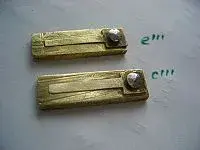
200px-Flutina-reeds.webp
The most obvious feature of Dirty Mike's reed that would exclude it from an accordion is
it's size. I am working on a small Hohner accordion at the moment. It,s largest treble reed
would be about half the dimensions of a paper match, but much thinner.
Hope I have not made the subject even more confusing. Kiwijohn
 
Upvote 0
Would that larger button happen to say A.J. Tower on it?

The reason I ask is I found an accordian reed near an A.J. Tower rain slicker button once. ;D
 
Upvote 0

Users who are viewing this thread

Back
Top Bottom