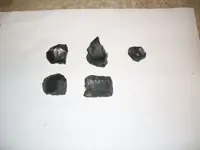
yakker, my friend from Great Britain offered this information on the gunspall my friend found and the difference from gunflints. I see from all the photos in this thread that some are gunspalls, and some are gunflints. The gunspall technology is older, but continued in use through the first half of 1800's, after the prismatic snap blade gunflints, which is the type you found, French made, and which started this thread.
----------------------------------------- ---------------------------------------------
"Just to clarify the terminology here. There are three main ways to make these things. You can individually knap them from small cores or shattered cobbles using bipolar reduction and direct percussion (usually producing one or perhaps two non-uniform items per session); you can knap them from short blade cores off a cobble (and certainly get a couple or more semi-uniform items by that route); or you can systematically mass-produce them from longer blade cores (mechanically snapping the blades to produce a series of relatively uniform items). Those three methods represent a general time progression from the 1550’s (rough items used for the forerunner of the flintlock, known as the snaphance gun) through to recent times, with the first purpose-made items appearing around 1650. There is date overlap between them and – in America – the likely dating possibilities may also be constrained by the quantities of what was actually exported from the Old World.
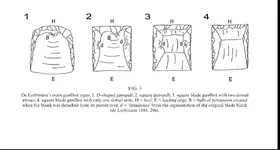
Although the terms gunflint and gunspall are used interchangeably by some folks, the conventional definition is that “gunspall” is reserved for the irregular, teardrop and then scallop shell shaped and thick wedge items, with more extensive edge trimming (unifacial) as time progresses; “gunflint” is reserved for the later prismatically shaped snap-blade items that originated in France around 1740 (as a closely guarded military/commercial secret). That technology was not available to the British until about 1775.
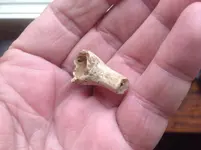
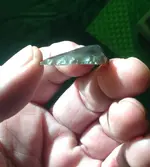
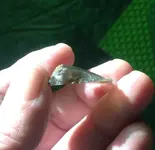
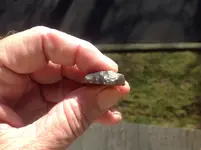
So, what you have is classified as a wedge gunspall and predates that more sophisticated technology. The large bulb of percussion suggests it has been produced by direct percussion from a core, or represents the fat end from a shortish flake off a small core. Note there’s a patch of the original cortex on what remains of the platform, so it has probably been struck from a cobble. If it’s French, the technology dates from between 1650 to 1740 and if British, between 1650 to 1775."
----------------------------------------- -------------------------------------------
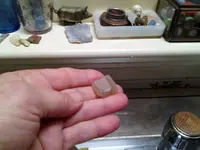
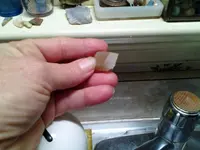
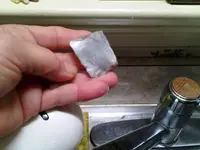
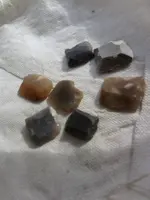
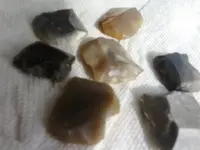
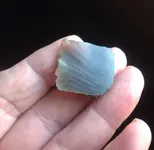
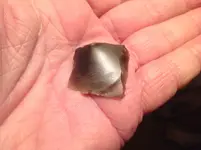
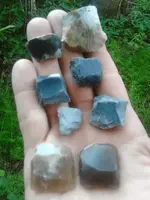
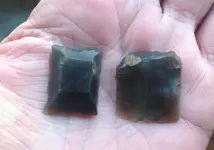
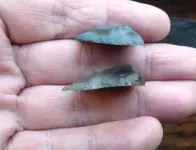
So, with my friend's info in mind, here are the two main types, gunspall on right, gunflint on left. My source also indicated that care needs to be taken IDing the source of the flint. It's only a general rule that French flint is amber colored; not all of it is. But the prismatic snap blade British gunflints did not start showing up in America much before 1800. It was a secret French technology until the British figured out how the French made gunflints. With all this in mind, this was his conclusion regarding the gunspall my friend found in my field last Sunday:
-----------------------------------------------
"In both France/Britain, the old gunspall technology was still used after 1740/1775 respectively, and the care with which your spall has been trimmed up suggests it’s not from the early period of gunspall technology. It’s not possible to be conclusive about the origin of the flint, other than to say it looks more characteristic of British flint than French flint. In both cases, “characteristic” means the flint type typically used for these items, since flints of all colours were available in both places (and let’s also not forget that the Spanish and Dutch were also big producers, but minor exporters).
The French dominated the export market and were the major suppliers to America until about 1790 when the British began to take over, but snap-blade prismatic gunflints didn’t arrive in America in bulk or overtake gunspalls until the beginning of the 19th Century.
So, in terms of probabilities, I would guess it’s most likely a British import from the early/mid 1700’s to early/mid 1800’s. There’s a lot of conjecture here but without context, probabilities are all we have to go on."
-----------------------------------
Of course, I was hoping for 1600's Contact Era, but no such luck! Note that determining the source of the flint can be tricky! In fact, as stated above, many colors were available in England and France.....













 Yakker