What's new

Captain Kidd did not bury treasure on Gardiner's Island

Cryptid1990

Sr. Member
🥇 Charter Member
Joined
Jun 3, 2025
Messages
495
Reaction score
442
Golden Thread
0
Many books, articles and websites repeat the claim that Kidd buried treasure on Gardiner's Island. I myself made the error of uncritically repeating this until today when I decided to look at historical sources to see what Kidd and Gardiner actually said. Kidd did not tell Gardiner to bury the "chest", “box of gold", "four bales of goods", and “bundle of quilts" he gave him (Graham Brooks, Trial of Captain Kidd [Glasgow: William Hodge and Company, 1930], 216).

From John Gardiner's testimony (17 July 1699):
"A Copy of the Narrative of John Gardiner of Gardner’s Island, alias Isle of Wight, relating to Captain William Kidd."

Relevant extract:
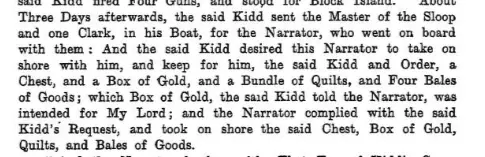
1777042294520.webp


What Kidd told Gardiner was to "keep for him" (on the island) the chest and boxes that were taken ashore. He did not give Gardiner instructions to bury the treasure.

Kidd's testimony does not either mention he buried anything nor told Gardiner to bury the treasure (chest, boxes) only saying he "delivered a chest of goods" to be "kept there" (on the island).

1777041797788.webp

1777041824762.webp


More of Kidd's Testimony (4 September 1699):

Captain William Kidd declareth and Saith that in his Chest which he left at Gardiner's Island there were three small baggs or more of Jasper Antonio, or Stone of Goa, several pieces of silk stript with Silver and gold Cloth of Silver, about a Bushell of Cloves and Nutmegs mixed together, and strawed up and down, several books of fine white Callicoa, several pieces of fine Muzlins, several pieces more of flowered silk. He does not well remember what further was in it. He had an invoice thereof in his other chest. All that was contained in ye said Chest was bought by him and some given him at Madagascar. Nothing thereof was taken in ye ship Quidah Merchant. He esteemed it to be of greater value than all else that he left at Gardiner's Island except ye Gold and Silver. There was neither Gold nor Silver in ye Chest. It was fastened with a Padlock and nailed and corded about.

Further saith that he left at said Gardiner's Island a bundle of nine or ten fine Indian quilts, some of ye silk with fringes and Tassels.

WM. KIDD.
No mention he buried anything only "left" the treasure at Gardiner's Island.

It is therefore incorrect to believe Kidd buried a treasure himself or he asked Gardiner to bury the chest and boxes on Gardiner's Island.

1777044861434.webp


Letter from Bellomont to Gardiner (8 July 1699):

Mr. Gardiner:

Having received the King's express Orders for Seizing and Securing the body of Capt. Kidd and all his associates together with all their effects till I should receive his Majesty's Royal pleasure how to dispose of the same, I have accordingly secured Capt. Kidd in the Gaol of this Town and some of his men. He has been examined by myself and the Council and has confessed among other things that he left with you a parcel of gold made up in a box and some other parcels besides, all of which I require you in his Majesty's name immediately to fetch hither to me, that I may secure them for his Majesty's use, and I shall recompense your pains in coming hither.

Again no mention the treasure was buried. Furthermore, the treasure (chest, boxes) is specifically stated to have been left with Gardiner. Kidd certainly never buried it. Bellomont in a letter to the Lords of Plantations and Colonies noted that Gardiner could not easily transport everything that Kidd left him since it was too big including six bales of goods and one was twice as large as the others "Kidd gave him particular charge of the bale and told him it was worth £2,000."

Kidd also mentioned he "left in custody of Mr Gardiner" a box that was sealed:

1777202006114.webp


Can anyone find sources that Gardiner even buried the treasure? I am now sceptical of that as well. Why was this not mentioned in his testimony?

Conclusion:
  • Kidd never buried the treasure on Gardiner's island nor asked Gardiner to bury it.
  • Kidd gave Gardiner the treasure (chest and boxes) to keep or look after but gave him no instructions to bury it.
  • Gardiner returned the treasure to Bellomont (or at least most of it; he apparently kept one of the diamonds).
  • Gardiner might not have buried the treasure and that story might have been an embellishment.
 
Last edited:
I think there is a general misconception of this pirates burying treasures idea. They are really the last men to bury anything in the ground:
- they are mostly seamen not farmers so its not the next thing comes in their mind when trying to secure their lot
- traditional ships are difficult to impossible to sail upwind so at least the ocean based pirates know that once they leave a place it could take a long time until they are able to come back to it.
- while pirate had traditional hideouts once those are discovered by authorities they could be relatively easily be ambushed especially on land so best is not to use it for too long time as a base of operations and avoid to visit it afterwards
- it is difficult to bury anything without the help of others but pirates had mostly no families that could be trusted so using other pirates help would be a bad idea (yes you had to kill them after burying 0 another stereo type taken from movies)
 
Strange that to this day the Gardiner's maintain that Kidd's loot was buried, And they even
went to the trouble of placing a marker at the burial site to memorialize the event.
1777101064354.webp
 
From the Robert David Lion Gardiner Foundation:

The Visit of Captain Kidd​

In June 1699, Gardiner’s Island received a legendary visitor, Captain William Kidd, privateer and pirate. He sailed his ship Adventure Prize into one of the harbors on the Island on his way to Boston where he would attempt to clear his name. With Lion Gardiner’s grandson Jonathan’s permission, he buried $30,000 worth of treasure in a ravine between Bostwick’s Point and the Manor House.
Kidd gave Mrs. Gardiner a piece of gold cloth (it can be found on display at the East Hampton Library) which he captured from a Moorish ship off of Madagascar, as well as a bag of sugar – a rarity at the time. He warned the Gardiners that if the treasure was not there when he returned he would kill them, and he headed off to Boston. While in Boston, Kidd was captured, put on trial and later executed. Governor of New York and Massachusetts, Richard Earl of Bellomont ordered the Gardiners to deliver the treasure to the court as evidence. The treasure included gold dust, silver bars, gold Spanish coins, rubies, diamonds, candlesticks and porringers. One diamond remained in Gardiner’s hands. Some argue that he took it; others argue that it was accidently left in his travel bag. The diamond was given to his daughter Elizabeth who married the Island chaplain, Mr. Green.
First problem: based on historical records, Lion Gardiner's grandson Jonathan Gardiner (1709-1735) was born after Kidd died so it is impossible he gave Kidd permission to bury treasure on the island. Does the foundation not do basic fact-checking?

Secondly, none of the trial testimonies mention Kidd or John Gardiner (Lion Gardiner's son who met Kidd) buried treasure, only that Kidd gave John the treasure to keep and look after.

Thirdly, the trial testimonies contradict the Foundation's claim that Kidd threatened to murder the Gardiners if they lost the treasure:

A legend developed that Kidd warned that if the treasure was not there when he returned he would kill the Gardiners, though trial testimony given by John Gardiner on July 17, 1699, makes no mention of any threats, and Kidd's conduct appears to have been quite civil.

Furthermore, this family legend (and a few others) arose after Kidd died and were not taken serious by the compiler Curtiss Gardiner:

Curtis Gardiner recorded the family legends that formed about the encounter over the next two centuries in Lion Gardiner and his Descendants 1599-1890. There are several different stories, the tale becoming increasingly embellished with generations of retellings. In one version the fearsome Captain Kidd broke down the door to Gardiner Manor, rousing John Gardiner from bed and hiding his loot “in a swampy place at Cherry Harbor." In another, Kidd tied Gardiner to a mulberry tree and demanded that Mrs. Gardiner roast him a pig, which was so delicious that he gifted her the cloth of gold. Curtis was generally skeptical of the folklore and very concerned with the lack of “proof” these family traditions offered. However, he chose to include them in his book because “certain pious family fictions…must not be disturbed." Although embellished and fantastical, the stories provided an oral tradition that imbued the cloth with meaning and connected the family to the salacious pirate.

The family tradition among the Gardiner's Kidd buried treasure "in a swampy place at Cherry Harbor" and threatened to murder John Gardiner or his son was first recorded by the seventh proprietor John Lyon Gardiner, c. 1800 (paraphrased by Curtiss):

He took fresh provisions he wanted, came in the night and cut the old gentleman's hands in the dark with his cutlass: destroyed feather beds, scattered the paper money about the house; stayed several days and lived well; tied the old man up to a mulberry tree, which is now standing at the north house: left money, with him. It was hid in a swampy place at Cherry Harbor. He showed Mr. John where he put it; told him 'if he never came for it he might have it; but it he called for it and it was gone would take his head, or his son's.
I managed to find this source. It is John Lyon Gardiner's memorandum book (written sometime between 1793 and 1809):

1777160526902.webp


In other words, this story is not traceable in literature until a century after Kidd died. Curtiss Gardiner (1890), a direct descendent of Lion Gardiner, who compiled the family traditions concerning Kidd (including from J. L. G's memorandum book), in 1890, doubted this story: "I have quoted the foregoing record of the seventh proprietor merely to show the unreliable character of family tradition." Curtiis went on to disprove some of these family traditions. He noted for example, that based on the trial testimonies, Kidd did not actually set foot on Gardiner's Island: "Kidd did not leave the sloop and go on the Island" (based on John Gardiner's testimony). John Gardiner met Kidd aboard the HMS San Antonio and Gardiner took with him the chest and boxes: "Kidd desired this Narrator [John Gardiner] to take on shore with him, and keep for him [...] a chest, and a boax of gold, and a bundle of quilts, and four bales of goods". Kidd therefore did not set foot on the island himself so it was impossible he buried the treasure. None of the other testimonies mention Kidd went on the island and his crew unloaded cargo on the shore. Curtiss also recognised there is no truth to the story Kidd threatened to murder Gardiner:

1777124620109.webp

If you try to find any other sources of Kidd's buried treasure on Gardiner's Island it becomes apparent most of the Gardiner family was repeating the same dubious and disproven family tradition throughout the 19th century that Kidd buried treasure in a swamp. In Connecticut Historical Collections (1836), John Warner Barber published the family story after having spoken with John G. Gardiner:

1777137064923.webp

1777137091140.webp


In The History of Long Island (1843), Benjamin Franklin Thompson wrote: "It having been ascertained, in some way, that he [Captain Kidd] had buried treasures upon this island, commissioners were dispatched from Boston, by Governor Belomont, to secure the same." (emphasis added) However, there is no evidence the treasure was ever buried and no sources are relied upon or quoted by Thompson. Nevertheless, the Gardiner family continued to publish the family tradition that the treasure was buried in a swamp by Kidd. This story is notably found in Gardiners of Gardiner's Island (1927) by John Lyon Gardiner.

There was another Gardiner family tradition Kidd buried treasure "in a small ravine between Bostwick Point and the manor house".

"Gardiner's Island", Robert David Lion Gardiner
New York History, Vol. 14, No. 1 (January 1933), pp. 53-60

1777144002545.webp


This is entirely absent from 18th century literature. According to this story, the area Kidd buried the treasure between Bostwick Point and the manor house was known as Cherry Tree Field. The earliest literary sources that mention this are from the 19th century, for example, New-England Historic Genealogical Society in 1877:

1777148890334.webp


In the 1870s or 1880s, a memorial stone was built.

"Captain Kidd's treasure was buried in this hollow and recovered 1699.”

A photo appears in "The Gardiner Manor" (1916) by Sarah Gardiner Tyler:

1777169538451.webp


A more recent photo:

1777149250694.webp


To summarise: there is total lack of historical evidence that Kidd or Gardiner buried the treasure on the island; the trial testimonies by John Gardiner and Kidd disprove the claim Kidd buried anything since he did not set foot on the island. The memorial stone and literary sources that mention Kidd's Hollow/Cherry Tree Field as the place the treasure was buried do not predate the 19th century. They do not even match the dubious family tradition first recorded c. 1800 that Kidd buried the treasure at a different location on the island in a swamp.

Shockingly, there are literally thousands of books, articles and websites repeating the false claim Kidd buried treasure on Gardiner's Island, despite this is disproven by the trial testimonies; and it is very improbable John Gardiner buried the treasure.
 
Last edited:

Here is the original estimate.

Please, by all means, those with better eyes than I, read it.

Screenshot 2026-04-26 162332.webp


Screenshot 2026-04-26 162455.webp


Captain William Kidd's memorandum of treasure left on Gardiner's Island
Date: 4 September 1699 Reference: CO 5/860 (65xx) Creator: Colonial Office, Commonwealth and Foreign and Commonwealth Offices, Empire Marketing Board, and related bodies

Crow
 
There is no mention of a treasure being buried on Gardiner's Island. In the following document below,
Abstract of the letter from Bellomont Date: 1699 Reference: CO 5/860 (64i) 1 of 2 Creator: Colonial Office, Commonwealth and Foreign and Commonwealth Offices, Empire Marketing Board, and related bodies Catalogue context: Correspondence, original - Board of Trade.

Screenshot 2026-04-26 193620.webp


It is what you can see left by Kidd with Mr Gardiner of Gardiners Island.

Crow
 
Here is a letter
Bellomont to Mr Gardiner
Date: 1699 Reference: CO 5/860 (64vii) Creator: Colonial Office, Commonwealth and Foreign and Commonwealth Offices, Empire Marketing Board, and related bodies Catalogue context: Correspondence, original - Board of Trade.

Screenshot 2026-04-26 195845.webp


This is why I also say, try to find the earliest account to find the truth.

Crow
 
I think there is a general misconception of this pirates burying treasures idea. They are really the last men to bury anything in the ground:
- they are mostly seamen not farmers so its not the next thing comes in their mind when trying to secure their lot
- traditional ships are difficult to impossible to sail upwind so at least the ocean based pirates know that once they leave a place it could take a long time until they are able to come back to it.
- while pirate had traditional hideouts once those are discovered by authorities they could be relatively easily be ambushed especially on land so best is not to use it for too long time as a base of operations and avoid to visit it afterwards
- it is difficult to bury anything without the help of others but pirates had mostly no families that could be trusted so using other pirates help would be a bad idea (yes you had to kill them after burying 0 another stereo type taken from movies)
I always understood pirate treasure maps to be a 19th century literary invention and trope popularised by Robert Louis Stevenson (1883). However, I previously thought that some pirates buried their treasure, albeit rarely. I now though doubt this since there is not a single verified case of a pirate burying treasure (Kidd never buried a treasure on Gardiner's Island and he is very unlikely to have instructed John Gardiner to have done so) but unlike pirate treasure maps that later arose in fictional literature, there were some rumours and legends in the 17th and 18th centuries that pirates buried treasure. None though have been proven and they remain improbable, for example, the book A General History of the Pyrates (1724) mentions a tale John Rackham buried treasure and stories circulated in the 18th century Blackbeard buried treasure. The main reasons to doubt pirates buried treasure is pirates typically seized from other ships textiles, wine and spices, not gold and jewels; most pirates also lived short lives at sea so it did not make sense they would bury the valuables what they plundered.

From the Royal Museums Greenwich:

Did Blackbeard bury his treasure? Sadly, pirates burying treasure is very likely a myth. Most of the booty seized would have been trade goods like spices, silks and wine rather than gold and jewels stored in treasure chests.
From History Extra:
The reality is that pirates had no reason to bury their treasure. In fact, the word ‘treasure’ often did not mean gold and jewels at all; rather, it usually referred to other valuable items, ranging from textiles and spices to various wines and spirits. The majority of pirates had short lives at sea and needed to get wealthy quick, so they plundered goods and sold them on land in order to repair and restock their ships, hire new crew, support their families, or buy plenty of food and women’s company. Burying these items would have only led to lost goods and likely death before they could be recovered. So, while it makes for a fun story, the reality of ‘buried treasure’ is as fiction as Treasure Island.
 
From the Robert David Lion Gardiner Foundation:

First problem: based on historical records, Lion Gardiner's grandson Jonathan Gardiner (1709-1735) was born after Kidd died so it is impossible he gave Kidd permission to bury treasure on the island. Does the foundation not do basic fact-checking?

Secondly, none of the trial testimonies mention Kidd or John Gardiner (Lion Gardiner's son who met Kidd) buried treasure, only that Kidd gave John the treasure to keep and look after.

Thirdly, the trial testimonies contradict the Foundation's claim that Kidd threatened to murder the Gardiners if they lost the treasure:


Furthermore, this family legend (and a few others) arose after Kidd died and were not taken serious by the compiler Curtiss Gardiner:


The family tradition among the Gardiner's Kidd buried treasure "in a swampy place at Cherry Harbor" and threatened to murder John Gardiner or his son was first recorded by the seventh proprietor John Lyon Gardiner, c. 1800 (paraphrased by Curtiss):


I managed to find this source. It is John Lyon Gardiner's memorandum book (written sometime between 1793 and 1809):

View attachment 2251671

In other words, this story is not traceable in literature until a century after Kidd died. Curtiss Gardiner (1890), a direct descendent of Lion Gardiner, who compiled the family traditions concerning Kidd (including from J. L. G's memorandum book), in 1890, doubted this story: "I have quoted the foregoing record of the seventh proprietor merely to show the unreliable character of family tradition." Curtiis went on to disprove some of these family traditions. He noted for example, that based on the trial testimonies, Kidd did not actually set foot on Gardiner's Island: "Kidd did not leave the sloop and go on the Island" (based on John Gardiner's testimony). John Gardiner met Kidd aboard the HMS San Antonio and Gardiner took with him the chest and boxes: "Kidd desired this Narrator [John Gardiner] to take on shore with him, and keep for him [...] a chest, and a boax of gold, and a bundle of quilts, and four bales of goods". Kidd therefore did not set foot on the island himself so it was impossible he buried the treasure. None of the other testimonies mention Kidd went on the island and his crew unloaded cargo on the shore. Curtiss also recognised there is no truth to the story Kidd threatened to murder Gardiner:

View attachment 2251613
If you try to find any other sources of Kidd's buried treasure on Gardiner's Island it becomes apparent most of the Gardiner family was repeating the same dubious and disproven family tradition throughout the 19th century that Kidd buried treasure in a swamp. In Connecticut Historical Collections (1836), John Warner Barber published the family story after having spoken with John G. Gardiner:

View attachment 2251631
View attachment 2251632

In The History of Long Island (1843), Benjamin Franklin Thompson wrote: "It having been ascertained, in some way, that he [Captain Kidd] had buried treasures upon this island, commissioners were dispatched from Boston, by Governor Belomont, to secure the same." (emphasis added) However, there is no evidence the treasure was ever buried and no sources are relied upon or quoted by Thompson. Nevertheless, the Gardiner family continued to publish the family tradition that the treasure was buried in a swamp by Kidd. This story is notably found in Gardiners of Gardiner's Island (1927) by John Lyon Gardiner.

There was another Gardiner family tradition Kidd buried treasure "in a small ravine between Bostwick Point and the manor house".

"Gardiner's Island", Robert David Lion Gardiner
New York History, Vol. 14, No. 1 (January 1933), pp. 53-60

View attachment 2251645

This is entirely absent from 18th century literature. According to this story, the area Kidd buried the treasure between Bostwick Point and the manor house was known as Cherry Tree Field. The earliest literary sources that mention this are from the 19th century, for example, New-England Historic Genealogical Society in 1877:

View attachment 2251650

In the 1870s or 1880s, a memorial stone was built.

"Captain Kidd's treasure was buried in this hollow and recovered 1699.”

A photo appears in "The Gardiner Manor" (1916) by Sarah Gardiner Tyler:

View attachment 2251685

A more recent photo:

View attachment 2251651

To summarise: there is total lack of historical evidence that Kidd or Gardiner buried the treasure on the island; the trial testimonies by John Gardiner and Kidd disprove the claim Kidd buried anything since he did not set foot on the island. The memorial stone and literary sources that mention Kidd's Hollow/Cherry Tree Field as the place the treasure was buried do not predate the 19th century. They do not even match the dubious family tradition first recorded c. 1800 that Kidd buried the treasure at a different location on the island in a swamp.

Shockingly, there are literally thousands of books, articles and websites repeating the false claim Kidd buried treasure on Gardiner's Island, despite this is disproven by the trial testimonies; and it is very improbable John Gardiner buried the treasure.
Again, another well researched post. I tend to believe that the version were he never even left the sloop is true. In addition to what I posted above coming from a source living a pirates live:
  • The pirates edge is their fast moving ships, which they are not inclined to leave when in a potentially hostile environment
  • They are commonly not trained soldiers, they are good (if at all) in close quarter combats on ships. On land they are sitting ducks.
  • If they land and plunder a place then their success depends on surprise mostly
  • Even on anchor they are inferior to coast guard or navy vessels and will avoid to stay around for a prolonged time that could allow locals to alarm the authorities
  • Shovels are made of iron and those tend to rust away. They have not much use on a ship and are not commonly kept around on board.
  • Pirates if at all would be inclined to hide rather then bury anything on land because recovery needs to be fast otherwise it leaves them open to an ambush
  • They are know how to navigate on the sea not so much on land, there was no Google Maps those days so they would try to stay close to the coast. On land they would be in a big disadvantage, they had no horses or carriages on board.

One can easily see why there is no motive to bury anything in the ground for a pirate and in Kidd's situation on Gardiner's Island even more so. The story that he buried it with the knowledge of the proprietor does make no sense. If he did bury anything ever that only in a most unusual, exceptional situation.
 
I always understood pirate treasure maps to be a 19th century literary invention and trope popularised by Robert Louis Stevenson (1883). However, I previously thought that some pirates buried their treasure, albeit rarely. I now though doubt this since there is not a single verified case of a pirate burying treasure (Kidd never buried a treasure on Gardiner's Island and he is very unlikely to have instructed John Gardiner to have done so) but unlike pirate treasure maps that later arose in fictional literature, there were some rumours and legends in the 17th and 18th centuries that pirates buried treasure. None though have been proven and they remain improbable, for example, the book A General History of the Pyrates (1724) mentions a tale John Rackham buried treasure and stories circulated in the 18th century Blackbeard buried treasure. The main reasons to doubt pirates buried treasure is pirates typically seized from other ships textiles, wine and spices, not gold and jewels; most pirates also lived short lives at sea so it did not make sense they would bury the valuables what they plundered.

From the Royal Museums Greenwich:


From History Extra:

I can understand your frustration.

Have you ever come across the treasure hunters paradox?

But academics are not treasure hunters. They look at famous pirates and not obscure ones. There are two examples I know of, but I am bound by non-disclosure agreements with other interested parties. And the irony is, I have more to lose than to gain by revealing them. In my country, I can be stripped of assets if believed to be having the proceeds of crime. Treasure hunting is, in effect, illegal, as concealing a discovery and revealing that discovery in the public domain leaves me open to incrimination. The paradox is better for me to be an enigma, a legend.

Here is one case where treasure was buried by privateers for the English and seen as pirates by the Spanish.

Screenshot 2026-03-26 220011.webp


John Oxenham was an English privateer who first came to America under Sir Francis Drake in 1572. From 1576 to 1578 he led a bold expedition to Spanish-held Panama. With support from the local Cimarron runaway slave community, he and his 57 men wintered at Panama, built a ship on the Pacific coast, and in the spring launched a surprise attack on Spanish ships loaded with Peruvian gold and silver. They were eventually pursued upriver and were able to bury some of their treasure. Oxenham and a few of his men fled into the interior and evaded capture for several months, but were eventually captured in Venezuela in 1578.
Offered here is a detailed file on Spanish efforts to recover this treasure.

I can post only this page, as the WHOLE document was bought for 6700 US dollars

Offered here is a detailed file on Spanish efforts to recover this treasure. Oxenham (appearing in the documents in this lot as "Juan de Hoznen") and the others were found with around 5,000 pesos of gold and silver. Agustín de Haro, the accountant of the royal treasury in Panama, was entrusted with the money. Some who had participated in the defeat and capture of the pirates claimed they were owed a share of the treasure for their efforts, and demanded it from Haro. However, the Holy Office of the Inquisition had a legal claim to all of the money. The captured pirates were in the Inquisition''s custody and would be tried in its courts. Because Oxenham and his crew were not Catholics, they were charged with heresy and apostasy, and thus they and their property fell under the jurisdiction of the Holy Inquisition. Haro would not budge, however, claiming that he was given strict orders to not deliver the money to anyone, for any circumstances, until he received orders from the highest authorities claiming otherwise. Haro was eventually jailed for his intransigence.

Official orders regarding the treasure were postponed due to the absence of the comisario of Panama City, Juan Constantino, on missionary work. Haro would die in jail (possibly of suicide) before the comisario could return to resolve the issue. Baltasar de Melo, the tribunal official who collected money and received evidence, complains about the comisario''s persistent absenteeism, and how it indefinitely postponed the resolution of crucial issues surrounding the capture of the pirates: "Es cosa perdida tenerlo aquí por Comisario porque los negocios perecen por su falta y ausencia. ¿Qué poco sirve que vengan de allá mandamientos si no hay acá quien los ejecute?" ("It is a waste to have him here as the commissioner because matters languish as a result of his unavailability and absence. What good does it do to have orders coming from far away if there is no one here to execute them?")

One such issue put on hold was the fate of the pirates themselves--including Oxenham and his sidekicks John Butler ("Juan Buthar/Butlar," known among Spaniards as Chalona) and brother Henry ("Henrrico Buthar"). They had been languishing in their cells, with little progress made on their cases, again because of the comisario''s absence. The pirates (who are mentioned in nearly every document) are spoken of in the present tense (se llaman, or "they are named"), and are mentioned as currently being imprisoned. The above three, who had gained considerable notoriety in the Hispanic world for their previous ventures with Francis Drake ("Chalona" was supposedly renowned for his navigational expertise), are always mentioned by name, along with the maestre "Thomas Jeroes" (Thomas Sherwell). None of the other Englishmen are named, and, curiously, nothing is said of the runaway slaves who avoided execution by being re-enslaved. Authorities eventually received the approval to move Oxenham, the Butlers, Sherwell, and the other more prominent pirates to Lima, where they were publicly executed in 1580. When the texts move forward into the 1580s, the pirates are referred to in the past tense.

The deaths of the pirates and the death of Haro would do nothing to bring back all of the missing wealth. The home of the deceased Haro showed no trace of lost silver and gold, and his estate amounted to little more than worthless "cachivaches y menajes de casa" ("pieces of junk and household items"). As it would turn out, the real reason why Haro refused to distribute the money, and why none of it could be found in his house, was that he had used it. Haro had been lending out the pirate''s loot to several people as far away as Cuzco. Juan de Saracho, another receptor of the Inquisition, petitioned the tribunal to authorize him to side-step the comisario''s absence and collect every last peso of gold and silver from those Haro had lent to. He also asked for the authority to threaten anyone who refused to cooperate with excommunication. Saracho''s petition received approval from the Inquisition in Lima. Soon, he and the other receptor, the aforementioned Melo, ruthlessly demanded the immediate repayment of the loans made with the pirate treasure. While they were able to retrieve much of the money this way, their strong-arm tactics were met with resistance. Included here is a 1583 petition by the family members and descendants of the late Gabriel de Loarte, a leading official whom Saracho and Melo had been targeting, complaining of the harassment. They argued that their father had received the loans from Haro, not them. The last document is a ledger from 1583 showing the enormous amount the two had collected, and the remaining amount, which, for all that is known, may have never been recouped.

There are cases like this, but that said very rare.

You can see above the treasure hunter paradox at play. You find a treasure, you suffer for finding it.

Crow
 
John Oxenham was an English privateer who first came to America under Sir Francis Drake in 1572. From 1576 to 1578 he led a bold expedition to Spanish-held Panama. With support from the local Cimarron runaway slave community, he and his 57 men wintered at Panama, built a ship on the Pacific coast, and in the spring launched a surprise attack on Spanish ships loaded with Peruvian gold and silver. They were eventually pursued upriver and were able to bury some of their treasure.
Speaking of Panama...

Daniel Chilson invented the Chilson bridge metal detector in 1924 (basically the first BFO) and in 1927 it was used in a hunt for "buried pirate treasure" in Panama. Reportedly (NYT, 3/12/27) the treasure was buried when Henry Morgan plundered Old Panama in 1671. The treasure hunters had a 4-year license with the Panamanian government and apparently detected and recovered some amount of treasure.

Some modern accounts call this the first use of a metal detector to hunt for buried pirate treasure, implying that a pirate (Morgan) buried the treasure. In reading the early accounts (Friona Star 5/13/27, Canberra Times 7/5/27), it appears as if the treasure was actually buried/hidden by the locals to prevent its capture. It seems that some or most of it was discovered in subterranean tunnels. And it wouldn't make sense for Morgan to loot the town, and then bury the loot right there.

It's funny, I looked into this story about 10 yrs ago, all I knew was that it had been reported by the NYT in the1920s. But I couldn't find the article and gave up. Now AI not only hands me the NYT article but also the 2 other sources. I feel lazy.
 
Last edited:

Speaking of Panama...

Daniel Chilson invented the Chilson bridge metal detector in 1924 (basically the first BFO) and in 1927 it was used in a hunt for "buried pirate treasure" in Panama. Reportedly (NYT, 3/12/27) the treasure was buried when Henry Morgan plundered Old Panama in 1671. The treasure hunters had a 4-year license with the Panamanian government and apparently detected and recovered a some amount of treasure.

Some modern accounts call this the first use of a metal detector to hunt for buried pirate treasure, implying that a pirate (Morgan) buried the treasure. In reading the early accounts (Friona Star 5/13/27, Canberra Times 7/5/27), it appears as if the treasure was actually buried/hidden by the locals to prevent its capture. It seems that some or most of it was discovered in subterranean tunnels. And it wouldn't make sense for Morgan to loot the town, and then bury the loot right there.

It's funny, I looked into this story about 10 yrs ago, all I knew was that it had been reported by the NYT in the1920s. But I couldn't find the article and gave up. Now AI not only hands me the NYT article but also the 2 other sources. I feel lazy.
I could tell you a few yarns about Panama. You can still visit the original Panama that was destroyed. Much treasure was hidden in small caches by the population when the city was attacked by pirates. But alas, another time.

Back to Kidd.

Crow
 
Cryptid1990

If you are going to National archives. looking for Kidd documents. Try finding much vaunted letter that kidd afectionados rave about but never produce a readable copy.

The days before his execution, Kidd attempted to bargain his way out. He wrote to Robert Harley, the leader of the Tories, offering to reveal the location of his hidden plunder, which was worth £100,000. Harley declined, and Kidd took the secret to the gallows with him.

Screenshot 2026-03-25 202313.webp


With a clear copy, we might be able to see in what context he was speaking about treasure lodged in the Indies, or buried in the Indies. Or was he referring to the West Indies St Thomas, Curacao, with valuable silks from the Quedah Merchant.

So much of William Kidds life has been taken out of context from the actual events.

Crow
 
Cryptid1990

If you are going to National archives. looking for Kidd documents. Try finding much vaunted letter that kidd afectionados rave about but never produce a readable copy.

The days before his execution, Kidd attempted to bargain his way out. He wrote to Robert Harley, the leader of the Tories, offering to reveal the location of his hidden plunder, which was worth £100,000. Harley declined, and Kidd took the secret to the gallows with him.

View attachment 2251754

With a clear copy, we might be able to see in what context he was speaking about treasure lodged in the Indies, or buried in the Indies. Or was he referring to the West Indies St Thomas, Curacao, with valuable silks from the Quedah Merchant.

So much of William Kidds life has been taken out of context from the actual events.

Crow
kidd2.webp

I tried to enhance the copy with various filters but my efforts are not that successful (see above). In any case it's quite readable as it is in the important parts. It clearly states: "In my late proceedings in the Indies I have lodged goods and treasures to the value of one hundred thousand pounds". Indies means Indies (no West-) but it doesn't say where he kept it hidden.

I suspect he told the truth that is why they didn't believe him. The sum was too big. The only treasure he could have had a chance to encounter was Avery's which is documented to be around that sum. And the Avery letter states that the information came from "WK". Kidd was chosen to lead the Indian ocean expedition because he was acquainted with the location of pirate hideouts.

He could have been lucky as the treasure was simply hidden but not buried by Avery's crew. Maybe or he got a hint when he visited NY. In any case while not having a prove it is a realistic scenario. With his unreliable crew he could have decided to leave the treasure were it is but buried the most valuable part of it at the same place so only he would know. This also would give the motive why he buried it as I wrote this was not the usual choice of hiding a treasure for pirates.

Later there were recovery efforts from various parties (some are documented) some made it into fiction (Treasure Island - the most known one)

As I said I have no prove but the theory does fit with the two Avery letters and the above. Also it does at least not contradict with the rest of the information we have gathered here.
 
Last edited:

Cryptid1990

If you are going to National archives. looking for Kidd documents. Try finding much vaunted letter that kidd afectionados rave about but never produce a readable copy.

The days before his execution, Kidd attempted to bargain his way out. He wrote to Robert Harley, the leader of the Tories, offering to reveal the location of his hidden plunder, which was worth £100,000. Harley declined, and Kidd took the secret to the gallows with him.

With a clear copy, we might be able to see in what context he was speaking about treasure lodged in the Indies, or buried in the Indies. Or was he referring to the West Indies St Thomas, Curacao, with valuable silks from the Quedah Merchant.

So much of William Kidds life has been taken out of context from the actual events.

Crow
The trial testimonies are quoted in Graham Brooks, Trial of Captain Kidd (Glasgow: William Hodge and Company, 1930).

Letters to and from Bellomont can be read in The Book of Buried Treasure by Ralph D. Paine (1911):

The witness testimonies were not limited to crew members who attended the trial, but included from John Gardiner (see above) and Robert Livingston; these were obtained while Kidd was detained in Boston in 1699 (by order of Lord Bellomont), prior to him being sent to England for trial in 1701. Livingston's testimony notes Kidd "hid and secured" gold (40 pounds in weight) somewhere between Boston and New York:

"Robert Livingston, Esq. being notified to appear before his Excellency and Council this day and sworn to give a true Narrative and Relation of his knowledge or information of any Goods, Gold, Silver, Bullion, or other Treasure lately imported by Capt. William Kidd, his Company and Accomplices, or any of them, into this Province, or any other of his Majesty's Provinces, Colonies, or Territories in America, and by them or any of them imbezelled, concealed, conveyed away, or any ways disposed of, saith:

"That hearing Capt. Kidd was come into these parts to apply himself unto his Excellency the Earl of Bellomont, the said Narrator came directly from Albany ye nearest way through the woods to meet the said Kidd here and to wait upon his Lordship. And at his arrival at Boston Capt. Kidd informed him there was on board his Sloop then in Port forty bales of Goods, and some Sugar, and also said he had about eighty pound weight in Plate. The Narrator does not remember whether he said this was on board the Sloop or not. And further the sd. Kidd said he had Forty pound weight in Gold which he hid and secured in some place in the Sound betwixt this and New York, not naming any particular place, which nobody could find but himself. And that all the said Goods, Gold, Plate and Sloop was for accompt. of the Owners of the Adventure Galley, whereof this Narrator was one.

This gold is not said to have been buried nor was Livingston considered to be a particularly reliable source and he could have easily made this up; his testimony was biased and largely aimed at protecting his own financial investment and trying to dissociate himself from Kidd.
 
The main reasons to doubt pirates buried treasure is pirates typically seized from other ships textiles, wine and spices, not gold and jewels; most pirates also lived short lives at sea so it did not make sense they would bury the valuables what they plundered.

Historian Jan Rogozinski states the following:
although everyone associates them with the caribbean, the modern image of the pirate does not resemble the real-life buccaneers.fictionalists have imposed these legends on west indian pirate, but their origins in defoes book remain apparent.

even in their exaggerated from, they are more suitable to the indian ocean of captain kidd than the caribbean of sir henry morgan.

caribbean villains, to take one example, are surrounded by great heaps of gold coins and gem.but mythical pirates do not spend their treasure; they instead bury it in the sand. they die with the gold still hidden, await-ing discovery by modern-day treasure hunters. this buried treasure myth was created during the eighteenth century, with captain kidd bbeing the first man credited with secreting vast wealth.

culminating in treasure island, pirate fiction elaborated the legends and moved them to the caribbean. movies and television routinely show henry morgan and other caribbearn buccaneers hiding treasure. but neither exquemelin nor any other contemporary ever mentions anything of the sort.

away from madagascar, buried treasure makes no sense at all. caribbearn and north american pirates rarely captured gems or gold and silver coins. (any other from of loot would rot away if buried.) and, when they did take plunder, north american rovers had no reason to conceal it. their voyages were brief and they were never far from home.

local officials did not enforce laws against pirates, who were welcome to spend their take in a dozen ports. ambitious men used their booty to buy sugar plantations, while less provident ones enjoyed gambling and other pleasures. why would any man have chosen instead to lose his gold by burying it in the sand?

Although no one has found captain kidd buried treasure,there were sensible reason to hide loot on madagascar (and only on madagascar).

The marauders in the indian ocean did seize golden treasure on many oceasions,taking far more many than they could spend quickly.

they were far from home,and many lived on madagascar for years at a time,there were many motives for putting money aside.

robert culliford might well have hidden loot from one cruise before embarking on another.adam baldridge and edward welch had to store coins while waiting for samuel burgess to bring supplies from north america.some men might have wanted to send money to their families.

other might have hidden it because they did not entirely trust their Malagasy wives and dreamed of going home some day.

whe samuel burgess was captured at the cape of god hope in december1699,his nineteen pirate passengers carried a total of 5million dollar.

there was no way to spend that much money on saint mary island,and it made good sense to store it away while waiting to return to north america.
(Jan Rogozinski Honor Among Thieves p.233)

There are several records of pirates burying treasure.

Thomas Tew
1014. xlviii. Deposition of Capt. Samuel Stone. The paper below was his handwriting which he gave to Col. Day in return for a pardon. It was said when he was at Rhoad Island that the money they had for the part owners of the Amity was buried in the ground.
Capt. Tew proposed to deponent to give him Outerbridge's part of the Amity, arguing that the rest of the owners of the sloop had given him their parts, and added that if not, he should not have Outerbridge's part of the produce. The paper referred to was:—Mr. Jno. Gilbert, I verily believe my brother Richard might receive 1,500l. at least for his son's share of Capt. Tew; for I had about 500l. or more as Uncle Outerbridge has said, and his was but a third to his. Copy. 1p.

Madagascar
Certain Pyrates having found the Island of Madagascar to be the most proper if not the only place in the world for their abode, and carrying on their destructive trade with security etc., and being since increased to a formidable body are become a manifest obstruction to trade, and scandal to our nation and religion, being most of them, English, at least 4/5ths. Upon a General Peace, when multitudes of soldiers and seamen will want employment, or by length of time and the pyrates generating with the women of the country, their numbers should be increased, they may form themselves into a settlement of robbers, as prejudicial to trade as any on the coast of Affrica.

It seems morally impossible to reduce them by force, for the pyrates have, by their liberality in bestowing part of their booties on the inhabitants, so gain'd their love and esteem that, should any superior force be sent to reduce them, they might readily march up far into the country and be safe.

Fair means is the only way to reclaim them; and in order to it endeavours of that nature have been used, but so ill managed that several of the pyrates who relied upon promises (and even Proclamations) and thereupon surrender'd themselves, having lost some their lives, all their effects, and been treated in a most inhumane manner, it is not to be expected the rest should come in without more ample security for the safety both of their lives and treasure, but have declared they are still willing to come in, on condition they were rendered secure to their satisfaction.

And though their treasure has been all got by robbery, yet since it can never be restored to the owners, having been taken (mostly, if not wholly) from the subjects of the Great Mogull, etc., and now lies buried or useless in or near Madagascar, it's much better they should be permitted to bring it to England with safety, where it may do good, etc., and the pyrates be reclaimed and become bold and skilful mariners and subjects of H.M. etc. Proposes that a person of considerable quality, well known to them, be sent with a pardon and conditions of surrender; and escort them to England with a squadron of 4 or 5 H.M ships, etc. Printed. 3¾ pp.

Caribbean sea
The Spanish prizes have been inventoried and sold, but the privateers plunder them and hide the goods in holes and creeks, so that the present orders little avail the Spaniard, but much prejudice his Majesty and his Royal Highness in the tenths and fifteenths of prizes.
 
According to a letter by Bellomont dated 19 June 1699, Kidd met Mr. Emmot and told him he abandoned a ship near the coast of Hispaniola, with a cargo valued at £30,000 but did not disclose the exact kocation. This ship was undoubtably the Quedagh Merchant [Adventure Prize]. In a letter Bellomont sent to the Lords of Plantations and Colonies on 26 July 1699, he noted "Kidd had left behind him a great Ship near the coast of Hispaniola that nobody but himself could find out, on board whereof there were in bale goods, saltpetre, and other things to the value of at least 30,000 pounds. That if I would give him a pardon, he would bring in the sloop and goods hither and fetch his great ship and goods afterwards."

These letters can be read in Paine (1911).

19 June 1699:
His letter of Bellomont was dated June 19, 1699, and had this to say:

Captain Kidd:

Mr. Emmot came to me last Tuesday night late, telling me he came from you, but was shy of telling me where he parted with you, nor did I press him to it. He told me you came to Oyster Bay in Nassau Island and sent for him to New York. He proposed to me from you that I would grant you a pardon. I answered that I had never granted one yet, and that I had set myself a safe rule not to grant a pardon to anybody whatsoever without the King's express leave or command. He told me you declared and protested your innocence, and that if your men could be persuaded to follow your example, you would make no manner of scruple of coming to this port or any other within her Majestie's Dominions; that you owned there were two ships taken but that your men did it violently against your will and had us'd you barbarously in imprisoning you and treating you ill most part of the Voyage, and often attempting to murder you.

Mr. Emmot delivered me two French passes taken on board the two ships which your men rifled, which passes I have in my custody and I am apt to believe they will be a good Article to justifie you if the peace were not, by the Treaty between England and France, to operate in that part of the world at the time the hostility was committed, as I almost confident it was not to do! Mr. Emmot also told me that you had to about the value of 10,000 pounds in the Sloop with you, and that you had left a Ship somewhere off the coast of Hispaniola in which there was to the Value of 30,000 pounds more which you had left in safe hands and had promised to go to your people in that Ship within three months to fetch them with you to a safe harbour.
26 July 1699:
In the letters of Lord Bellomont to the Lords of Plantations and Colonies are fully related the particulars of Kidd's downfall and of the finding of his treasure. On July 26th, he stated:


"My Lords:

"I gave your Lordships a short account of my taking Capt. Kidd in my letter of the 8th. Inst. I shall in this letter confine myself wholly to an account of my proceedings with him. On the 13th, of last month Mr. Emmot, a lawyer of N. York came to me late at night and told me he came from Capt. Kidd who was on the Coast with a Sloop, but would not tell me where; that Kidd had brought 60 pounds weight of gold, about 100 weight of silver, and 17 bales of East India goods (which was less by 24 bales than we have since got out of the sloop). That Kidd had left behind him a great Ship near the coast of Hispaniola that nobody but himself could find out, on board whereof there were in bale goods, saltpetre, and other things to the value of at least 30,000 pounds. That if I would give him a pardon, he would bring in the sloop and goods hither and fetch his great ship and goods afterwards.

"Mr. Emmot delivered me that night two French passes which Kidd took on board the two Moors' ships which were taken by him in the seas of India (or as he alleged by his men against his will). One of the passes wants a date in the original as in the copy I sent your Lordships, and they go (No. 1) and (No. 2). On the said 19th. of June as I sat in Council I wrote a letter to Capt. Kidd and showed it to the Council, and they approving of it I despatched Mr. Campbell again to Kidd with my said letter, a copy whereof goes (No. 4). Your Lordships may observe that the promise I made Capt. Kidd in my said letter of a kind reception and procuring the King's pardon for him, is conditional, that is, provided he were as Innocent as he pretended to be. But I quickly found sufficient cause to suspect him very guilty, by the many lies and contradictions he told me.
Shortly before being executed, Kidd wrote to Robert Harley and said there was £100,000 worth of treasure on Quedagh Merchant.

This letter is mentioned on numerous books on pirates, for example:

1777555830674.webp

- Black Flags, Blue Waters: The Epic History of America's Most Notorious Pirates by Eric Jay Dolin (2018)

Zack (2002) quotes the letter:

1777569939493.webp


Kidd had earlier (on 5 January 1700) stated the goods on the ship were worth £50,000-£60,000:

1777569657300.webp


Therefore Kidd variously claimed, over three years, the valuables on the Quedagh Merchant were worth £30,000 (in 1699), £50,000-£60,000 (in 1700) and £100,000 (in 1701). The latter appears to have been an exaggeration in an attempt to be pardoned and save his life. Bellomont estimated the treasure aboard the ship was worth £70,000.

Bonner (1944):

1777570739000.webp

There is no evidence whatsoever that any of the cargo from the Quedagh Merchant was buried.
 
According to a letter by Bellomont dated 19 June 1699, Kidd met Mr. Emmot and told him he abandoned a ship near the coast of Hispaniola, with a cargo valued at £30,000 but did not disclose the exact kocation. This ship was undoubtably the Quedagh Merchant [Adventure Prize]. In a letter Bellomont sent to the Lords of Plantations and Colonies on 26 July 1699, he noted "Kidd had left behind him a great Ship near the coast of Hispaniola that nobody but himself could find out, on board whereof there were in bale goods, saltpetre, and other things to the value of at least 30,000 pounds. That if I would give him a pardon, he would bring in the sloop and goods hither and fetch his great ship and goods afterwards."

These letters can be read in Paine (1911).

19 June 1699:

26 July 1699:

Shortly before being executed, Kidd wrote to Robert Harley and said there was £100,000 worth of treasure on Quedagh Merchant.

This letter is mentioned on numerous books on pirates, for example:

View attachment 2252146
- Black Flags, Blue Waters: The Epic History of America's Most Notorious Pirates by Eric Jay Dolin (2018)

Zack (2002) quotes the letter:

View attachment 2252169

Kidd had earlier (on 5 January 1700) stated the goods on the ship were worth £50,000-£60,000:

View attachment 2252168

Therefore Kidd variously claimed, over three years, the valuables on the Quedagh Merchant were worth £30,000 (in 1699), £50,000-£60,000 (in 1700) and £100,000 (in 1701). The latter appears to have been an exaggeration in an attempt to be pardoned and save his life. Bellomont estimated the treasure aboard the ship was worth £70,000.

Bonner (1944):

View attachment 2252171
There is no evidence whatsoever that any of the cargo from the Quedagh Merchant was buried.
Most certainly nothing of the QM was buried. But neither did he claim that the treasure he offered in exchange for his life came from the QM. "Late proceedings in the Indies" it says - a vague expression and not fitting in a situation where he has but one shot left to save his life.

If it came from the QM he could simply have said so! If it came from some other source it would have been wise to reveal which one. Even an invented one. For me it seems he could not tell where it came from. Not publicly at least. And he says so in the first paragraph of his letter. In such a situation every word is selected with great care. It means he carried a secret and it made it impossible to convince people of his innocence.

At least this is my feeling as I see him wrongfully painted as a common criminal. A tragic figure suspected by all those snakes around him of similar intent as they would have acted themselves.

There is only one piece of evidence that one can truly claim a great pirate treasure was buried - that is the "Avery the Pirate" letter. "he buried three chests or boxes full of treasure in the sand of the seashore" - this is what the interviewer claims to have heard (he is regularly insecure of what he heard so I wouldn't take his word as the bible neither). All came from a source having WK as initials. Well I see this still as too much of a coincidence.

Kidd landed in NY shortly after Avery departed and he would have rightfully assumed that Avery was negotiating a pardon in exchange for a great part of their treasure. Also it would have been stupid to take that treasure along with him all the way to London. There were only a few places for Kidd to visit as pirates have not the vast choice of harbors that anyone else has got. I doubt that Avery left the treasure unguarded but as the letter states they were shipwrecked. It could have been that only a few survived hiding the treasure and leaving in search for help. They would have returned soon leaving Kidd with little to no time to act.

I know I have no prove but the above fits both letters and the above and it does explain the buried treasure story because it happened in extreme circumstances that would force a seaman to bury something in the ground.
 
According to a letter by Bellomont dated 19 June 1699, Kidd met Mr. Emmot and told him he abandoned a ship near the coast of Hispaniola, with a cargo valued at £30,000 but did not disclose the exact kocation. This ship was undoubtably the Quedagh Merchant [Adventure Prize]. In a letter Bellomont sent to the Lords of Plantations and Colonies on 26 July 1699, he noted "Kidd had left behind him a great Ship near the coast of Hispaniola that nobody but himself could find out, on board whereof there were in bale goods, saltpetre, and other things to the value of at least 30,000 pounds. That if I would give him a pardon, he would bring in the sloop and goods hither and fetch his great ship and goods afterwards."

These letters can be read in Paine (1911).

19 June 1699:

26 July 1699:

Shortly before being executed, Kidd wrote to Robert Harley and said there was £100,000 worth of treasure on Quedagh Merchant.

This letter is mentioned on numerous books on pirates, for example:

View attachment 2252146
- Black Flags, Blue Waters: The Epic History of America's Most Notorious Pirates by Eric Jay Dolin (2018)

Zack (2002) quotes the letter:

View attachment 2252169

Kidd had earlier (on 5 January 1700) stated the goods on the ship were worth £50,000-£60,000:

View attachment 2252168

Therefore Kidd variously claimed, over three years, the valuables on the Quedagh Merchant were worth £30,000 (in 1699), £50,000-£60,000 (in 1700) and £100,000 (in 1701). The latter appears to have been an exaggeration in an attempt to be pardoned and save his life. Bellomont estimated the treasure aboard the ship was worth £70,000.

Bonner (1944):

View attachment 2252171
There is no evidence whatsoever that any of the cargo from the Quedagh Merchant was buried.
If the Quedagh Merchant was not burnt then the "Deadman Island" map signed by Captain Kidd becomes much more interesting. Captain Kidd captured and renamed the Quedagh Merchant the "Adventure Prize" and he wrote this on his last Deadman Island treasure map. Kidd got over confident when he succeeded in getting the huge treasure to Oak Island, plus, he had the French passes that he was sure would clear him of any charge of piracy.
The one place where Kidd had powerful friends was at the Isle sf Saint Thomas (Danish) where he was held in very great esteem by the Danish People The Privateer had previously alerted those people (and others) to a terrifying threat, war with France had been declared. Every one must quickly spread the news and prepare for the imminent arrival of a powerful French invasion squadron. The carefully timed surprise top secret mission of the French was to capture the unaware Leeward Islands, then the whole of the Caribbean Sea where the news of the state of war with France had also not yet reached.

There are two possibilities to consider, one that if Captain Kidd were taken to find treasure on the Island of Saint Thomas the locals would either raise the money, or two, they would free him and arrange his escape. But the simple fact is that with a royal warrant for his arrest no amount of money in the whole world was going to save this previous war hero, he was now a doomed scapegoat.

Lord Bellomont had first coerced Captain Kidd into undertaking a Royal mission then he when a scandal came the former became very unpopular, and became ostracised both in the colonies and England. He complied with the Kings instruction to arrest Kidd and send back to England for trial. Bellomont did send the French Passes to England but they were 'mislaid'. Captain Kidd's farcical trial was so corrupt that at the time anyone who would swear in court that they had seen the French Passes would soon find themselves in very serious trouble. Captain Kidd's star witness Lord Bellomont conveniently died suddenly before the trial.
Captain Kidd was not convicted of piracy, he was convicted of murder, but he did not kill the mutinous gunner William Moore. The man recovered from the blow to the head when Kidd in a frustrated rage threw a wooded bucket at him, it was done to silence him when he was loudly inciting mutiny, and it knocked him out. In court Captain Kidd expressed deep regret over the blow which was not intended.
The ships cabin boy testified at the trial that the mutineer William Moore actually recovered but he died later of a fever that he had long been suffering with, many of the crew also died of it, his testimony was totally ignored. The ship's (coerced) doctor had to amend his original statement to save his own skin and he submitted false evidence like many others.

Oak Island Sage
 
Last edited:

Users who are viewing this thread

Back
Top Bottom