You are using an out of date browser. It may not display this or other websites correctly.
You should upgrade or use an alternative browser.
You should upgrade or use an alternative browser.
Just in case?
- Thread starter rock
- Start date


Little River Hunter
Jr. Member
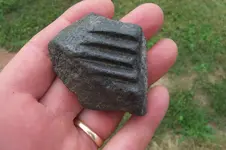
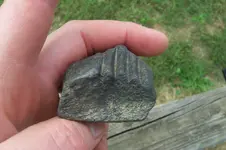
Reminds me of a paddle to create designs on pottery.
Nice find!
LRH
Nice find!
LRH

NC field hunter
Silver Member
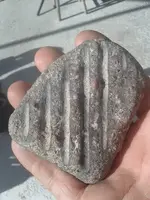
It's a small shaft finishing tool, I think. Thinking has screwed me over, however. Gator, your piece, is that stone? It looks kinda like concrete. I guess you call it concrete. Just has pea gravel as a filler. You know the stuff I'm thinking of.

rock
Gold Member
- #6
Thread Owner
It's a small shaft finishing tool, I think. Thinking has screwed me over, however. Gator, your piece, is that stone? It looks kinda like concrete. I guess you call it concrete. Just has pea gravel as a filler. You know the stuff I'm thinking of.
What? So you are thinking modern then?
NC field hunter
Silver Member
What? So you are thinking modern then?
No. Not if its what I think it is Larson has quite a few shaft working tools. Let him take a look for a positive ID.

tomclark
Bronze Member
- Joined
- Dec 18, 2006
- Messages
- 1,184
- Reaction score
- 1,643
- Golden Thread
- 0
- Location
- Tampa Bay, FL
- Detector(s) used
- ShadowX2, TEJON, Eyes, Pony Shovel
- Primary Interest:
- Other
I have no idea!


Last edited:

GatorBoy
Gold Member
- Joined
- May 28, 2012
- Messages
- 14,812
- Reaction score
- 6,156
- Golden Thread
- 0
- Primary Interest:
- All Treasure Hunting
Me either.
I have one abraiding stone with several indents..that appears to have been used for bone pins...but the depth of the indents taper at the ends and the sides.
Not like that piece at all.
I have one abraiding stone with several indents..that appears to have been used for bone pins...but the depth of the indents taper at the ends and the sides.
Not like that piece at all.
NC field hunter
Silver Member
Me either.
I have one abraiding stone with several indents..that appears to have been used for bone pins...but the depth of the indents taper at the ends and the sides.
Not like that piece at all.
You guys must agree its not natural, right? Mother Nature has created some doozies, I'm living proof. That one is just odd. Gator, you and Tom posted what appear to be abraders. You know after abrading the shaft, it had to be worked to a smooth finish. Rocks find looks like it would do at least one step in the finishing process. Agree? Still, I'm throwing darts in the dark while blindfolded. Some of you fossil cats may know of a vertebrate like this.
GatorBoy
Gold Member
- Joined
- May 28, 2012
- Messages
- 14,812
- Reaction score
- 6,156
- Golden Thread
- 0
- Primary Interest:
- All Treasure Hunting
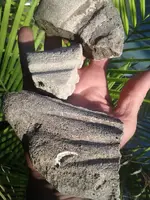
I have no idea what mine is.. its not an abraiding stone..some of the indents don't go off the end.
I found it on a beach I fossil hunt.
I don't know what rock's is either.
Tom's are typical Florida shaft abraiders.
I found it on a beach I fossil hunt.
I don't know what rock's is either.
Tom's are typical Florida shaft abraiders.
NC field hunter
Silver Member
I have no idea what mine is.. its not an abraiding stone..some of the indents don't go off the end.
I found it on a beach I fossil hunt.
I don't know what rock's is either.
Tom's are typical Florida shaft abraiders.
Yeah, I can't determine by the pictures if yours is even pure stone. It looks like a mixture for a type of cement. Not sure at all. Interesting to say the least. Rocks piece as well. Keepers in my catalogue.
rock
Gold Member
- #13
Thread Owner
Ok so do you guys think I should hang onto it then? I did find a piece of a stone bowl in the same area and one tiny piece of worked broken flint. The creek was so clean of artifacts somebody else surly walks it daily or weekly there is no way it hasnt been walked before or recent. You can tell if you walk creeks as I do. It just looks too good not to have a nice point laying on one of the many rock bars. Thanks for looking at it. I even posted it in the what forum and only one person took a guess at it and said possible "Abrading Stone". Now there is allot of people in that forum that can ID anything.

larson1951
Silver Member
- Joined
- Apr 8, 2009
- Messages
- 4,974
- Reaction score
- 3,894
- Golden Thread
- 0
- Location
- North Dakota
- Detector(s) used
- tesoro
- Primary Interest:
- Other
Me either.
I have one abraiding stone with several indents..that appears to have been used for bone pins...but the depth of the indents taper at the ends and the sides.
Not like that piece at all.
i think i saw that piece you have gator and i agree it was probably used for sharpening pins and awls
You guys must agree its not natural, right? Mother Nature has created some doozies, I'm living proof. That one is just odd. Gator, you and Tom posted what appear to be abraders. You know after abrading the shaft, it had to be worked to a smooth finish. Rocks find looks like it would do at least one step in the finishing process. Agree? Still, I'm throwing darts in the dark while blindfolded. Some of you fossil cats may know of a vertebrate like this.
well rusty you say that "you know after abrading the shaft, it had to be worked to a smooth finish"..........wrong, the abraders are what made the finish smooth
I have no idea what mine is.. its not an abraiding stone..some of the indents don't go off the end.
I found it on a beach I fossil hunt.
I don't know what rock's is either.
Tom's are typical Florida shaft abraiders.
agreed tom has a real abrader and the piece you have is most likely not....it looks like cement that maybe broke away from some rebar or wire grid....then it looks water tumbled
but i th nk i would have given it a look also
Ok so do you guys think I should hang onto it then? I did find a piece of a stone bowl in the same area and one tiny piece of worked broken flint. The creek was so clean of artifacts somebody else surly walks it daily or weekly there is no way it hasn't been walked before or recent. You can tell if you walk creeks as I do. It just looks too good not to have a nice point laying on one of the many rock bars. Thanks for looking at it. I even posted it in the what forum and only one person took a guess at it and said possible "Abrading Stone". Now there is allot of people in that forum that can ID anything.
rock we will probably never know what you have there...i can see why you gave it a look and i mean no disrespect but i don't think it is an artifact.......abrading stones do not have evenly spaced grooves that are all the same size and depth....i was thinking a broke piece of granite block which has also been water tumbled
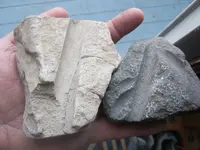
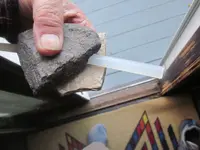
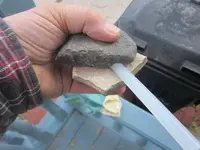
here are some images for your info....along with this description on how an abrader works....they were used in pairs and held as shown the piece i am using to represent the shaft is a hot glue stick
two abraders were placed with the shaft inside so it could be polished as shown....i gotta say i have tried these out and i actually cannot think of anything even modern that could do such a quick nice job as these do.....these abraders were used until the groove got too deep then a new groove ws started usually on both sides......we find the some times with 3 grooves on one side and 2 on the other......i have one with 6 grooves somewhere........they were almost always made of sandstone because of its abrading qualities....
.....also i wanna say we find lots of these that are worn out.....what i mean is the grooves got so deep that they broke and were discarded
well i did not mean to get so awful long winded here...just wanted to share what i have learned about these important tools
here have a look...the one on the right is granite and is the only granite abrader i have found out of about 50 or so and it does not work good like the sandstone pieces
larson1951

smokeythecat
Platinum Member
I saw TWO of the whatever they are's on the beach yesterday. The were definitely not old.
larson1951
Silver Member
- Joined
- Apr 8, 2009
- Messages
- 4,974
- Reaction score
- 3,894
- Golden Thread
- 0
- Location
- North Dakota
- Detector(s) used
- tesoro
- Primary Interest:
- Other
hey hey i was explaining what i know about these abraders
i was talking about the fact of the groove getting so deep that they were unusable cuz they broke in half when the groove got deep and the initial 'blank was not very thick
as i said these were used in pairs....now i will show an abrader that has to be pretty old as it was not an arrow shaft abrader, it was most likely a shaft for a staff or spear, or an atlatl dart.........the size of the diameter it was used for is quite large
btw hey hey rock i don't mean to steal your thread here i just am sayin' a bit about the subject and hope it is ok with you
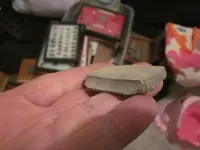
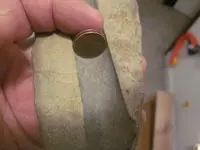
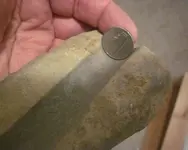
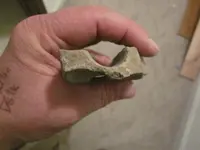 see why they break? once again rock, thanks for allowing me to post this info here, i hope it's ok
larson1951
i was talking about the fact of the groove getting so deep that they were unusable cuz they broke in half when the groove got deep and the initial 'blank was not very thick
as i said these were used in pairs....now i will show an abrader that has to be pretty old as it was not an arrow shaft abrader, it was most likely a shaft for a staff or spear, or an atlatl dart.........the size of the diameter it was used for is quite large
btw hey hey rock i don't mean to steal your thread here i just am sayin' a bit about the subject and hope it is ok with you
see why they break? once again rock, thanks for allowing me to post this info here, i hope it's oklarson1951
Last edited:
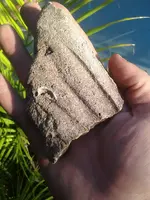
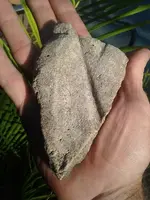
larson1951
Silver Member
- Joined
- Apr 8, 2009
- Messages
- 4,974
- Reaction score
- 3,894
- Golden Thread
- 0
- Location
- North Dakota
- Detector(s) used
- tesoro
- Primary Interest:
- Other
nice examples gator




Featured Treasure Finds
Featured Treasure Finds
Similar threads
- Replies
- 2
- Views
- 444

- Replies
- 10
- Views
- 2K

Users who are viewing this thread
Total: 2 (members: 0, guests: 2)