What's new

What ya think?

Status
Not open for further replies.

rock

Gold Member
Joined
Aug 25, 2012
Messages
14,751
Reaction score
8,933
Golden Thread
0
Location
South
Detector(s) used
Coin Finder
Primary Interest:
All Treasure Hunting
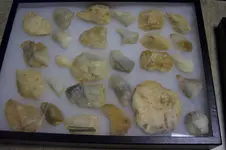
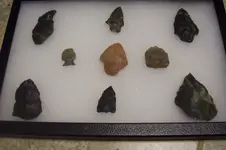
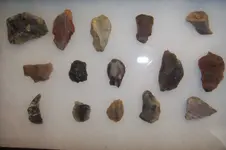
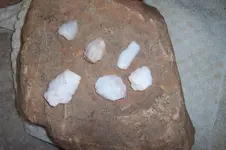
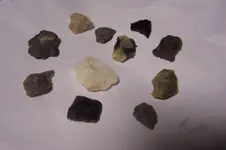
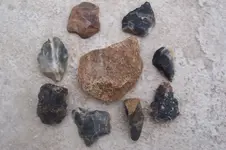
Ive been thinking on this for a while now. Why would there be so many tools like scrapers and knifes in one spot? I am leaning towards these type of spots to be a kill spot. Which means they killed a animal and then cleaned it for process and then carried it back to camp to eat. Well I have found spots with just tools and maybe 1 or 2 damaged points in the general area. My question is this.......do you think they just cleaned the animal and left their tools in the kill spot or do you believe they carried all of their tools with them back to camp? I am thinking they could make tools fast and just left them and made more later as needed. I am sure they had some favorites and hung onto them. Here are some I have found in the same spot. Each pic is a different spot. Id like to hear some theories on this as to what everyone has to say.
 

Attachments
  • 100_3151.webp
    100_3151.webp
    277.2 KB · Views: 259
  • 100_2962.webp
    100_2962.webp
    179.7 KB · Views: 248
  • 100_2968.webp
    100_2968.webp
    171.3 KB · Views: 249
  • 100_3058.webp
    100_3058.webp
    112.2 KB · Views: 258
  • 100_3054.webp
    100_3054.webp
    301.1 KB · Views: 233
  • 100_2857.webp
    100_2857.webp
    91.7 KB · Views: 244
Upvote 0

Back in 2008, we went though what they called a 500 year flood, if the finds weren't within the reach of something of the sort, I don't think they will move much.
The plows are just as likely to return them to their original spot as well through the years...I don't buy the suggestion that the plow would move them very far.
JMO,
BCI
 
I'm not even talking much about the plow..that was only around for a short time and only moves the surface...mostly back and forth.
I'm talking about thousands of years of landscape changes and soil movement.
Much bigger picture.

That was my only point.. no big mystery that needs answers.
Its only fact.
 
" i don't buy the suggestion that the plow would move them very far."

well if they went the same direction year after year they could get them to dang near the end of the field in a few centuries, maybe. I am still finding stuff on the same hilltop that the 80 year old farmer found them when he was a kid, and the field only gets worked 2 directions because of a fenceline's location.
 
I'm just saying that odds are, 1/2 the time it would move to the right, 1/2 the time to the left... Most of the time it would not be moved at all. Centuries if plowing hasn't moved much significantly. That's just my opinion???
" i don't buy the suggestion that the plow would move them very far."

well if they went the same direction year after year they could get them to dang near the end of the field in a few centuries, maybe. I am still finding stuff on the same hilltop that the 80 year old farmer found them when he was a kid, and the field only gets worked 2 directions because of a fenceline's location.
 
I think a farmers field is one thing, a village site another, a camp site another, a barter spot another, butcher site another...so different reasons for different sites. I will say one thing, it has always amazed me how darn many arrowheads can come out of a farmers field in Illinois. A flat piece of ultra rich black dirt. Fermi lab close by to Naperville has an amazing display of artifacts that they sifted out of the black dirt when they built the place. Just overwhelming...and I see what has happened to Naperville...when ma lived there it was about 3,500 in population...now I think it is the 4th largest city in the state...but the farms that I have seen go into houses and stripmalls and other developments...and each time they scrape off the black dirt down to nothing before they build. bah...talk about raping history or looting...it isn't you guys picking up a worked stone in a stream in Florida tha's for sure!
 
quote_icon.png
Originally Posted by GatorBoy
I'm not even talking much about the plow..that was only around for a short time and only moves the surface...mostly back and forth.
I'm talking about thousands of years of landscape changes and soil movement.
Much bigger picture.

That was my only point.. no big mystery that needs answers.
Its only fact.

I can see why you would forget about THESE points you made, the points I am questioning. Rocks moving through and being sorted by soil like water does to materials. c'mon.

"rock my honest opinion is that most of the small material you find in a plowed field is not at all where it was hundreds or even thousands of years ago.
Century after century of season changes..floods..freezes.thaws...wind..rain..follo wed by year after year of plowing and more of the same natural cycles have changed the landscape drastically in most cases.

Things move not only vertically but horizontaly. Lighter items like flakes move alot and may even accumulate with other items with the same general density and surface area much like things do in the moving water of a stream or creek.. just at a slower pace."what I tried to convey to you was that material..especially lighter material...when it winds up in loose surface soil through... the natural processes that I described moves and gathers together much the same way as in moving water.
If you could see it in time lapse you would get what I'm saying.
The biggest difference in the way soil and water move is that the molecules are closer together"more dence" in soil.. the effect that has is slowing it down.
Somebody 3,000 years ago did not put that stuff in a pile..right where you found it."

Hmmm. So like rocks rocks, these cache's people find on ocassion may just be soil sorted relics? Very Interesting!
 
"Lol! Nice topic. I concur with Rock's theory. There can be "hotspots." When I find a hotspot there can be many different materials deposited also."

I agree too. Where there's lots of flint, (hot spots) there's where someone worked with stone.
 
Well I didnt mean to have a loud disagreement on this topic. I am still learning and learning I am. I do have questions and will ask from time to time. If I find more than one example and then it starts to be a puzzle and I dont have the answer then I will ask. It just seems to unusual to find these little piles in different spots. That is why last yr I asked Larson if the plow could carry artifacts and then dispose of them in one spot. The answer he gave is no it doesnt do that. Well after finding so many piles and then a broken point or whole in the mix I then started thinking kill sites. I believe if it is everywhere and is scattered it is probably a camp there is a difference in what I am finding. I have learned allot from this DISCUSSION and if anyone else has more to add please do I would like to hear it. Thanks, rock
 
Last edited:
"Well after finding so many piles and then a broken point or whole in the mix I then started thinking kill sites. I believe if it is everywhere and is scattered it is probably a camp there is a difference in what I am finding. I have learned allot from this DISCUSSION and if anyone else has more to add please do I would like to hear it. Thanks, rock"

Try to remember to keep things in context rock. Kill sites are not likely to be where natives camped or lived, animals fear humans. Keep in mind also, these camp sites were used over and over again for hundreds and thousands of years, and likely not in the exact same spots. Near, but not always the same. Think about this scene. Several humans regularly going to the bathroom outdoors, meat, fish, and hides drying in the sun. Infrequent bathing likely too. Now think about how putrid a place like that becomes. Flies and stench had to be noticeable. I think the natives had to move often, to let things air out if you will. They likely didn't not move too far, but far enough. This could explain scattered relics over a good size area.

Keep on learning rock, knowing everything will just get you in trouble.

Joel
 
'Quito' is correct, I think. Thank you for pointing out the ridiculous, Quito.

Artifacts don't move far from the point of deposition without extraordinary (mostly human) intervention. Some years ago this was tested in the Ocklawaha River which has a fairly swift current for a Florida River. The results were that fine river sediments moved, but the heavier flaked chert simply settled.

One human intervention I've not seen mentioned is the practice of picking up every bit of chert while field walking, then dumping the finds at the end of the field. Apparently, the idea is to conceal from other collectors the fact that there is chert to be found in the field. I don't know if this is widely practiced, but I have seen it done. The net result is concentrations of chert.

Over the years, the layout of fields will change . . . more mechanization, contour plowing, less hedgerow. Concentrations of chert produced by crafty collectors a hundred years ago might turn up anywhere in a modern plowed field.
 
"One human intervention I've not seen mentioned is the practice of picking up every bit of chert while field walking, then dumping the finds at the end of the field."

GUILTY!!! On muddy days, I do pick up a lot of flakes that I can't clean right away, so at the end of my hunt, I often go through what I brought back looking for utilized flakes. The rest just get deposited on the driveway at the fields edge.
 
Thanks I went back out today. The field I am hunting now there is a camp site I do believe. Its 100 by 50 feet of debiatge and tools and a few broken arrowheads today. I will post them later in another thread. I have a few IDK in the mix. I will do them by each. I gtg for now. Thanks for all the knowledge you guys are giving.
 
i think everyone is right,it is hard to imagine 1000 years let alone 15 to 20 thousand,gator is giving real good thoughts,a tornado could of picked them up hundreds of times,they could of grown with a tree a hundred foot high,than rotted out to were they are now.or rock it could be what is left over from a kill site,find the big broken ones that are there also if a kill site should be more than just those little things,but harry is most likely dead on,found years ago by a head hunter trying to hide the fact that points were there,we should be nicer to each other.
 
Good reply Jamey.. for anyone who would like to learn about what I'm speaking of..the course is called Geoarchaeology...the the subject is called soil creep... there have been hundreds of well documented studies.
Or...you could just think its all crap. And rediculous .
Also..the single study that Harry mentioned was done in a relatively slow moving river filled with muck and clay.
I love diving for fossils there.
 
Last edited:
Most of the documented studies I've read about are crap....
I think it mainly depends on the locality and water sources. Around here, sand is always the smoking gun when it comes to soil creep and displacement of any artifacts. Again, just my opinion.

Good reply Jamey.. for anyone who would like to learn about what I'm speaking of..the course is called Geoarchaeology...the the subject is called soil creep... there have been hundreds of well documented studies.
Or...you could just think its all crap.
Also..the single study that Harry mentioned was done in a relatively slow moving river filled with muck and clay.
I love diving for fossils there.
 
My previous education will not allow me to scientifically argue the fluid movement of soil but my practical knowledge of rock shelters and mounds tells me that artifacts don't seem to be displaced and redeposited. I do know for a fact that the objects in my metal detecting test bed move up and down...surprisingly...quite a bit. I have never tested for side to side movement though....interesting. Obviously, there is a big difference between my yard and a rock shelter. I host a few detectorists from Canada on occaision and they swear that the older artifacts in my area are subjected to liquifaction...(spelling? meaning?) which does give me an open mind on the subject...anyway.....

There have been many studies regarding artifact distribution with the consensus being that you'll find more of X and less of Y in a lithic rich environment....less of X and more of Y in a lithic poor environment. From there you can reasonably predict what was being done at a particular site based on the tools. You then must factor whether the artifacts were recylced or currated. Generally speaking, in a lithic poor environment, the tools would have been used until exhausted. In order to honestly answer your question(s) from a scientific view, you really have to get to know your area and be able to study and identify wear patterns on the tools you find.

And yes, "they" did have clothes. Not duds like ours but rest assured, Native Americans had clothing. Tool bags and belts were pretty common...the forerunner of the modern day pocket....lol.
 
If it helps the soil type is red clay. When it rains it will stick to your shoes for days. When its dry it is like solid it doesnt crumble. There is waste like leaves mixed in the soil. Some of these were found on a hill side and some on flat land but who is to say what it looked like back when the indians were there.
 
"Some of these were found on a hill side and some on flat land but who is to say what it looked like back when the indians were there."

Rock, it wasn't much over a hundred years ago the natives were there and here. What you see now is likely pretty much what the indians saw back then. The stuff gb was carrying on about, short of earthquakes and landslides, would take eons, not decades or centuries to occur. I'd bet except for a few rare instances, the sites still are right were they always were.
 
Ive been thinking on this for a while now. Why would there be so many tools like scrapers and knifes in one spot? I am leaning towards these type of spots to be a kill spot. Which means they killed a animal and then cleaned it for process and then carried it back to camp to eat. Well I have found spots with just tools and maybe 1 or 2 damaged points in the general area. My question is this.......do you think they just cleaned the animal and left their tools in the kill spot or do you believe they carried all of their tools with them back to camp? I am thinking they could make tools fast and just left them and made more later as needed. I am sure they had some favorites and hung onto them. Here are some I have found in the same spot. Each pic is a different spot. Id like to hear some theories on this as to what everyone has to say.
Flint was too hard to come by, in my opinion ,they would never intentionally leave it behind.
 
"Flint was too hard to come by, in my opinion ,they would never intentionally leave it behind."

All I can add to that is, some places it sticks out of the ground there is so much of it, so we need to keep things in proper context.

It sure doesn't appear that flint was hard to come by where rock hunts based on the amount he brings home these days.
 
Last edited:
Status
Not open for further replies.

Users who are viewing this thread

Latest Discussions

Back
Top Bottom