What's new

The Treasure of Captain William Kidd.

Even the most skeptical minds are easy to deceive when it comes to treasure and gold. Its more then just the promised wealth - its something out of paradise, some magic tale where the poor and exploited get their chance to level the scales again.
If you're referring to them then I agree, if you'r referring to me then you either completely misunderstand or misjudge me. I am not after treasure and gold.
I wasn't there but if someone would present me with some slightly alternated maps that are already public then I would try to get some verifiable info to confirm the authenticity of those maps. As far as I can see he confirmed that there are 7 but not the other way around.
You seem to have completely missed the fact that I did. I eventually obtained their agreement to have the papers verified, but the Oak Island owners, prominently Dan Blankenship and David Tobias, were not at all interested. I also approached Bill Millstead, but with similar negativity.
The altered shape confirming (one map?) to be Oak Island would also arise suspicion as it is very publicly known. Insisting it to be Juan Fernandez - maybe it is similar to both or simply trying to lower the suspicion of being hoaxed.
I reckon it's fairly simple. If you decide beforehand that the Wilkin's map is not based on Juan Fernandez then you won't see it. If you concede that it could be then you'll see that it is. Of course, you'd need to undertake research in order to find the chart that it's actually based on, but it can be done. Of course, you could have just asked me!
Normally those upper class people could effort a more serious kind of middle man - like a lawyer or similar. The cloak and dagger behavior seems a bit strange for them.
My experience of treasure hunters over the years is that they act in exactly this way! My contact did insist on bringing lawyers in when he offered to hand the materials over. It was a lawyer who informed me of his death. It's possible they didn't want anyone, including lawyers, to have full access to the file. I certainly didn't.
What was the motivation of that contact? Did he from the beginning seek help to find the treasure? Did they seek advice?
He suspected that I had information about the other half of the file they owned. He didn't initially ask for help, he probed to determine whether his suspicion was correct. They weren't seeking advice, they were seeking knowledge. I intimated that I knew the answer, and I feel that they thought it possible I had access to the other half.

They weren't fully convinced, but this was the second generation of owners and they were dying off. They just wanted the matter resolved, but they did want a share in the proceeds.

My feeling about the matter is that maybe access to the documentation in order to have it authenticated wouldn't be necessary. Simply test the suggested reconstruction on Oak Island. If it's correct then it will more than likely reveal more ground markers, known or unknown.

Once more, the greatest obstacle will be those who have decided, without a test, that there is no substance at all to the suggestion, because some other answer they prefer is correct. This can be seen in reactions to the proposed solution on the Oak Island forum here.
 
If you're referring to them then I agree, if you'r referring to me then you either completely misunderstand or misjudge me. I am not after treasure and gold.
I am referring to the trade in general and its attraction of conman. I tried to reason my deep probe into your story.

I preserve my skepticism so I won't go down any of the rabbit holes that pop out of the treasure hunter's fields like daisies in the spring.
I reckon it's fairly simple. If you decide beforehand that the Wilkin's map is not based on Juan Fernandez then you won't see it. If you concede that it could be then you'll see that it is. Of course, you'd need to undertake research in order to find the chart that it's actually based on, but it can be done. Of course, you could have just asked me!
Wilkins did two charts and the one he changed the cardinal point so the island is upside down does in all probability represent Juan Fernandez as it was popular in that time. I do doubt the original chart is drawn from it. From my researches all (incl. Palmer's) have their origin in some yet unknown and in the 17th/18th century uncharted desert island that was much smaller.
He suspected that I had information about the other half of the file they owned. He didn't initially ask for help, he probed to determine whether his suspicion was correct. They weren't seeking advice, they were seeking knowledge. I intimated that I knew the answer, and I feel that they thought it possible I had access to the other half.
Did he explicitly ask you or it comes from your observations?
They weren't fully convinced, but this was the second generation of owners and they were dying off. They just wanted the matter resolved, but they did want a share in the proceeds.
Did you ever have any clue of who they were or where they did come from?
My feeling about the matter is that maybe access to the documentation in order to have it authenticated wouldn't be necessary. Simply test the suggested reconstruction on Oak Island. If it's correct then it will more than likely reveal more ground markers, known or unknown.

Once more, the greatest obstacle will be those who have decided, without a test, that there is no substance at all to the suggestion, because some other answer they prefer is correct. This can be seen in reactions to the proposed solution on the Oak Island forum here.
It is always a pity when someone tries to preserve their theories by ignoring facts or not putting their ideas to the test. Conformation bias is sometimes a almost violent act pushing anything and anyone away that doesn't confirm their believe system.
 
I have been researching more objects of dubious provenance (Pamela Hardy), some which were in the possession of/sold by Cutler.

Seems Cutler was not only fabricating pedigree notes for Captain Kidd/Lord Nelson but Emma Hamilton as well.

A beadwork case and hankerchief (in the collection of National Maritime Museum) accompanied by a letter (presumably fake pedigree note) from Arthur Hill Cutler:

View attachment 2213572

View attachment 2213575

It appears "Ye Oak Room" was the name of Cutler's antique shop in Eastbourne (45 South Street).

Gold lace inscribed 'Lace of the coat Lord Nelson wore at Teneriffe'. According to the National Maritime Museum:


Dubious provenance again (Hardy). Cutler is not mentioned but Palmer is and it is likely Cutler sold Palmer this object.

View attachment 2213576

I then used a more advanced search function for "Pamela Hardy". Turns out there are 67 (!) objects in the National Maritime Museum collection (not all on public display) with the fabricated Hardy record of ownership for these. However, the vast majority of these objects do not mention Palmer or Cutler, in fact, most do not mention any verifiable previous owners.

View attachment 2213577

View attachment 2213578

Of particular interest is a bureau. This is not the same bureau a Kidd-Palmer map was found in by Palmer (in the presence of Cutler in his shop according to Wilkins), however, they are very similar and date to same period (mid-18th century, although the ink found inside the other bureau was dated slightly earlier). The bureau was claimed to have belonged to Nelson's father, Edmund Nelson (dubious) and notably has secret compartments of drawers, almost identical to the bureau Palmer found a map in (very likely guided to it by Cutler). It think it is probable the Nelson bureau was also sold by Cutler given its similarities and age to the other bureau.

View attachment 2213579


Several objects of the same dubious Pamela Hardy provenance have ended up abroad. One object notably appeared at an exhibition in 2005, New Zealand Auckland Central City Library

View attachment 2213580

It would be useful to compare the writing on some of these objects (such as a watch, pictured above) to the writing on the Kidd-Palmer maps and inscriptions on some of the furniture they were found in. I have not yet done a detailed examination or comparison, but from a glimpse the writings do appear similar. This suggests the same hoaxer.

View attachment 2213581

In May 1932, a large collection of Lord Nelson objects (of dubious provenance) was sold by Christie's (renowned for its auctions).

View attachment 2213583


Many of these objects were from the collection of Hubert Palmer and undoubtedly some were sold to him by Arthur Hill Cutler.

Pamela Hardy is mentioned as having sold the objects to the "present owner" (= Palmer). While this suggests Palmer was involved in the hoax, it is more probable they were sold through Cutler since if you read Wilkins that is how Palmer acquired the Hardy Chest.

View attachment 2213585

An object sold in February 1933 (again, dubious Hardy provenance) at Christies mentions Cutler:

View attachment 2213588

Pamela Hardy is mentioned in earlier auctions at Christies., for example in July 1930:
View attachment 2213589

I can't though trace her name in any auction prior to 1930.

Objects with her name attached (fake pedigree notes) were sold up to 1936.


Sadly, there is whole industry of faking artifacts. painting. objects of art ancient artifacts. even ancient coins. Many a museums are showing fake artifacats fooled by fake prenences.

Crow
 
Bocaj has asked who were this mysterious group. I met with my contact three times and spoke to him five times on the phone. I’d guess that in total we may have talked together for about four to five hours. We didn’t only talk about the maps as we discovered that we shared a number of interests one of which, perhaps not surprisingly, is ciphers in history. We also both enjoyed reading fictional detective stories.

Even over such a short time, one cannot but betray a good deal about oneself, no matter how much one resolves not to. However, my contact was most concerned that our discussions should remain confidential. It always amused, if not surprised, me that the treasure hunting fraternity was so readily prepared to take the word of someone who expressed an interest in what they knew. However, it became obvious to me that they were so keen to talk about their subject matter that practically nothing would stop them!

I mentioned in an earlier post that at our first meeting it clicked with me as to who the group may have been. To understand, we should go back to an Oak Island anecdote reported in 1906 by Josephine Fredea. In one of my books, I report it as follows:

“In the 1920s, a file surfaced containing papers some of which, from internal evidence, dated back to the mid-to-late 1700s and early 1800s. The papers had been discovered shortly before 1900, and came into the hands of a prominent collector, but were lost from view until some time after his death.

“This behind-the-scenes activity seems first to have appeared in Oak Island literature in 1906 at the hands of Josephine Fredea, whose report contains the typical embellishments of such accounts that inevitably make them resemble fiction.

“In essence, the tale is of a gentleman, prominent in English literary circles, who purchased an ancient manor house on the south coast of England, and while rambling through it one day (the way one does), chanced upon a long-unused room in which there was an ancient sea chest (isn’t there always?) The chest contained, “maps, diagrams and instructions as to the location of certain hidden valuables” (no surprise there, then.) Apparently, between a certain islet in the West Indies and another ‘past Sesambre’ (Sambro Island near the entrance to Mahone Bay?) there was a clearly-defined track. Other papers referred to the removal and subsequent re-deposit of several packages, each with individual markings, on a specified date.

“Fredea’s preamble introduces the approximate period at which the enterprise may have taken place as, “during the last siege of Louisbourg,” which occurred in the early years of The Seven Years’ War, 1756-1763 (The French and Indian War.) The previous siege of Louisbourg occurred towards the conclusion of The War of Austrian Succession, 1740-1748 (of which King George’s War was part.) It would seem that dates around 1760 were implied by the documents pertaining to the deposits, and this, then, prompted the observation concerning the siege.

“The version of the events reported to me involved an inheritance, rather than the purchase of a house. It did not involve a sea chest in a long-unused room but a portmanteau in the library, and there was no specific mention of several treasures but of several maps. Furthermore, the intimation given to me was that the events leading up to the deposit could have taken place during the War of Austrian Succession (the 1740s) mainly because of names mentioned in the papers - though most were alive during the following war, a few years either side of 1760.

“Eventually, a group of wealthy dilettantes came into possession of the papers, and they began trying to piece together the puzzle. They possessed a large sheaf of paperwork and a number of ‘maps’ each of which, they assumed, might assist them in locating a treasure. The accompanying documents were in a mixture of languages, mostly English but including Spanish, Latin and Greek. Two of the papers were in cipher. Fredea reports that the inscription on the map discovered in the manor house was in Spanish and Dutch. In any event, it did seem that someone had been assembling documentation pertaining to some secret enterprise.”

Having put two and two together, I simply related this to my contact, to his surprise and near horror. In his haste to impress upon me the need not to make this known he revealed the identity of one of the original owners.

It may not be widely known, but when pressed on the matter Fredea resolutely refused to divulge the identity of the individual referenced. I assume that, like me, she had promised to reveal nothing that would identify the people involved. However, it seems that some believe that their wish for answers must override such moral or ethical considerations.

In the last week, I experienced such on the Oak Island forum here. Responding to a statement that nobody is aware of who had purchased the Palmer-Kidd maps I revealed that I do know. The response was that had I really known then I would have revealed the details, further implying that I could not do so and would not. I’ve encountered this numerous times in the past, interpreting it as euphemistically declaring that the claim is a lie.

However, the refusal to divulge is simply respecting a confidence rather than being a sure indication of a complete fabrication. I would hope that people here might recognise this and understand why. Should those involved appreciate that their secret is known, currently safe but potentially at risk, they may be encouraged to open up and produce what they hold for assessment. I believe that it would be wrong to expose their names and addresses.
 
Last edited:
A Christie's auction in December 1932 did not mention the owner of Lord Nelson objects of dubious provenance, who wanted to remain anonymous. This is not surprising; the owner was said to have bought the objects from Pamela Hardy who never existed. Was this Cutler?

1750603301614.webp


Finally, I found this bit of information from the Royal Observatory:

Even the desk (which you can just about see) had an interesting story. Although it was a fake, it as a fabulous and elaborate fake. It was claimed by a ‘Pamela Hardy’ – a creation of two dodgy antique dealers from Eastbourne, a fictitious character claiming descent from Thomas “Kiss Me Hardy” Hardy fame.
1750603701321.webp


If you note the snippet of text above, you realise one buyer at the auction bought nearly all these objects then sold them to the National Maritime Museum which explains why 67 objects with Hardy's name attached appear in the museum's collection. This also explains why a few of these objects showed up in the Royal Observatory (the Observatory is part of the National Maritime Museum and is managed as a single entity, Royal Museums Greenwich.)
 
Last edited:
Bocaj has asked who were this mysterious group. I met with my contact three times and spoke to him five times on the phone. I’d guess that in total we may have talked together for about four to five hours. We didn’t only talk about the maps as we discovered that we shared a number of interests one of which, perhaps not surprisingly, is ciphers in history. We also both enjoyed reading fictional detective stories.

Even over such a short time, one cannot but betray a good deal about oneself, no matter how much one resolves not to. However, my contact was most concerned that our discussions should remain confidential. It always amused, if not surprised, me that the treasure hunting fraternity was so readily prepared to take the word of someone who expressed an interest in what they knew. However, it became obvious to me that they were so keen to talk about their subject matter that practically nothing would stop them!

I mentioned in an earlier post that at our first meeting it clicked with me as to who the group may have been. To understand, we should go back to an Oak Island anecdote reported in 1906 by Josephine Fredea. In one of my books, I report it as follows:

“In the 1920s, a file surfaced containing papers some of which, from internal evidence, dated back to the mid-to-late 1700s and early 1800s. The papers had been discovered shortly before 1900, and came into the hands of a prominent collector, but were lost from view until some time after his death.

“This behind-the-scenes activity seems first to have appeared in Oak Island literature in 1906 at the hands of Josephine Fredea, whose report contains the typical embellishments of such accounts that inevitably make them resemble fiction.

“In essence, the tale is of a gentleman, prominent in English literary circles, who purchased an ancient manor house on the south coast of England, and while rambling through it one day (the way one does), chanced upon a long-unused room in which there was an ancient sea chest (isn’t there always?) The chest contained, “maps, diagrams and instructions as to the location of certain hidden valuables” (no surprise there, then.) Apparently, between a certain islet in the West Indies and another ‘past Sesambre’ (Sambro Island near the entrance to Mahone Bay?) there was a clearly-defined track. Other papers referred to the removal and subsequent re-deposit of several packages, each with individual markings, on a specified date.

“Fredea’s preamble introduces the approximate period at which the enterprise may have taken place as, “during the last siege of Louisbourg,” which occurred in the early years of The Seven Years’ War, 1756-1763 (The French and Indian War.) The previous siege of Louisbourg occurred towards the conclusion of The War of Austrian Succession, 1740-1748 (of which King George’s War was part.) It would seem that dates around 1760 were implied by the documents pertaining to the deposits, and this, then, prompted the observation concerning the siege.

“The version of the events reported to me involved an inheritance, rather than the purchase of a house. It did not involve a sea chest in a long-unused room but a portmanteau in the library, and there was no specific mention of several treasures but of several maps. Furthermore, the intimation given to me was that the events leading up to the deposit could have taken place during the War of Austrian Succession (the 1740s) mainly because of names mentioned in the papers - though most were alive during the following war, a few years either side of 1760.

“Eventually, a group of wealthy dilettantes came into possession of the papers, and they began trying to piece together the puzzle. They possessed a large sheaf of paperwork and a number of ‘maps’ each of which, they assumed, might assist them in locating a treasure. The accompanying documents were in a mixture of languages, mostly English but including Spanish, Latin and Greek. Two of the papers were in cipher. Fredea reports that the inscription on the map discovered in the manor house was in Spanish and Dutch. In any event, it did seem that someone had been assembling documentation pertaining to some secret enterprise.”

Having put two and two together, I simply related this to my contact, to his surprise and near horror. In his haste to impress upon me the need not to make this known he revealed the identity of one of the original owners.

It may not be widely known, but when pressed on the matter Fredea resolutely refused to divulge the identity of the individual referenced. I assume that, like me, she had promised to reveal nothing that would identify the people involved. However, it seems that some believe that their wish for answers must override such moral or ethical considerations.

In the last week, I experienced such on the Oak Island forum here. Responding to a statement that nobody is aware of who had purchased the Palmer-Kidd maps I revealed that I do know. The response was that had I really known then I would have revealed the details, further implying that I could not do so and would not. I’ve encountered this numerous times in the past, interpreting it as euphemistically declaring that the claim is a lie.

However, the refusal to divulge is simply respecting a confidence rather than being a sure indication of a complete fabrication. I would hope that people here might recognise this and understand why. Should those involved appreciate that their secret is known, currently safe but potentially at risk, they may be encouraged to open up and produce what they hold for assessment. I believe that it would be wrong to expose their names and addresses.
As far as I can see there are claims that can't be sustained because of the secrecy of everyone involved.

The sources of those maps stay hidden. The original maps are unverified and all we really have are those copies of Palmer's maps that we can't verify neither as the present owners names are also a secret.

I do understand the need to keep confidence. Unfortunately with a lot of dead ends and infinite amount of speculations a bit of substance is urgently needed.
 
As far as I can see there are claims that can't be sustained because of the secrecy of everyone involved.

The sources of those maps stay hidden. The original maps are unverified and all we really have are those copies of Palmer's maps that we can't verify neither as the present owners names are also a secret.

I do understand the need to keep confidence. Unfortunately with a lot of dead ends and infinite amount of speculations a bit of substance is urgently needed.
Once again, I have to disagree. The Oak Island ground plan that forms the basis for constructing the instruction sets can be determined and in so doing this reveals how the instruction sets are formulated and exposes the true meaning and intent of each.

The real purpose of the map instructions is thereby revealed. The knowledge does not depend on the validity of the sources. If you have a treasure map that leads to treasure then you know that both are real. You don’t have to wonder whether or not the map is fake. You don’t have to wonder if those who owned the map at any time were real.

I repeat, the answer is to conduct a test, or a series of tests. However, I sense that it has been decided that the hypothesis, the proposed solution, can be rejected without testing. It’s not a stand that I can subscribe to which convinces me yet again that I can contribute nothing more here.
 
Once again, I have to disagree. The Oak Island ground plan that forms the basis for constructing the instruction sets can be determined and in so doing this reveals how the instruction sets are formulated and exposes the true meaning and intent of each.

The real purpose of the map instructions is thereby revealed. The knowledge does not depend on the validity of the sources. If you have a treasure map that leads to treasure then you know that both are real. You don’t have to wonder whether or not the map is fake. You don’t have to wonder if those who owned the map at any time were real.
I totally agree on this one. I have hard fight here because I still do not agree that the maps are a simple fake.

So whoever find the treasure will prove their authenticity. It will be difficult not impossible to prove that they are a hoax without being able to research their past. For me it is an undecided question but I don't blame those who dismiss them as fake because of too many failures to find anything or the quite questionable history of their discovery by Palmer/Cutler.
I repeat, the answer is to conduct a test, or a series of tests. However, I sense that it has been decided that the hypothesis, the proposed solution, can be rejected without testing. It’s not a stand that I can subscribe to which convinces me yet again that I can contribute nothing more here.
I won't stand in your way to test your ideas! For me at least I can see nothing on those maps that point to any of the suggested places (incl Oak I). For what its worth I can see many alternatives that fit much better and plan to visit them on my expedition.
 
I totally agree on this one. I have hard fight here because I still do not agree that the maps are a simple fake.

So whoever find the treasure will prove their authenticity. It will be difficult not impossible to prove that they are a hoax without being able to research their past. For me it is an undecided question but I don't blame those who dismiss them as fake because of too many failures to find anything or the quite questionable history of their discovery by Palmer/Cutler.

I won't stand in your way to test your ideas! For me at least I can see nothing on those maps that point to any of the suggested places (incl Oak I). For what its worth I can see many alternatives that fit much better and plan to visit them on my expedition.
The provenance of the Hardy Chest was demonstrably fabricated (proof was already posted) while the others (e.g., Morgan Chest) are dubious at best. Pamela Hardy never existed and the Hardy chest dates to mid-18th century (after Captain Kidd died), so it is not possible Kidd passed it on to one of his shipmates (Ward) as the pedigree note says. If the map found in this chest is genuine, why was the pedigree note of this chest made up, and why does the chest not date to the time when Kidd or his shipmate (Ward) was alive, but several decades later, c. 1750? How do you reconcile this [the fake pedigree of the Hardy Chest and age of the chest] with the map in the Hardy Chest being genuine? :confused: If any of the Kidd-Palmer maps were authentic maps owned or drawn by Captain Kidd and/or his shipmates - you should be able to trace the objects the maps were found in by records of ownership, back to Kidd or at least when he was alive but you cannot do that.
 
The provenance of the Hardy Chest was demonstrably fabricated (proof was already posted) while the others (e.g., Morgan Chest) are dubious at best. Pamela Hardy never existed and the Hardy chest dates to mid-18th century (after Captain Kidd died), so it is not possible Kidd passed it on to one of his shipmates (Ward) as the pedigree note says. If the map found in this chest is genuine, why was the pedigree note of this chest made up, and why does the chest not date to the time when Kidd or his shipmate (Ward) was alive, but several decades later, c. 1750? How do you reconcile this [the fake pedigree of the Hardy Chest and age of the chest] with the map in the Hardy Chest being genuine? :confused: If any of the Kidd-Palmer maps were authentic maps owned or drawn by Captain Kidd and/or his shipmates - you should be able to trace the objects the maps were found in by records of ownership, back to Kidd or at least when he was alive but you cannot do that.
No I can't. Nor am I obligated to do so. I do not claim that they are authentic. I simply see no prove that they are not! Even if we had the originals and we could test the ink, the parchments the handwriting etc. it could still be argued that they are copies done from the originals kept secret within those collection of old documents as researched by GJB.

As I have already written above it is reasonable to assume that Cutler could have acquired those maps through other sources and merged them to his old furniture to raise the value of both. Such tricks would not be unusual for the time and his trade. Rich collectors, museums they all were keen to get a slice of the past and there was simply not enough to go around. It wasn't robbery or drug trading - no=one would loose really and no-one would ask too many questions neither.

When it comes to the furniture it could also be that those maps were drawn or copied by Kidd's wife and/or later hidden in the furniture. Sarah Kidd died in 1744!

Sure the story as it is officially presented creates serious doubts to the maps authenticity and I don't blame anyone who dismisses them as a fraud. On the other hand I have no reason to doubt what GJB wrote about his meetings and that would point to the relevance of those maps as copies of an authentic collection.
 
The provenance of the Hardy Chest was demonstrably fabricated (proof was already posted) while the others (e.g., Morgan Chest) are dubious at best. Pamela Hardy never existed and the Hardy chest dates to mid-18th century (after Captain Kidd died), so it is not possible Kidd passed it on to one of his shipmates (Ward) as the pedigree note says. If the map found in this chest is genuine, why was the pedigree note of this chest made up, and why does the chest not date to the time when Kidd or his shipmate (Ward) was alive, but several decades later, c. 1750? How do you reconcile this [the fake pedigree of the Hardy Chest and age of the chest] with the map in the Hardy Chest being genuine? :confused: If any of the Kidd-Palmer maps were authentic maps owned or drawn by Captain Kidd and/or his shipmates - you should be able to trace the objects the maps were found in by records of ownership, back to Kidd or at least when he was alive but you cannot do that.
Hello cryptid1990

I am very impressed with methodology and clinical research. You remind me of some of researchers I worked with several years ago that made me very very wealthy. If your interested in Archival historical research PM me.

Crow
 
For those interested, I have attached Anthony D. Howlett's (1958) article 'The Mystery of Captain Kidd's Treasure'. It was published in Wide World Magazine. Howlett's account of who discovered the Kidd-Palmer maps and their sequence/date of discovery is mostly wrong. Wilkins (1935) is much more accurate. Nevertheless, the article contains some useful information and photos.

1751115774302.webp


1751113403199.webp

1751113424951.webp

1751113458124.webp

1751115526194.webp

1751115535534.webp

1751115558779.webp

1751115593022.webp

1751115604033.webp
 
No I can't. Nor am I obligated to do so. I do not claim that they are authentic. I simply see no prove that they are not! Even if we had the originals and we could test the ink, the parchments the handwriting etc. it could still be argued that they are copies done from the originals kept secret within those collection of old documents as researched by GJB.

As I have already written above it is reasonable to assume that Cutler could have acquired those maps through other sources and merged them to his old furniture to raise the value of both. Such tricks would not be unusual for the time and his trade. Rich collectors, museums they all were keen to get a slice of the past and there was simply not enough to go around. It wasn't robbery or drug trading - no=one would loose really and no-one would ask too many questions neither.

When it comes to the furniture it could also be that those maps were drawn or copied by Kidd's wife and/or later hidden in the furniture. Sarah Kidd died in 1744!

Sure the story as it is officially presented creates serious doubts to the maps authenticity and I don't blame anyone who dismisses them as a fraud. On the other hand I have no reason to doubt what GJB wrote about his meetings and that would point to the relevance of those maps as copies of an authentic collection.
It really depends what your threshold of "prove" (proof) is. If "prove" means "beyond a reasonable doubt" (say >99% probability), the criminal standard of proof - the maps are hoaxes (not authentic), at least the map that came in the Hardy Chest. However, if by prove/proof you mean "beyond all doubt" (absolute certainty), then no, they are not proven hoaxes (we cannot be 100% sure). Another way to look at this is the total absence of evidence the maps are authentic. Inductive reasoning provides proof from probability rather than certainty, and the maps are proven hoaxes by the criminal standard of proof. As I said, it depends on how "proof" is defined or its threshold (very high probability but not certainty). The people arguing the maps are authentic have not provided a shred of evidence in nearly 100 years. At some point it sensibly has to be recognised, absence of evidence is evidence of absence, like Bigfoot or the Loch Ness Monster.
 
It really depends what your threshold of "prove" (proof) is. If "prove" means "beyond a reasonable doubt" (say >99% probability), the criminal standard of proof - the maps are hoaxes (not authentic), at least the map that came in the Hardy Chest. However, if by prove/proof you mean "beyond all doubt" (absolute certainty), then no, they are not proven hoaxes (we cannot be 100% sure). Another way to look at this is the total absence of evidence the maps are authentic. Inductive reasoning provides proof from probability rather than certainty, and the maps are proven hoaxes by the criminal standard of proof. As I said, it depends on how "proof" is defined or its threshold (very high probability but not certainty). The people arguing the maps are authentic have not provided a shred of evidence in nearly 100 years. At some point it sensibly has to be recognised, absence of evidence is evidence of absence, like Bigfoot or the Loch Ness Monster.
As I wrote before adding stories to antiques to sell them at a better price is nothing new and in any case it refers to the furniture and not the maps. Other maps like Wilkin's show similar details.

Also the "Avery the Pirate" letter does mention a treasure that has many similarities (three gray stones covered wit grass - stumps, SW position from there, cave, cliff etc). It is from an official archive in Cornwall and the only reason why I even had a look at Palmer's maps. I remembered to have seen those three stumps somewhere...

Treasure hunting isn't a modern science, lot of information is questionable data at best. Who thinks that a single source will show him the location of a treasure better travel to Disney's Peter Pan. It is a lot of study involved and a lot of uncertainty involved. You need to see the bigger picture and forget about to be able to verify anything from 300 years ago. Even officials lie or make mistakes. Nothing is certain and those maps can have all kind of sources.

If you call them a hoax then prove it! That the source of the furniture is questionable is not enough of a prove. I doubt that anyone involved tried to misguide the public intentionally. Whatever it is hoax is a strong word without prove of intention.

In any case there are facts for both sides of the argument but I see no harm in leaving the question undecided for now. It is in any case not your time or money if you think its a hoax the stay away it.
 
As I wrote before adding stories to antiques to sell them at a better price is nothing new and in any case it refers to the furniture and not the maps. Other maps like Wilkin's show similar details.

Also the "Avery the Pirate" letter does mention a treasure that has many similarities (three gray stones covered wit grass - stumps, SW position from there, cave, cliff etc). It is from an official archive in Cornwall and the only reason why I even had a look at Palmer's maps. I remembered to have seen those three stumps somewhere...

Treasure hunting isn't a modern science, lot of information is questionable data at best. Who thinks that a single source will show him the location of a treasure better travel to Disney's Peter Pan. It is a lot of study involved and a lot of uncertainty involved. You need to see the bigger picture and forget about to be able to verify anything from 300 years ago. Even officials lie or make mistakes. Nothing is certain and those maps can have all kind of sources.

If you call them a hoax then prove it! That the source of the furniture is questionable is not enough of a prove. I doubt that anyone involved tried to misguide the public intentionally. Whatever it is hoax is a strong word without prove of intention.

In any case there are facts for both sides of the argument but I see no harm in leaving the question undecided for now. It is in any case not your time or money if you think its a hoax the stay away it.
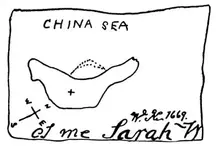
The convergence of evidence is proof (beyond a reasonable doubt) the maps are a hoax, at least the map from the Hardy Chest. The fact the objects the maps were found in have fabricated pedigree notes and/or a dubious provenance is only one line of evidence. Other lines of evidence I have detailed or touched upon, for example, one of the maps forensically investigated by the Home Office Forensic Science Laboratory concluded the cardinal points on the map "was not in use on maps for many years after the death of Captain Kidd". Map experts from the British Library have also written to say the maps were drawn in the early 20th century (I already quoted Peter Barber: "...a twentieth century artifact can be seen by the hand it is written") and some have suggested the drawer was influenced by fictional Treasure Island. Another, is inconsistent dates on the maps e.g., one has "W.K. [William Kidd] 1669" written on it with the name "Sarah" underneath yet Sarah Bradley would not have used Kidd's name until they were married ~20 years later. There are also different signatures of Kidd on one of the maps and Yunnan Parchment meaning even you would have to agree at least one must be a fake.

1751130191716.webp

Yunnan Parchment (see W K initials).

Looks clearly different to:

1751130304720.webp

Signature on one of the Kidd-Palmer maps.

I could go on... Suffice to say, I do not believe people who claim the maps are authentic or might be authentic are being objective or they simply have not done enough research. I also think it is lazy to shift the burden of proof onto those who recognise they are a hoax.
 

Attachments

  • 1751130235274.webp
    1751130235274.webp
    12.5 KB · Views: 48
The convergence of evidence is proof (beyond a reasonable doubt) the maps are a hoax, at least the map from the Hardy Chest.
Some of them could be copies or even all of them, as I said it does indicate issues with their authenticity and it is your privilege to judge them as hoax. For me I think you are jumping to a conclusion without due diligence.
The fact the objects the maps were found in have fabricated pedigree notes and/or a dubious provenance is only one line of evidence. Other lines of evidence I have detailed or touched upon, for example, one of the maps forensically investigated by the Home Office Forensic Science Laboratory concluded the cardinal points on the map "was not in use on maps for many years after the death of Captain Kidd".
I do disagree on this point, the Portuguese used an arrow on their charts. In any case those maps are sketches not charts and I doubt that there are enough sketches of islands from the 17th century to compare.
Map experts from the British Library have also written to say the maps were drawn in the early 20th century (I already quoted Peter Barber: "...a twentieth century artifact can be seen by the hand it is written") and some have suggested the drawer was influenced by fictional Treasure Island. Another, is inconsistent dates on the maps e.g., one has "W.K. [William Kidd] 1669" written on it with the name "Sarah" underneath yet Sarah Bradley would not have used Kidd's name until they were married ~20 years later.
Maybe all the maps are drawn by Sarah (either the wife or the daughter)? All possible. That those maps are drawn by Kidd is just a possibility. the "W.K. 1669" could have been added by Cutler to fit those maps to the story. Maybe they have nothing to do with Kidd at all!
There are also different signatures of Kidd on one of the maps and Yunnan Parchment meaning even you would have to agree at least one must be a fake.

View attachment 2214442
Yunnan Parchment (see W K initials).
Its not really a signature!
Looks clearly different to:

View attachment 2214444
Signature on one of the Kidd-Palmer maps.
As the line below says "by me Sarah W." - maybe she draw it, who knows. There are many innocent explications. Like those who see their favorite island in the maps you also let your judgement be guided by your conclusion not the other way around.
I could go on... Suffice to say, I do not believe people who claim the maps are authentic or might be authentic are being objective or they simply have not done enough research. I also think it is lazy to shift the burden of proof onto those who recognise they are a hoax.
I don't want you or anyone sell you the maps! I simply do mot have any conclusion about those maps. I am in my right to be careful to judge until I really need to.

Those maps could be a hoax or not and yes you have the burden of proof because you made the claim to know the truth about them - I didn't claim anything. I do not claim the contrary, I simply are not convinced by your reasoning.
 
I didn't start this thread to change minds or to slam peoples opinions. I intended for people to voice their theories and to let me voice mine. Provenance is an elusive beast. If you are a fan of Antiques Roadshow, you have seen first hand how family stories of an heirloom can evolve and gain more stature over years of retelling its history. For example, if an item was made in France in the 19th century it will inevitably be attributed to Napoleon at some point.
If a dealer enhances, or even makes up an item's lineage, does that automatically make it a fake?
Lets look at the antithesis argument. We know that Captain Kidd was a real and well known person, so it makes sense that some of his personal items would have survived and been saved until the present day. So it is possible for at least some of these items to have been actually owned by Kidd. It doesn't make logical sense that 90+ years ago somebody crafted all of these objects and drew these charts (and then hid them in secret compartments) just to sell a few hundred dollars in antiques to one gullible collector.
All the players in this mystery are dead. Even the actual charts themselves are MIA. If you want to believe the charts are fake, I can accept that. But you can't conclusively claim that you are correct and others are wrong because it's still just your opinion. I believe the maps are real, and the island is real. That's my opinion. Since I'm not ready to reveal the conclusions of my own research I'm an easy target for ridicule. But so far I haven't heard any counter arguments on the validity of the charts that affect my beliefs.
 
I didn't start this thread to change minds or to slam peoples opinions. I intended for people to voice their theories and to let me voice mine. Provenance is an elusive beast. If you are a fan of Antiques Roadshow, you have seen first hand how family stories of an heirloom can evolve and gain more stature over years of retelling its history. For example, if an item was made in France in the 19th century it will inevitably be attributed to Napoleon at some point.
If a dealer enhances, or even makes up an item's lineage, does that automatically make it a fake?
Lets look at the antithesis argument. We know that Captain Kidd was a real and well known person, so it makes sense that some of his personal items would have survived and been saved until the present day. So it is possible for at least some of these items to have been actually owned by Kidd. It doesn't make logical sense that 90+ years ago somebody crafted all of these objects and drew these charts (and then hid them in secret compartments) just to sell a few hundred dollars in antiques to one gullible collector.
All the players in this mystery are dead. Even the actual charts themselves are MIA. If you want to believe the charts are fake, I can accept that. But you can't conclusively claim that you are correct and others are wrong because it's still just your opinion. I believe the maps are real, and the island is real. That's my opinion. Since I'm not ready to reveal the conclusions of my own research I'm an easy target for ridicule. But so far I haven't heard any counter arguments on the validity of the charts that affect my beliefs.

You do seem thin skinned when asking for and then disagreeing with opinions.

So Kid had furniture dated post his era?
And hid charts in them pre death.
Quite an argument.

Now, for Kid to hide charts in furniture for safe keeping wouldn't the furniture in turn require safe keeping?
Not a chest to pack his spare frilled shirt in. Not a lap desk /secretary for writing. But a desk. each ship. Each ship or shore; transfer the damn desk gets lugged aboard ,debarked.
Each careening of a ship to scrape and repaint with boot topping what happens to the furniture?

Kids hat with a chart in it's sweat band I might ogle for quality of parchment.
Faith in furniture around someone who's subject is seawater?
IF date of furniture and origins made it feasible the silks within could have been Kids ; we can then step towards documents within too. Why documents hidden let alone in furniture should rightly follow.
Marooned on a far shore or imprisoned instructions to a secondary to secure a chart at the Captains home or quarters aboard a ship (in who's possession and under who's watch) following arrest or detainment?

A cart should be as valuable as the X it could put a holder on. Shouldn't it be?
Fire ashore and the desk would be removed before it burned? Very doubtful.
Ship scuttled by an enemy or Moby Dick or a rock in a gale ; the desk gets carried where?

A chart found hidden in furniture is great.
How many things have to click for us to see such a chart today?
The chat had to be made.
The furniture had to exist as well with it's built in ability to hide a chart after the chart was made. No Scotch tape under a drawer or a rawhide wallet stapled securely for this story!)
Of course the chart(s) had to be squirreled in the furniture by someone.
Most importantly the chart had to be "found" discovered by someone other than who placed it.
It could happen! Things have been associated with being hid in furniture.

Why would Kid hide a chart? For whom?
IF a chart hid by Kid was not for himself , then he failed. Right?
IF a chart was not meant for other than Kid or someone he assigned, that too was a failure ; right?
To me that reduces the odds Kid employed a furniture for securing a chart or charts.
If you go to sea where should your insurance papers be secured at?
What of redundancy against fire or theft of sinking ships or geographical change?

Let's put you in charge of a chart.
Add a high value to needing access to it.
Wouldn't you secure multiple copies in places you could still access under proxy during prosecution or war among existing warring parties? I wouldn't blame you if you did make multiple copies.

Given the era of infectious diseases and even the risk a shaving cut could kill a person as antibiotics were not a familier thing let alone sanitation.. ... I also wouldn't blame you for having a trusted (good luck with that) advocate in the event you were sick or arrested or dead. In fairness you could keep it all to yourself.
Crews shared; but whatever.

In your finding charts back track till your sick of it. Then really start back tracking and discard copies until provenance actually matters for more than a fabricated sales pitch. Then keep back tracking.

Where does furniture fit in any original document?
Why would I hide a copy of a chart in furniture when I'm not Kid?
.
 
Hi releventchair,
Could you please cite the source of this statement?

The same source showing Kidds name on a sea chest. Palmer.
Are you convinced the pictured bureau is 1600's? If it's civil war era it is lucky. Gone to sea I doubt it would have made it that far before Madagascar.. And was the furniture English as the Adventure Galley was?
Legs look fine. No bolt holes. For being a sea in the 1600's it is in remarkable condition.
Ship must have never encountered careening or rough weather?

Did Palmer elaborate how the furniture made it from Madagascar?
And if I was tasked with stripping the ship before scuttling it after the hull rotted out ; and affixing postage to the furniture to send to Palmer (?) I might rather have nabbed the silver.

Odd News

May 7, 2015 / 3:15 PM

Capt. Kidd's purported pirate treasure discovered off Madagascar​

A team led by U.S. archaeologist Barry Clifford found the silver slab near the wreckage of what is believed to be Capt. William Kidd's ship, the Adventure Gallery.​


1751595427677.webp
 

Users who are viewing this thread

Back
Top Bottom