Michigan Badger said:
I should also mention that many of the rocks in my rock pile were metal detector "hot rocks."
As I dug them on the property (large) I piled them up by the building.
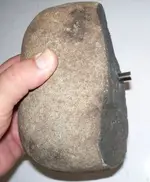
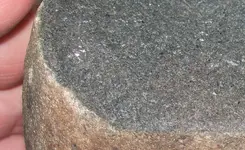
I found one that looked more the classic shape but wasn't magnetic.
Badger
Here's another low-tech test for meteorites. It worked with the Willamette Meteorite, found in 1903 by Ellis Hughes about 15 miles from where I live. Strike the suspected stone with a hammer sharply. If the rock breaks, it may not be a meteorite. It you hear a ringing sound, as of a bell, it may well be a meteorite. Striking an iron-nickel meteorite with a small hammer is unlikely to produce fragments, but you should probably use goggles to protect your eyes, just in case. Ellis Hughes used a rock pick at first. The resulting gong was quite loud, similar to striking a 13.5-ton bell with a sledge hammer.
BTW, meteorites are not generally porous, either. But in the pioneer sense, porous meant "with holes". You might want to look at the Willamette Meteorite to see if there are any "holes" visible.
Regarding rounded meteoritical surfaces: there are some. There is even a famous meteorite that looks like a ring, with a large hole in the center of it!
Meteorites strike the earth constantly, day and night. Only recently has it been learned that larger meteorites striking the atmosphere are much more common than previously suspected. Some 25-50 world-wide strikes resulting in atomic-bomb-like blasts are known each year. Most meteorites are tiny. One way to find some, perhaps even on your home, is to take a magnet to where the downspouts from your house drain. There should be at least some tiny meteoritical fragments on almost everyone's house or roof.
While damage to roofs is not common, at least several houses or buildings have apparently been hit by meteorites over the last 100 years and been documented.
And lastly, one of the features many (but not all) meteorites have is a nose-cone-like top. Literally, this is how re-entry capsules for rockets and satellites were designed: based on the known rocks which already made it through the atmosphere.




 )
)