What's new

The Treasure of Captain William Kidd.

I think you misunderstand him - he didn't say he forged the map but published the map with that ruler and his conclusions about their authenticity proved. That's all.
Correct, yes; if by map you mean the photographic copy. I never claimed or meant Furneaux had any involvement in the original maps (nor did he write to Cutler or Palmer, although he wrote to Wilkins in 1953). Furneaux acquired photographic copies of all four maps (likely Dick's) after Palmer died which he pointed out in 1969. I cannot prove it but I think he is the individual most likely responsible for taking a photo of the British Museum stamp/ruler (he had positioned) on a photographic map copy. This was done to pass-off the British Museum as having authenticated the chart(s) and he put it on the front cover of his book. In reality, the museum did no such thing and has no records of the map or even copies (any copies of the Skeleton Map, Skelton made would have been "off-the-record" with no British Museum stamp/ruler.)

Furthermore, Furneaux is one of the least reliable writers on the Kidd-Palmer maps, so his deception with the British Museum stamp/ruler thing is not unexpected for his dishonest character. I already provided a source for the latter (see my post #619).

1753127145924.webp


Furneaux (1972) supported the Oak Island claptrap but in the late 1970s he changed his mind to identify the island on the Kidd-Palmer maps with the Providenciales. His account is largely fictional and he went as far as trying to dupe people that he found a rock with Captain Kidd's initial "K" in a cave and other hidden signs for directions to Kidd's treasure (e.g. "E" [East]). A critical review of his sensational 1977 article can be read above which appeared in the same newspaper. Of course, no one else verified the cave markings (nor were there even photos) and the critical review makes clear Furneaux made it up; no treasure of course was found.
 
Last edited:
Hi Bocaj,
I do not believe in conspiracy theories. I have read cryptid's posts and he seems to be repeating the same theories over and over. I already explained why the British Museum has no record of the charts (post #614).
#614:
George Edmunds owns the photographic negatives of the Kidd charts that were photographed by Skelton for Palmer, left to his housekeeper, given to Anthony Howlett and then given to him.
Wrong. Skelton only received and examined one map (Skeleton Map) in 1950, a year after Palmer died:

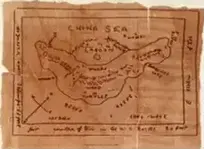
The only one of the four treasure island charts reported by Wilkins that I have, myself, seen is the one in the 'third chest'. This, which was shown to me some 14 or 15 years ago, was drawn on the back of a perfectly genuine will, apparently of the early 18th century, and gave latitude and longitudes which locate it somewhere in the China Sea.s
- Letter to Rupert Furneaux, 1965

Skelton's own words literally disprove your claims but your response to this letter is to bury your head in sand and continue to post incorrect information. It can though be presumed (and is very likely) he made photographic copies but only of the Skeleton Map because that was the only map he saw and examined. Skelton's letter also further disproves more of your unfounded claims:

Mr Skelton was privately commissioned by Palmer in the 1930's to try to obtain the best resolution possible from the originals.

Never happened. Do basic maths; 14 to 15 years before 1965 is 1950-1951. Palmer died in 1949. :tard:

Therefore, these Skelton reproductions are the best possible copies available today. As this was a private commission, the British Museum has no records in their files regarding the Kidd charts, and they possess no copies of them. The staff have understandably become irritated over the years by people who mistakenly think they have.
The problem is this "private commission" would almost certainly not have involved the British Museum stamp/ruler. Secondly, it is questionable whether even the Skeleton Map photographic copy Edmunds acquired is actually from Skelton. It could have instead been a copy made by Elizabeth Dick. Note that Skelton's name is not on it. I have come to doubt the map Edmunds shows is actually a "Skelton reproduction" (to his credit, Bath takes a much more cautious approach on this question). As for the British Museum stamp/ruler, a photograph could have easily been taken of the stamp/ruler positioned on a photographic copy of the map.

Furneaux was obsessed with Oak Island. He wrote the "Mystery of Oak Island" in 1972. Why would he forge a treasure chart in 1934, and then wait 38 years to publish a picture of it on the cover of a book?
I never wrote, meant or even implied any of that. You misunderstood my post. Seems to me you are setting up a straw-man.

Cryptid's contributions have been noted, but they consist mostly repetitive static and unsupported nonsense.

Aside from the fact you get virtually everything wrong, refuse to admit you constantly post falsehoods (despite I thoroughly disprove your claims like above [another example is your demonstrably false claim Skelton was stationed in Austria until 1947; even when this statement was showed to be erroneous you did not retract it and quickly moved on to post another falsehood]), repeatedly misrepresent my views (going as far as making straw-man arguments) and overall come across as incredibly arrogant - there is strong confirmation bias evident in your posts. You rely on Edmunds (1996) solely because he held your same far-fetched belief the maps are authentic (of the Golden Age of Piracy era) drawn by/in the possession of Captain Kidd. Edmunds, however, came to his senses to realise the maps are a hoax but unsurprisingly you do not rely on his second book (Anson's Gold) because it goes against your dogmatic belief the maps are authentic.

Unlike you, I never began researching the Kidd-Palmer maps with a pre-conceived idea.

"It is a capital mistake to theorize before one has data. Insensibly one begins to twist facts to suit theories, instead of theories to suit facts." - Sir Arthur Conan Doyle, Sherlock Holmes

Finally, I would just point out multiple users here PMed me to wonder why I was wasting so much of my time responding to you. I won't name these posters but their assessment of you very closely matches my own e.g.,

Randang72 wants to build an entire theory of his interpretation of a imaginary map that is fraud created by the imagination of Cutler for the purpose of fraud to sell antiques with provenance entirely made up. And he cannot except that as it makes his narrative fall flat.

Claiming I have posted "unsupported nonsense" is sheer psychological projection.
 
Last edited:
Furneaux never had access to a single Kidd-Palmer map and he only ever claimed to have photographic copies. Why would I change my "primary suspect" to Furneaux?
I assume that English is your primary language? Didn't you say that Rupert Furneaux was "most likely responsible for this deception"?. And if so, doesn't that mean you think he was somehow involved in your alleged Hoax?
(I do not appreciate your personal insults while I am simply trying to follow your twisted logic.)

It was presumably Dick who made the first map copies, directly or indirectly (sources suggest she hired a journalist to assist her)
(Presumably?) Source please!...

There are clear differences to various drawings/photographic copies of the Skeleton Map:

View attachment 2217780
The above chart is of Edmunds' refined version. He owns a copy of the original 'Skeleton' map, and he carefully traced the faint lines and palimpsest markings to help define the detail. He said in his book that he can vouch that with reference to the original, this in an exact copy.

it appeared on the front cover of his 1972 book The Money Pit Mystery. Furneaux also drew himself or got someone to draw two of the maps which were published in the book.
Are you saying that the version of the Key chart on the Money Pit book cover didn't exist before 1972?
Please explain??

hence why I said "Death Valley" could possibly have been on the original Skeleton Map
The only reference to Death Valley was from Wilkins imagination. Wilkins (and you) acknowledged that he drew the fake "Mar Del" maps (post #596).
 
I assume that English is your primary language? Didn't you say that Rupert Furneaux was "most likely responsible for this deception"?. And if so, doesn't that mean you think he was somehow involved in your alleged Hoax?
(I do not appreciate your personal insults while I am simply trying to follow your twisted logic.)
Deception of positioning a stamp/ruler on a photographic copy of the map (likely one of Dick's copies) when the map never entered the museum [the deception was to pass-off the British Museum as having examined/authenticated the maps when they did not]:

#634
It appears he went as far as to mislead people by putting the British Museum stamp/ruler next to a photographic copy of one of the maps and then put it on his book cover to sell more copies by duping gullible people into thinking the British Museum had actually authenticated the maps, even though the museum has no records/knowledge of the maps.

#641
I cannot prove it but I think he[Rupert Fuerneaux] is the individual most likely responsible for taking a photo of the British Museum stamp/ruler (he had positioned) on a photographic map copy. This was done to pass-off the British Museum as having authenticated the chart(s) and he put it on the front cover of his book. In reality, the museum did no such thing and has no records of the map or even copies (any copies of the Skeleton Map, Skelton made would have been "off-the-record" with no British Museum stamp/ruler.)
If you cannot understand this, I do not feel the need to repeat it a third (or fourth) time.

(Presumably?) Source please!...
There was already some posted earlier in this thread. For example, newspaper articles in 1951 mentioned Dick made photographic copies to put in a Singapore bank. These sources also quoted Dick's own words she actually did this, so I consider them to be fairly reliable. This means there were photographic copies as early as 1951 and likely the previous year when Skelton said he examined the Skeleton Map; he probably made copies including infra-red/ultra-violet photography and redrawings. Only Dick was in possession of the maps at that time, so this suggests she gave the Skeleton Map to Skelton (directly or indirectly). I do not think the journalist who assisted her much matters but they are mentioned in one of the newspapers, although I do not have the snippet right now.

1753144444138.webp

Daily Herald (22 October 1951)

The above chart is of Edmunds' refined version. He owns a copy of the original 'Skeleton' map, and he carefully traced the faint lines and palimpsest markings to help define the detail. He said in his book that he can vouch that with reference to the original, this in an exact copy.
Sure, but he provides no evidence that the copy of the original Skeleton Map was Skelton's (whose name is not on it).

Are you saying that the version of the Key chart on the Money Pit book cover didn't exist before 1972?
Please explain??
No. I am saying Furneaux added the ruler by positioning it at bottom of the photographic copy, then took a photo to put on his book. The photographic copy is from Dick or Skelton (more likely former) but the latter is very unlikely to have put the ruler there for his "private commission" and none of the maps (including the Skeleton Map) entered the British Museum, at least not officially.

The photographic copy I think Furneaux made by adding the ruler:

1753146686266.webp


The Dick or Skelton photographic copy he owned before adding the ruler
[Note: I removed the ruler myself for comparison purposes]:

1753146894176.webp


The only reference to Death Valley was from Wilkins imagination. Wilkins (and you) acknowledged that he drew the fake "Mar Del" maps (post #596).
Probably but I do not think that is definite for reasons I already outlined. Wilkins could have got Death Valley from "DV" on the (touched up) Skeleton Map but it is admittedly unlikely. Another possibility is he confused Death Valley on a different map (not related to the Kidd-Palmer maps) which I previously discussed. Furthermore, Bath has discussed other possibilities in his books.
 

Attachments

  • 1753146782376.webp
    1753146782376.webp
    4.9 KB · Views: 61
What a discovery. :tchest:

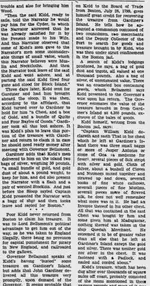
Hubert Palmer penned private letters to Charles Benedict Driscoll and one of those is quoted in an article Driscoll published on the Hardy Chest on 6 July 1930. There is even a drawing of the Hardy Chest. Five years before Wilkins wrote his book, Driscoll published this article. I believe it is the earliest to mention a Kidd-Palmer map. To my knowledge, no other Kidd-Palmer map researcher has read or referenced it and it appears in no bibliography. For reasons I explain below it is clear Anthony Howlett, Rupert Furneaux and George Edmunds never read this article because they all got the date wrong when Palmer acquired the Hardy Chest.

The Pittsburgh Press (6 July 1930)
1753223511589.webp

1753223549000.webp

1753223893871.webp

What can we learn from this article and quoted private letter from Hubert Palmer?

Anthony Howlett, Rupert Furneaux and George Edmunds were all wrong about the date Palmer acquired the Hardy Chest; they wrongly stated 1931. He must have had the chest sometime before 6 July 1930 (the date the article was published) and we are told by Driscoll (who corresponded with Palmer by letters) that Palmer acquired it about three years earlier (1927) from Pamela Hardy.

Here is what Rupert Furneaux (1969) wrote:

He [Palmer] made another dramatic discovery in 1931 when he purchased an old sea chest from Miss Pamela Hardy....

George Edmunds (1996):

Towards the end of 1931, Palmer bought an old oak sea chest from his antique dealer friend [Arthur Hill Cutler]

Anthony Howlett (1958):

Towards the end of 1931, Palmer bought an old, oak sea chest from Miss Pamela Hardy

In contrast, Wilkins (1935) wrote:

In the summer of 1930, the very old lady [Pamela Hardy] residing in a pretty seaside town... decided to part with various heirlooms which had been in the hardy family... The consequence was that a chest of Captain William Kidd... made its appearance in an antique shop owned by Mr. Hill Cutler... it fell into the hands of... Mr. Hubert Palmer...
Wilkins also got the date wrong (1930) but he is slightly closer to the actual date Palmer acquired it (1927).

We also know now that Palmer discovered the map on his own in his house:

1753228243686.webp


On this I was previously mistaken since I took the view, in earlier comments, he received the chest already knowing the map in the secret compartment. However, that said, my mistake was primarily based on misunderstanding Wilkins (1935), who wrote:

One day, someone fingering the chest, chanced to touch a nail on its side, near the bottom.... another similar nail, one the opposite side of the chest, was likewise loose. A false bottom was revealed!
I thought by "someone", Wilkins implied someone else (since he mentions Palmer in preceding paragraphs) but now rereading this sentence - he does not exclude Palmer at all. Wilkins (1935) account is the most accurate compared to what Edmunds, Furneaux and Howlett wrote, for example, Wilkins description of the nails most closely matches Palmer's private letter. Howlett also got wrong various details about the Hardy Chest (Palmer's letter makes that clear, and again Wilkins description is the most accurate.) We now know based on this 1930 article by Driscoll and Palmer's private letter to Driscoll that the Hardy Chest was the first furniture piece (with a map) acquired by Palmer (Driscoll mentions other items in Palmer's collection and there is no mention of the other chests or maps). Wilkins gets the sequence correct, but Edmunds, Furneaux and Howlett wrong - all three incorrectly claimed that Palmer first acquired the oak bureau (with map) in 1929.

To quote Edmunds (1996):

First discovery - the bureau. The story starts in Eastbourne in 1929... The bureau he [Hubert Palmer] bought in 1929...

G. J. Bath was also wrong on the date (1929/1930) of when Palmer acquired the Hardy Chest (1927):

1753231167030.webp


However, credit where it is due, Bath got much closer to the truth than the others about the sequence. The bureau was certainly not found first. Edmunds, Furneaux and Howlett are all unreliable. As I said repeatedly in this thread but I got attacked by Randawg72 for saying it - Wilkins (1935) is the most accurate in regards to the sequence of when the Kidd-Palmer maps were acquired by Palmer, and general other bits of information about them. This makes sense since Wilkins corresponded with Palmer when he was alive like Driscoll did. A final observation, Driscoll does not mention Arthur Cutler but says Hardy sold the chest to Palmer (I have already proved beyond a reasonable doubt Hardy was imaginary and likely Cutler's invention). However, Driscoll does not quote Palmer's letter when he mentions Hardy. Instead, he writes a brief summary and probably left Cutler out. This article should not be read as to exclude Cutler as having sold the Hardy Chest since we know he was heavily involved based on private letters he sent to Wilkins and even Edmunds (1996) recognised Palmer must have acquired the Hardy Chest through Cutler. The fact Palmer found the map in the Hardy Chest on his own and was not told it was already there when he bought it does not change the fact he was informed beforehand about the maps in the three other furniture pieces (or in the case of the bureau he was in the presence of Cutler's antique shop when it found it and likely guided to it by Cutler).

Driscoll's summary:
1753232953873.webp
 

Attachments

  • 1753224024019.webp
    1753224024019.webp
    74.3 KB · Views: 48
  • 1753223951555.webp
    1753223951555.webp
    18.7 KB · Views: 59
Last edited:
What a discovery. :tchest:

Hubert Palmer penned private letters to Charles Benedict Driscoll and one of those is quoted in an article Driscoll published on the Hardy Chest on 6 July 1930.

G. J. Bath was also wrong on the date (1929/1930) of when Palmer acquired the Hardy Chest (1927):

View attachment 2217943
Great discovery! Palmer's correspondence makes clear that the first item purchased was the Hardy Chest, and Wilkins echoes this. My guess at 1929 was based on the report by Howlett that an item had been obtained in that year. The only dates I was actually certain about were the bureau (1932) and the workbox (1933), and my intention was to stress the sequence not the years.
 
What a discovery. :tchest:

Hubert Palmer penned private letters to Charles Benedict Driscoll and one of those is quoted in an article Driscoll published on the Hardy Chest on 6 July 1930. There is even a drawing of the Hardy Chest. Five years before Wilkins wrote his book, Driscoll published this article. I believe it is the earliest to mention a Kidd-Palmer map. To my knowledge, no other Kidd-Palmer map researcher has read or referenced it and it appears in no bibliography. For reasons I explain below it is clear Anthony Howlett, Rupert Furneaux and George Edmunds never read this article because they all got the date wrong when Palmer acquired the Hardy Chest.

The Pittsburgh Press (6 July 1930)
View attachment 2217929
View attachment 2217930
View attachment 2217931
What can we learn from this article and quoted private letter from Hubert Palmer?

Anthony Howlett, Rupert Furneaux and George Edmunds were all wrong about the date Palmer acquired the Hardy Chest; they wrongly stated 1931. He must have had the chest sometime before 6 July 1930 (the date the article was published) and we are told by Driscoll (who corresponded with Palmer by letters) that Palmer acquired it about three years earlier (1927) from Pamela Hardy.

Here is what Rupert Furneaux (1969) wrote:


George Edmunds (1996):


Anthony Howlett (1958):


In contrast, Wilkins (1935) wrote:


Wilkins also got the date wrong (1930) but he is slightly closer to the actual date Palmer acquired it (1927).

We also know now that Palmer discovered the map on his own in his house:

View attachment 2217940

On this I was previously mistaken since I took the view, in earlier comments, he received the chest already knowing the map in the secret compartment. However, that said, my mistake was primarily based on misunderstanding Wilkins (1935), who wrote:


I thought by "someone", Wilkins implied someone else (since he mentions Palmer in preceding paragraphs) but now rereading this sentence - he does not exclude Palmer at all. Wilkins (1935) account is the most accurate compared to what Edmunds, Furneaux and Howlett wrote, for example, Wilkins description of the nails most closely matches Palmer's private letter. Howlett also got wrong various details about the Hardy Chest (Palmer's letter makes that clear, and again Wilkins description is the most accurate.) We now know based on this 1930 article by Driscoll and Palmer's private letter to Driscoll that the Hardy Chest was the first furniture piece (with a map) acquired by Palmer (Driscoll mentions other items in Palmer's collection and there is no mention of the other chests or maps). Wilkins gets the sequence correct, but Edmunds, Furneaux and Howlett wrong - all three incorrectly claimed that Palmer first acquired the oak bureau (with map) in 1929.

To quote Edmunds (1996):


G. J. Bath was also wrong on the date (1929/1930) of when Palmer acquired the Hardy Chest (1927):

View attachment 2217943

However, credit where it is due, Bath got much closer to the truth than the others about the sequence. The bureau was certainly not found first. Edmunds, Furneaux and Howlett are all unreliable. As I said repeatedly in this thread but I got attacked by Randawg72 for saying it - Wilkins (1935) is the most accurate in regards to the sequence of when the Kidd-Palmer maps were acquired by Palmer, and general other bits of information about them. This makes sense since Wilkins corresponded with Palmer when he was alive like Driscoll did. A final observation, Driscoll does not mention Arthur Cutler but says Hardy sold the chest to Palmer (I have already proved beyond a reasonable doubt Hardy was imaginary and likely Cutler's invention). However, Driscoll does not quote Palmer's letter when he mentions Hardy. Instead, he writes a brief summary and probably left Cutler out. This article should not be read as to exclude Cutler as having sold the Hardy Chest since we know he was heavily involved based on private letters he sent to Wilkins and even Edmunds (1996) recognised Palmer must have acquired the Hardy Chest through Cutler. The fact Palmer found the map in the Hardy Chest on his own and was not told it was already there when he bought it does not change the fact he was informed beforehand about the maps in the three other furniture pieces (or in the case of the bureau he was in the presence of Cutler's antique shop when it found it and likely guided to it by Cutler).

Driscoll's summary:
View attachment 2217945
Which leads us to the question of why would Cutler sell that box without the knowledge of the map inside? How would he profit or reclaim his effort inventing and drawing that (plain?) map?

Interestingly Palmer had the idea that the map was given to Kidd by another pirate - confirming my own idea that it was given by Avery.

The article does not mention when he discovered the maps but it seems he found the map soon after he acquired the chest from Cutler?
 
Last edited:
Hubert Palmer penned private letters to Charles Benedict Driscoll and one of those is quoted in an article Driscoll published on the Hardy Chest on 6 July 1930. There is even a drawing of the Hardy Chest. Five years before Wilkins wrote his book, Driscoll published this article. I believe it is the earliest to mention a Kidd-Palmer map. To my knowledge, no other Kidd-Palmer map researcher has read or referenced it and it appears in no bibliography. For reasons I explain below it is clear Anthony Howlett, Rupert Furneaux and George Edmunds never read this article because they all got the date wrong when Palmer acquired the Hardy Chest.
Nice find Cryptid. I have never seen that Pittsburgh Press article before. You proved everybody wrong on the timeline of Palmer's acquisition of the Hardy chest. (Including Mr Wilkins). I retract any contrary comments that I may have posted. While interesting info, if he did actually get the chest earlier, it doesn't really change anything.
We also know now that Palmer discovered the map on his own in his house:

On this I was previously mistaken since I took the view, in earlier comments, he received the chest already knowing the map in the secret compartment. However, that said, my mistake was primarily based on misunderstanding Wilkins (1935)
You called this scenario "demonstrably incorrect" in post #573. It was big of you to admit this mistake. Maybe I'm not as delusional as you seem to think?
It's hard to believe that so many people reference 'Miss Hardy' if she never existed. And if Palmer actually got the chest directly from Hardy, that leaves Cutler out of the conspiracy loop.
However, credit where it is due, Bath got much closer to the truth than the others about the sequence. The bureau was certainly not found first. Edmunds, Furneaux and Howlett are all unreliable. As I said repeatedly in this thread but I got attacked by Randawg72 for saying it - Wilkins (1935) is the most accurate in regards to the sequence of when the Kidd-Palmer maps were acquired by Palmer,
But Bath and Wilkins were still wrong...
Driscoll does not mention Arthur Cutler but says Hardy sold the chest to Palmer (I have already proved beyond a reasonable doubt Hardy was imaginary and likely Cutler's invention). However, Driscoll does not quote Palmer's letter when he mentions Hardy. Instead, he writes a brief summary and probably left Cutler out.
Probably? Is this more speculation?
This article should not be read as to exclude Cutler as having sold the Hardy Chest since we know he was heavily involved based on private letters he sent to Wilkins and even Edmunds (1996) recognised Palmer must have acquired the Hardy Chest through Cutler.
Edmunds' book mentions only a 'Dealer friend' in regard to the Hardy chest. The name "Hill Cutler" does not appear until he discussed the Morgan chest.
 
Great discovery! Palmer's correspondence makes clear that the first item purchased was the Hardy Chest, and Wilkins echoes this. My guess at 1929 was based on the report by Howlett that an item had been obtained in that year. The only dates I was actually certain about were the bureau (1932) and the workbox (1933), and my intention was to stress the sequence not the years.
You should certainly be credited for working out the sequence correctly and we now have confirmation the Hardy Chest was the first to be acquired by Palmer, not the bureau. Edmunds (1996) and Furneaux (1969) both uncritically copied Howlett (1958), but he got a lot wrong. In terms who is more reliable in order I would rank these > G. J. Bath [accessed Palmer's private letters], Wilkins (1935) [met in person and corresponded with Palmer by letters] > George Edmunds (1996) > Furneaux (1969) > Anthony Howlett (1958). As I said in two seperate threads, I appreciate your high-quality research on the Kidd-Palmer maps but not your ideas about Oak Island or attempts to link the maps to OI (which I am highly critical), however, I will not dwell on the latter and apologise if any of my criticisms crossed the line into being disrespectful. I would like to point out the Driscoll article opens up a new line of investigation because Palmer corresponded with Driscoll by private letters and these are possibly in the Charles Benedict Driscoll Papers collection (Folder B: Correspondence, 1927-1935) at University of Kansas, Kenneth Spencer Research Library.


Includes incoming typed and handwritten letters from Benjamin de Casseres, Hamilton Owens, Oswald Garrison Villard, Edith Lustgarten, J.W. Ferman, Maurice S. Sullivan, J. Frank Dobie, Simon Lake, Humphrey M. Cobb, Spud Johnson, F. van Wyck Mason, Charles E. Coughlin, Henry Blackman Sell, Jacob Omansky, John D. Rockefeller Jr., Heywood Broun, and others. Also includes a typed outgoing letter to H.L. Mencken, typed letters from J. Edgar Hoover and Alf M. Landon to O.O. (Odd) McIntyre, a typed letter from Will H. Hays to Mrs. O.O. McIntyre, and a typed letter from Ruth Bryan Owen to Thelma Nurenberg.
Palmer is not mentioned but not every person is listed ("and others") so it is possible his private letters are in the collection.

I would be interested in reading Palmer's letters because we would get more information about the Hardy Chest. Driscoll only provides us with two quotes from Palmer's letters, everything else he summarised but he is very brief. I would like to know if Palmer mentioned Arthur Hill Cutler (or the "dealer").

Finally, there is some useful information here about Driscoll.

1753292047518.webp

1753292081308.webp

1753292106967.webp


Driscoll like Palmer was a collector of pirate items and owned a large collection. This explains why they corresponded. Note that Palmer is mentioned in one of Driscoll's books Doubloons: The Story of Buried Treasure (1930).

1753292386353.webp


This is how I found Driscoll's (1930) article. I own Driscoll's 1930 book (although admittedly did not pay it much attention until recently) and found Palmer's name in the acknowledgement section. I then scanned newspaper archives for any articles that mentioned both Driscoll and Palmer and came across Driscoll's article in The Pittsburgh Press (6 July 1930).

Unfortunately, I do not own any of Driscoll's other pirate books but at least one other mentions Palmer:

1753292938119.webp


Driscoll's Book of Pirates (1934) is nicely illustrated but it is too expensive.
Copies sell for £90 to £1,000 (depending on condition) on AbeBooks.

1753293663920.webp


Palmer and Driscoll continued to correspond in the early 1930s:

1753293460779.webp

1753293498634.webp

The Washington Reporter (11 January 1932)
 
Last edited:
Driscolls' article was reprinted in The Boston Herald (20 July 1930).

1753315883810.webp


I also found the following article with some excellent photos I had never seen before.
There is a photo of one of the Kidd-Palmer maps but unfortunately the island is barely visible.
Elizabeth Dick owned a dog named Peter (never knew that before today).

The Boston Globe (8 January 1950)

1753315681892.webp
 
Last edited:
Cutler himself died in 1958 as you can see below.

View attachment 2212665

Crow

His obituary was published in The Daily Telegraph (January 24, 1958).

1753401888336.webp


Full name: Arthur Chrichton Hill-Cutler.

He is described as a Major but he only reached the rank of a Second Lieutenant during WWI and I could not find any records for him having ever served in WWII despite extensive searches (can you find anything?). Did he make up being a Major? Second lieutenant is the lowest commissioned officer rank in the British Army. He served in WWI in the Royal Army Service Corps.

1753402243207.webp


UK, WWI, British Army Medal Roll Index Cards, 1914-1920

1753402114843.webp

1753402085470.webp
 
1939 England and Wales Register for Arthur Hill-Cutler shows him aged given 68 in 1939. He was just too old to serve in WW2.

Screenshot 2025-07-25 114941.webp


Crow
 
It should not be overlooked that everything indicates that the map found in the Hardy Chest was the one I refer to as the Coral Island Map (that is, Edmunds' Skull Chart claimed to have been in the Morgan Chest). The key to this is the Wilkins postcard (in my possession) that has been reproduced in earlier posts on this and other forums.
 
It should not be overlooked that everything indicates that the map found in the Hardy Chest was the one I refer to as the Coral Island Map (that is, Edmunds' Skull Chart claimed to have been in the Morgan Chest). The key to this is the Wilkins postcard (in my possession) that has been reproduced in earlier posts on this and other forums.
No image/photo credit or attribution was given which is bad. In contrast, if I uploaded or posted an image/photo from books I gave the appropriate credit or attribution. George Edmunds uploaded the Wilkins postcard to one of his websites and then a poster in this thread (freeman) copied Edmunds; this is because the poster mistakenly thought Wilkins was confessing to drawing the map found in the Hardy Chest based on what he wrote on the postcard:

Legend at base (but not as on my chart)
Edmunds erroneously thought this was a confession by Wilkins he drew the Hardy Chest map (freeman uncritically copied Edmunds without fact-checking). It is not though a confession. By writing "not as on my chart", Wilkins is not referring to the Hardy Chest map but the Mar Del map(s) he made. The same daft error appears in Edmunds book Anson's Gold (with no image/photo credit on p. 242). However, there is still useful information in Edmunds' books despite this error but he also got the sequence of the Kidd-Palmer maps completely wrong. That said, Edmunds appears to have sloppily copied Howlett (1958) to the extent of copying partial sentences verbatim and only slightly changing them. I will not go as far as accusing him of outright plagiarism but take a look below.

George Edmunds (1996):

Towards the end of 1931, Palmer bought an old oak sea chest from his antique dealer friend [Arthur Hill Cutler]

Anthony Howlett (1958):

Towards the end of 1931, Palmer bought an old, oak sea chest from Miss Pamela Hardy
 
Last edited:
It should not be overlooked that everything indicates that the map found in the Hardy Chest was the one I refer to as the Coral Island Map (that is, Edmunds' Skull Chart claimed to have been in the Morgan Chest). The key to this is the Wilkins postcard (in my possession) that has been reproduced in earlier posts on this and other forums.
But is is documented by a photo (can someone re-post it?) that the "Coral Island Map" came out of the back of the mirror in the Morgan Chest. Wilkins may have mixed up the chests...
 
Harold T. Wilkins published a series of 14 articles "On the Treasure Trail of the Wicked Pirates" in American Weekly.
These were reprinted in numerous newspapers.

Below I have uploaded some and will follow up with more in another post as I am limited to an amount uploads per each post.

Two articles relevant to the Kidd-Palmer maps I will upload in my next post.

Article 2
The Boston American (28 January 1940)

1753450353032.webp

1753450476602.webp

1753450603574.webp


Article 3
The Boston American (4 February 1940)
1753445402514.webp

1753445584100.webp

1753445691243.webp

1753445744673.webp

1753445825068.webp


Article 4
The Milwaukee Sentinel (11 Feb 1940)
1753444765638.webp

1753444812649.webp

1753445963773.webp

1753446997268.webp

1753447098626.webp


Article 6
The Boston American (25 February 1940)

1753451437571.webp

1753451480021.webp

1753451532922.webp


Article 9
The Boston American (17 March 1940)

1753452052260.webp

1753452096792.webp

1753452154576.webp

1753452272176.webp

1753452330047.webp


Article 10
The Boston American (24 March 1940)

1753451638232.webp

1753451723162.webp

1753451786673.webp

1753451893262.webp


Article 12
The Boston Advertiser (7 April 1940)

1753450981915.webp

1753451045177.webp

1753451154752.webp

1753451193244.webp

1753451291602.webp
 
Two articles relevant to the Kidd-Palmer maps I will upload in my next post.
Article 1 mentions the Kidd-Palmer maps. Most confusingly, the article contradicts what Wilkins wrote in his 1935 book; for example, in the 1940 article (see below) he now claims he discovered one of the maps inside chest with Hubert Palmer? However, it is possible an editor of the newspaper wrote that detail because it is a not part of Wilkins' main text in the article but a text underneath a drawing; Wilkins is in third-person ("Explorer Wilkins", while the rest of Wilkins article is in first-person). So this looks to me like an error by the editor.

1753454484377.webp

However, Wilkins in the article (main text) himself appears to change/introduce some details quite different to his 1935 book. For example, Hubert Palmer is now said to have read an auctioneer's catalog when seeing a photo of the Hardy Chest (?):

1753454790514.webp

1753454932041.webp

Arthur Hill Cutler certainly was not an auctioneer, although many of his items appeared and were sold at auctions. The date has also changed when Palmer acquired the chest from his book. Article says 1932 (we know this is wrong, but in his book Wilkins wrote):

In the summer of 1930, the very old lady [Pamela Hardy] residing in a pretty seaside town... decided to part with various heirlooms which had been in the hardy family... The consequence was that a chest of Captain William Kidd... made its appearance in an antique shop owned by Mr. Hill Cutler... it fell into the hands of... Mr. Hubert Palmer...
Although it is possible Wilkins got confused with the dates. Wilkins no longer states Palmer was in Cutler's antique shop and in the presence of Cutler when he bought and looked at the bureau. Why has Cutler's name or involvement been removed between Wilkins 1935 book and 1940 article? It should be noted that Bath has a private letter confirming Cutler's involvement with the bureau. That said, Wilkins in his 1940 article does not explicitly deny Cutler's involvement although fails to mention him.

We are provided another letter of Wilkins to Palmer. Gjb, have you seen this letter?

1753455877109.webp

1753455917061.webp


Article 8 contains a drawing of a map Wilkins claims he found with his companion of treasure hunts "H. P." (= Hubert Palmer?).

1753453374096.webp


Article 1
The Boston American (21 January 1940)

1753456017084.webp

1753456156540.webp

1753456228581.webp

1753456283559.webp

Article 8
The Milwaukee Sentinel (9 March 1940)
1753453182138.webp

1753453471271.webp

1753453542968.webp


Edit: I have uploaded part of Article 5 which briefly touches upon the Kidd-Palmer maps [I do not have access to remaining pages].

The Boston American (18 February 1940)

1753462689234.webp

1753462816079.webp


Article 7
The Boston American (3 March 1940) [I only have access to this single page].

1753462995316.webp
 
Last edited:
I think most researchers missed Wilkins 1940 article (see above) because they do not name the owners of the bureau before Cutler.

For example, here is what Edmunds (1996) says:

It came from London and was a heavy seventeenth-century oak bureau.

Wilkins provides the following information ("A Lady, descended from the Hoods"):

1753458151591.webp


A new line of investigation? :sunny:
 
Last edited:
But is is documented by a photo (can someone re-post it?) that the "Coral Island Map" came out of the back of the mirror in the Morgan Chest. Wilkins may have mixed up the chests...
Do all Howlett's and Edmunds' claims necessarily have to be correct? I'm simply suggesting that the evidence (from Palmer's letters) would seem to indicate otherwise. So, perhaps this matter might bear investigation.
 

Users who are viewing this thread

Back
Top Bottom