What's new

The Treasure of Captain William Kidd.

It's impossible to authenticate any document from a copy. All they can do is offer their opinion based on the composition, handwriting style, and context. Even so, a person's opinion (even a supposed expert opinion) is just that. It's not substantiation, and no respectable researcher would consider it "proof".
You have no clue how to evaluate evidence. For example, the fact the handwriting/signature "W. K." on one map does not closely resemble Kidd's genuine signature is compelling evidence alone the maps are not authentic. As Edmunds (1996) noted (quoting an expert who examined map copies): "The handwriting on the charts does not resemble that of William Kidd in the Welbeck Harley papers". Even more problematic for your dogmatic belief the maps are authentic, is the signed initials "W. K." on one map (see below) does not even resemble the style of the signed initials on the Yunnan Parchment. How do you explain this discrepancy?

1754138273976.webp

1754138305237.webp


Compare with:

1754138419224.webp


1754138444693.webp


Edmunds (1996) usefully provided Kidd's genuine handwriting and signature for a comparison:

1754138840808.webp

See also here.

Plus the same book you referenced contains several statements from experts that claim the charts to be authentic.
Who exactly? No expert ever claimed the drawn maps are authentic (dating to the Golden Age of Piracy and/or owned by Kidd.) Skelton only ever said one of the maps he examined was drawn on the back of an "old will" and thought the parchment looked early 18th century. This is not the same as saying the map was drawn c. 1700. The use of the parchment is not surprising for a hoax since the hoaxer would not have used early 20th century paper to try to pass-off as centuries older (using modern paper would not trick anyone).

Again, just because someone wrote that a 'policeman' supposedly tested one chart in 1951 it's still not conclusive evidence. And even if true, mid century forensics for chemical testing of ink was not as precise or reliable as it is today. Did he use chromatography, spectroscopy, or mass spectrometry? Do you have the name of the officer involved, or the methods used, or his test results?
More information about the forensic report can be found in Gjb's and Edmund's books. I find it odd that you are a true believer in these treasure maps and believe they were made by Kidd, but have done so little research and do not own relevant literature.

Proven by whom? So far I have not read or heard any conclusive evidence that the charts are fake. And I have already acknowledged that without the actual charts in hand for proper testing (or Kidd's treasure) they cannot be positively authenticated. (By you, me or anyone else).
As I said, you do not know how to evaluate evidence. The evidence the maps are fake/a hoax is from multiple lines of evidence and they point to the same conclusion. Do you know what convergence of evidence is? As for "proven" and my threshold of proof, I meant beyond a reasonable doubt and I mentioned this pages back.
Both views deserve equal consideration until one is proven true. To summarize, you have offered a lot of hearsay, not Evidence to support your case.
The major discrepancies in handwriting (see above) is not "hearsay" nor was anything else I posted over several pages but reliable evidence. This goes back to you not knowing how to evaluate evidence or possibly you do not even know what credible evidence is.
Attitude and repetition does not make you "almost certainly correct".
Then, as a capper to your defense, you post that your 'Expert witness' responsible for 98% of your assumed "Proof" is a science fiction and fantasy writer, and confirmed treasure map forger, who believed in the Occult, Ghost ships, Haunted houses, and Cult rituals, Mr Harold T Wilkins!

This comment is a self-own seeming as your far-fetched belief is the same as Wilkins. You actually believe the maps are authentic and drawn by Captain Kidd. Please stop with the psychological projection? My view instead is the maps are a hoax which is not what Wilkins believed or argued but the total opposite (your views align with Wilkins, not mine; I am not sure who you think you are fooling). My viewpoint is also reasonable and evidence-based, while yours/Wilkins is not and based on a dogmatic belief - this is clear to any objective researcher. As for what I said about Wilkins being "reliable", all I said is he got the sequence correct and other details of when and how Palmer acquired the furniture pieces and maps because he met him in person and corresponded by letter (it makes sense Wilkins fairly accurately reported what Palmer told him* and he is more reliable in that regard than people who never met Palmer and wrote decades after his death). Considering your views on the maps mirror Mr. Wilkins crackpottery, I would not be surprised if you share his belief in flying saucers from the Moon. :laughing11:

* E.g., we know based on Palmer's letter to Driscoll (1930) that Wilkins was correct about Palmer first acquiring the Hardy Chest.
 
Last edited:
For those interested, I have dug up Peter Barber's full reply to Paul Hawkins concerning the Kidd-Palmer maps.

Letter by Peter Barber, MA, FSA, FRHistS, Map Librarian, Map Library, The British Library (not dated but early 2000s):
Dear Mr Hawkins
This reply is primarily to acknowledge receipt of your message and to apologise for the delay in replying to your first message. The departmental secretary has been off sick for some days and I am afraid your message was not picked up until yesterday.

Your letter contains much information about the background to the Kidd 'charts' which is new to me and particularly about RA Skelton's presumed involvement. I would be grateful if you could document this involvement since Skelton's papers (now in Newfoundland and, in part, in the BL) seem to contain no correspondence relating to or mention of this matter. Do you have original letters from Skelton? I have my doubts whether he would have been involved in the 1930’s since at that time he was employed as a cataloguer in the British Museum's German section. He only became active in the maps field after 1945 following his appointment as deputy to Edward Lynam in the Map Room. He succeeded as Superintendent of the Map Room in 1952. Moreover the hand of the text on the reconstructed charts (which I viewed on your web site, to confirm they were the ones familiar to me) does not resemble his own hand - though I accept that the handwriting used for text on a map could be different from the handwriting normally employed in correspondence.

Do you also have the original charts, faded though they may be? I am a little puzzled at your statement about their fragility since in my experience parchment/vellum is as tough (quite literally, since it is essentially the same material) as old boots and is very rarely brittle unless subjected to damage from chemicals.

If I was rather undiplomatic in the language I used when talking to the press, this can be explained by the fact that I was caught unaware and that the 'Kidd charts' are regularly produced by people who are usually so convinced of their authenticity that they will accept no evidence to the contrary even thought they can supply no material evidence, such as the original charts or original letters, to support their assertions. In order to answer these enquiries in the past I have had to look at the 'charts' and to compare them closely with genuine late seventeenth-century charts. When I came to the Map Library in 1987 I had spent 12 years in the Department of Manuscripts and had done extended courses in palaeography. In my last decade in Manuscripts I had also been increasingly involved with manuscript maps and charts. On the basis of this, and after consulting colleagues who specialise in palaeography I had come to the conclusion that these 'charts' were, in effect, not reconstructions or, if reconstructions, then so loosely based on originals as to be in effect new creations. My main reasons for reaching this conclusion were paleographic and contextual. The content seemed to be an amalgam of elements from clichéd treasure maps, owing more to the Treasure Island maps than to the (very few) authentic treasure maps of the period.

I cannot comment on Skelton's conclusions on the ink and the parchment other than to point out that he had no expertise in either field and that I do not know of any record of scientific experiments having been carried out in the British Museum's laboratories. On the other hand by the 1950's Skelton would have been eminently qualified to talk about the content - particularly after writing Explorers' Maps, a popular introduction to the mainly manuscript maps of that type, in 1958. So his disclaimer in this respect seems as odd as his claim to expertise in the other.

There is a further ground for concern on my part and that is Skelton's expertise as relates to manuscripts. There is no question of his knowledge of printed maps and of the enormous contribution he made in that field, particularly in the field of carto-bibliography. He was also an excellent populariser. However he was no expert on manuscripts which, in his period, were safeguarded by the Department of Manuscripts which also provided the expertise (in the late 1950's in the person of P.D.A. Harvey who is, happily, still extremely active in the field). When Skelton was tempted into getting involved with evaluating manuscript maps, his touch was unsure. The outstanding example is his championship of the Vinland Map, which is now generally (though not universally) thought to be a forgery. There are, however, other examples - one of them being a supposed mid-seventeenth-century chart of Manhattan which is almost certainly a later (probably twentieth-century) derivative of a genuine map.

If you could provide me with Skelton's original letters and the original charts, faded though they may be, we could take this discussion further.

In the meanwhile I see no reason to retract or to modify the substance of my original assessment.


I pretty much agree with everything Barber said, except he may have been mistaken when Skelton became Superintendent of the British Museum Map Room; Barber stated 1952, other sources state 1950 (a small difference). However, Barber clarifies Skelton began working in the Map Room after 1945. I provided evidence for this a few pages back which Randawg72 ignored:

Skelton had nothing to do with the British Museum Map Room before 1945/1946. While he worked in the British Museum years before (he joined the staff in 1931), he did so in a different department i.e., as Assistant Keeper of the Department of Printed Books. Your dates are wrong; he was not stationed in Austria until 1947. He was secretary of the Hakluyt Society from 1946 to 1966 meaning he must have been back in London in 1946, and probably was working at the Map Room the previous year, shortly after World War II ended. The President of the Hakluyt Society in 1945 was Edward Lynam, Superintendent of the Map Room at the British Museum (Skelton replaced him in 1950). So as usual, your information is embarrassingly wrong. It is clear from the available timeline that Edmunds statements are also incorrect. Skelton only gained an international reputation as an expert in maps during the 1950s.

Randawg72's claim that Skelton examined the maps by Palmer in the 1930s is thoroughly disproven. Never happened.

Barber was clearly frustrated at the time when debating dogmatic believers in the Kidd-Palmer maps, writing "convinced of their authenticity that they will accept no evidence to the contrary". Indeed, that sums up Randawg72 in this thread.

Identical to Randawg72, Paul Hawkins dismissed Barber's reasonable conclusion the maps are fake based on comparing the copies "with genuine late seventeenth-century charts" and then went on to say the following:

The senior librarian at the British Library, who has never seen, let alone tested the original pieces of parchments, has declared the maps to be “Fakes” ~ purely on their general contextual appearance. Unfortunately, this assessment set my project back several years, even though I, and every eminent researcher who went before me, knew they were genuine. Since this exchange several years ago, I have visited the island site and can verify the maps and content to be absolutely genuine. There will be many people left with egg on their face when I publish my full account in the near future.
Who really has "egg on their face"? Paul of course never found the treasure. Nor will Randawg72.

Finally, I found a source I earlier referenced, concerning the fabricated/dubious (Pamela Hardy) provenance of items in Hubert Palmer's collection sold at a Christie's auction in 1932. The book Swords for Sea Service (Vol. 1) [1970] has been described as:

A monumental study and standard reference... This detailed and accurate survey is based on the exceptional sword collection, which includes dirks and cutlasses, housed within the National Maritime Museum of Greenwich.

So it is an important source on swords. Page 107 mentions:
The relics at this sale were said to have belonged to Captain Thomas Masterman Hardy, to have been bequeathed by him to his younger brother John Hardy (1771-1822) and to have been sold by the latter’s great-grand-daughter Pamela Hardy to Hubert Palmer. This pedigree was no doubt a fabrication. John Hardy died a bachelor and left his property to his sisters.

1754176416093.webp
 
Last edited:
You have no clue how to evaluate evidence. For example, the fact the handwriting/signature "W. K." on one map does not closely resemble Kidd's genuine signature is compelling evidence alone the maps are not authentic. As Edmunds (1996) noted (quoting an expert who examined map copies): "The handwriting on the charts does not resemble that of William Kidd in the Welbeck Harley papers". Even more problematic for your dogmatic belief the maps are authentic, is the signed initials "W. K." on one map (see below) does not even resemble the style of the signed initials on the Yunnan Parchment. How do you explain this discrepancy?

View attachment 2219495
View attachment 2219496
This is no signature, I don't know how much sense it makes to compare it to an official letter.

It also clearly states "of me Sarah ~W" - either daughter or wife? in any case not Kidd. So it never pretended to be anything else. I don't know why everyone so far simply ignores this! Maybe all the charts are copies done by her?

I think we know very little of something that was drawn 300 years ago. Even if they were drawn 100 years ago we assume that the motivation was a hoax but there is no prove of that. Hoax needs to be an intentional.

All I can see is that there are probably not drawn by Kidd and if at all copies. Who and to what end they were created? More facts are needed to judge this.

It would be quite helpful to have more handwriting examples from everyone involved. I also have to admit that Wilkins handwriting looks suspiciously similar to the maps. It would be helpful to have some expert in this field analyzing it.
 
Who exactly? No expert ever claimed the drawn maps are authentic
R. A. Skelton (pages 7, 9, 14, 21, 221, 222, 223). Anthony Howlett (pages 21, 224).
More information about the forensic report can be found in Gjb's and Edmund's books.
(This boys and girls is what we call a non-answer answer!)
(your views align with Wilkins, not mine; I am not sure who you think you are fooling).
I am not here to argue with or to 'fool' anyone.
So you would vote to convict a person based on your 'evidence'? My written initials don't match my signature. Do yours? (be honest!). I think it's safe to assume that you are not employed in the legal defense field..
Nobody's writing matches exactly when comparing a handwritten letter to a shopping list. Kidd intentionally used a varied writing style on his charts. Maybe to confuse, or to disguise his handwriting. A good example of this are the "F's" and "S's" in the word 'Reefs'.
1754323581353.webp

So now you think Wilkins is a crackpot? I have Never believed his writings, nor have I ever cited his contrived nonsense in any context on this thread or anywhere else.
You, on the other hand, referenced the man's name 32 times in your prior 3 posts!
I think the readers of this thread can decide for themselves who's clueless.
 
R. A. Skelton (pages 7, 9, 14, 21, 221, 222, 223).
Dumb quote-mining. Skelton never said the maps are authentic. Edmunds took what Skelton wrote out of context:

"The only one of the four 'treasure island charts' reported by Wilkins that I have, myself, seen is the one found in a "third chest". This, which was shown to me some 14 or 15 years ago, was drawn on the back of a perfectly genuine will, apparently of the early 18th century..."
- R. A. Skelton (1965)

The fact Skelton concluded one of the maps was drawn on a parchment dating c. 1700 after examining it does not mean he said it was drawn then (the hoaxer was not likely to have used modern paper). Note as well Skelton's letter contradicts Edmunds' (1996) dubious claim Skelton examined more than one so-called Kidd-Palmer map (in Skelton's own words, "only one of the four").
Anthony Howlett (pages 21, 224).
He was not remotely an expert and had no relevant qualifications or credentials. At best, he was an amateur researcher and we know he got a lot wrong so he is not a reliable source. Experts with advanced knowledge and qualifications in cartography/palaeography have concluded the maps are fake and were drawn in the early 20th century. See for example, Peter Barber's letter quoted above. Barber, a scholar with an MA, worked at the British Library from 1975 until his retirement in 2015 including 12 years in the Department of Manuscripts and Head of Maps and Topography from 2001 to 2015; he has also (based on his own letter) taught extended courses in palaeography. To put it bluntly, his opinion is more valuable on the Kidd-Palmer maps than Howlett's who had no expertise, and quite frankly your lowbrow opinions.

(This boys and girls is what we call a non-answer answer!)
I simply told you to read the relevant literature but you are incredibly lazy. If you bothered to look up the name at the bottom of the quoted forensic report on the page I uploaded, you would find it was Wilson R. Harrison, M.Sc., Ph.D.

1754334507141.webp

Director of the Home Office Forensic Science Lab (South Wales and Monmouthshire).

This is who you dismissed as a local Bobby. :laughing11:

Again, we go back to whose opinion is more valuable. Suffice to say, I trust what forensic, palaeography and cartography experts like Mr. Harrison and Mr. Barber have to say over the delusions you have been posting in this thread.

I am not here to argue with or to 'fool' anyone.
So you would vote to convict a person based on your 'evidence'? My written initials don't match my signature. Do yours? (be honest!). I think it's safe to assume that you are not employed in the legal defense field.
The point I was making is a jury in a court case viewing the multiple lines of reliable evidence, strong convergence and expert opinion would come to the conclusion the maps are beyond a reasonable doubt fake and a hoax (20th century). No jury would side with you since all you have is a dogmatic belief. You have not presented a shred of credible evidence the maps are authentic despite babbling on for >36 pages.

Nobody's writing matches exactly when comparing a handwritten letter to a shopping list. Kidd intentionally used a varied writing style on his charts. Maybe to confuse, or to disguise his handwriting. A good example of this are the "F's" and "S's" in the word 'Reefs'.
View attachment 2219790
The handwriting on the so-called Kidd-Palmer maps (including above) have been examined by palaeography experts. They did not only look at the W.K. initials (as signatures). As Barber pointed out, the handwriting style is "unambiguously twentieth century".

So now you think Wilkins is a crackpot? I have Never believed his writings, nor have I ever cited his contrived nonsense in any context on this thread or anywhere else.
You, on the other hand, referenced the man's name 32 times in your prior 3 posts!
I think the readers of this thread can decide for themselves who's clueless.
Laughable. Your posts:

#1
I believe the treasure exists, and that the "Kidd/Palmer" charts are authentic.

#3
I only believe the Kidd/Palmer charts were drawn by Kidd.

These are identical to Wilkins beliefs who like you (wrongly) believed the maps were drawn/owned by Kidd and authentic late 17th century/early 18th century. As I said, I have no clue why you keep on bashing Wilkins when you share his far-fetched beliefs about these maps (I never have done). No contemporary scholar claims the Kidd-Palmer maps are authentic. So yes, you are utterly clueless. Why should people trust one crank on an internet forum (you) over qualified experts in cartography and palaeography who have examined the maps?
 
Last edited:
So. Besides the maps. Any other thoughts.
 
There’s so much to go through, I’ll run through it to see if anything else turns up. As you observe, there may be something in his many articles on treasure hunting after 1932.
Like finding a needle in a haystack... I found a seller of The Listener (3 July 1935) on Ebay for £10.

I now have the final letter Wilkins wrote in response to an anonymous reviewer and I scanned/uploaded it:

1754404314631.webp


There is some useful information here. The Hardy Chest was not sold directly from Hardy to Palmer but "came into the market" which supports what Wilkins stated in his 1935 book, more specifically, that the Hardy Chest had appeared in Arthur Hill Cutler's antique shop. Wilkins clarified that Palmer did not give him permission to "reproduce exact details" from the maps because in Palmer's mind that would potentially lead people to find the treasure. To my knowledge, this is the first time in writing Wilkins admitted the Mar Del Maps were not accurate copies of the so-called Kidd-Palmer maps.

I believe it is possible Wilkins first wrote of the Kidd-Palmer maps in an article in Oct. 1932 (before his article in The Passing Show):

Nash's Pall Mall Magazine [Vol. XC, No. 473, October 1932):
  • Harold T. Wilkins, "Can You Solve These Mysteries?", pp. 52-55.
Can you confirm this if you have read this article?

I am still searching for:
  • Harold T. Wilkins, "Captain Kidd's Treasure", The Passing Show, May 6 (1933) v2 #59, pp. 5-6.
  • Harold T. Wilkins, "Captain Kidd and his Treasure Island", December 1936 in The Scottish Field.
Other articles of interest (I found listed in a Harold T. Wilkins bibliography here):
  • "Six Treasure Hoards Worth Seeking," The Passing Show, 18 February 1933.
Perhaps Wilkins discussed Captain Kidd and the Kidd-Palmer maps in this article?

Two more treasure hunting articles [but these do not mention the Kidd-Palmer maps]:
  • "Treasure on the Cruise Routes," The Passing Show, 12 January 1935.
  • "Two Billion Dollars of Unclaimed Treasure," Pleasure Winter, 1937.
The latter I managed to find a copy online:

1754406968372.webp


Other Bits and Bobs

I have found a digital archive of over 23,000 auction/sales catalogues (from the 17th century to 1945) including Christie's.

This adds to my post here.

If you search "Pamela Hardy" and "Hubert Palmer":

You can on above URLs find the relevant 1930s records from Christie's (Christie, Manson & Woods), for example, 28 Feb., 1933:

1754405907231.webp


Finally, a 1986 treasure hunting book that discusses the Kidd-Palmer maps:

1754407563865.webp

1754407633510.webp

Lost Treasure of the World
by Groushko, Michael (1986)
 
Last edited:
So. Besides the maps. Any other thoughts.
Unfortunately everyone concentrates on those cursed maps! I suggested a connection between Avery and Kidd but the interest is quite limited as it seems all have made up their minds already and are here to fight over a dead corpse (the maps). With some (seems most) going wild if the other's ideas do not fit their favorite island/spot.

Not that I complain because the story of the maps is a valuable discovery by itself.
 
Unfortunately everyone concentrates on those cursed maps! I suggested a connection between Avery and Kidd but the interest is quite limited as it seems all have made up their minds already and are here to fight over a dead corpse (the maps). With some (seems most) going wild if the other's ideas do not fit their favorite island/spot.

Not that I complain because the story of the maps is a valuable discovery by itself.
 
1754500855909.webp

These are identical to Wilkins beliefs who like you (wrongly) believed the maps were drawn/owned by Kidd
The comment you referenced was in direct opposition to Wilkins. I was countering a poster who thought the "Mar-Del" maps that were created by confirmed map forger Wilkins were drawn by Kidd. (post #3).
Context is everything.

(Note: There are no references to "Death valley", or "Corall bancks" on Kidd's charts as these notes only appear on the infamous fake maps drawn by Mr Wilkins).
 
The comment you referenced was in direct opposition to Wilkins. I was countering a poster who thought the "Mar-Del" maps that were created by confirmed map forger Wilkins were drawn by Kidd. (post #3).
Context is everything.

(Note: There are no references to "Death valley", or "Corall bancks" on Kidd's charts as these notes only appear on the infamous fake maps drawn by Mr Wilkins).
Harold T. Wilkins believed the maps in Palmer's possession were owned by Kidd and were drawn in the 17th century/early 18th century (so were authentic pirate treasure maps). This is your same viewpoint devoid of credible evidence. It is an extremely far-fetched idea not supported by a single contemporary scholar with expertise in cartography or paleography. Heck, even Robert Charroux (the 'ancient astronaut' pseudohistory writer) had sense to realise the Kidd-Palmer maps were fake (Treasures of the World, 1966). The main amateur researcher who espoused your and Wilkins view the maps are authentic (George Edmunds) in the 1990s and early 2000s, renounced it in the late 2000s. In his 2016 book Anson's Gold, he acknowledged the maps are an early 20th century hoax. While he should be applauded for giving up his almost-dogmatic belief in the maps authenticity, he now erroneously believes Wilkins was the hoaxer. This does not make sense based on the timeline. Wilkins first corresponded with Palmer in 1932, five years after Palmer acquired the Hardy Chest and first map. Yet Edmunds in his 2016 book claims Wilkins is responsible for having faked the map in the Hardy Chest and all the others. He then oddly argues Wilkins knew the location of a real treasure (so why did he not dig it up?), jumping from the Shugborough Inscription, to Oak Island, to Rennes-le-Château, with Knights Templar and masonic conspiracy theories thrown in. The book is a mess, jumps over the place and is largely incoherent. He concludes by saying the maps were created by the "Wilkins/Latcham group" and are part of a "grand riddle". According to Edmunds, there is a buried treasure on the Pinaki atoll and Wilkins "who was in the know" had learnt about it and provided clues in the Kidd-Palmer maps. I can only describe this as sheer nonsense. That said, there is some diligent research and useful information in the book such as the 1951 forensic report. It was probably the forensic report that changed Edmunds mind and he now accepts the reality the maps are a hoax (although he is wrong about the identity of the hoaxer and there is almost certainly no buried treasure on Pinaki).
 
That said, there is some diligent research and useful information in the book such as the 1951 forensic report. It was probably the forensic report that changed Edmunds mind and he now accepts the reality the maps are a hoax (although he is wrong about the identity of the hoaxer and there is almost certainly no buried treasure on Pinaki).
I do give some weight to this report but also have some doubts about the experts knowledge in historic matters, he is after all a forensic expert not a historian.

At least I have to strongly disagree with his conclusion of the cardinal point. The Portuguese have used a design with an arrow pointing north long before Kidd and the maps are no nautical charts but sketches so the cardinal point is not artistic as we see them in the charts.

How much this mistake (as I see it) taints his other judgements I do not know but it is in any case only the opinion of a single expert who was not even specialized in 18th century artifacts.

We do not have the originals but the copies we have show at least the handwriting and it is possible to have an expert opinion of those. I can see similarities to Wilkins writings but I am not qualified enough to come to a conclusion if its the same or not. Neither I am sure of Kidd's handwriting to compare with the maps. I would be helpful to find someone with experience in that matter who can compare those.
 
Harold T. Wilkins believed the maps in Palmer's possession were owned by Kidd and were drawn in the 17th century/early 18th century (so were authentic pirate treasure maps).
Harold Wilkins was an unscrupulous author in the business of peddling books. He capitalized on fantasy and folklore to earn his living. And apparently he wasn't one to refrain from peppering his stories with a little embellishment here and there. Convincing people that the Kidd legend was true was advantageous to his business.
I find his forged maps and outright lies distasteful. Sadly, his major contribution to the Kidd saga has been to confuse the facts and distract from the real truth.
I can't believe that gullible people are still referencing and quoting Wilkins' outrageous falsehoods on this very thread.
Mr George Edmunds has urged me to give up on the Kidd treasure. He and I do not share the same thoughts on the 'Admiral Lord Anson' connection, and that's OK. But his years of extensive research on Kidd and his treasure charts should not be dismissed. I believe his findings reveal much more than even he is aware.

(PS: Robert Charroux also believed in Racialism and Nazism, and some refer to him as a Lunatic. Nobody cares what he thinks).
 
Harold Wilkins was an unscrupulous author in the business of peddling books. He capitalized on fantasy and folklore to earn his living. And apparently he wasn't one to refrain from peppering his stories with a little embellishment here and there. Convincing people that the Kidd legend was true was advantageous to his business.
I find his forged maps and outright lies distasteful. Sadly, his major contribution to the Kidd saga has been to confuse the facts and distract from the real truth.
I can't believe that gullible people are still referencing and quoting Wilkins' outrageous falsehoods on this very thread.
Mr George Edmunds has urged me to give up on the Kidd treasure. He and I do not share the same thoughts on the 'Admiral Lord Anson' connection, and that's OK. But his years of extensive research on Kidd and his treasure charts should not be dismissed. I believe his findings reveal much more than even he is aware.

(PS: Robert Charroux also believed in Racialism and Nazism, and some refer to him as a Lunatic. Nobody cares what he thinks).
Hubert Palmer never published a book or an article about the maps, so aside from his private letters to Harold T. Wilkins and the private letter I dug up he sent to Charles Benedict Driscoll (partially quoted by Driscoll, 1930), Wilkins articles/books he published when Palmer was alive are reliable sources of information concerning when and how Palmer acquired the so-called Kidd-Palmer maps since Wilkins met him in person and was one of the few people (alongside Reginald Hall) who was granted access to look at the map(s), as well as sporadically corresponded by letter. Many things Wilkins wrote are also corroborated by Palmer's private letters.

Some of Wilkins articles and his 1935 book quote and paraphrase Palmer's own words; Wilkins (1935) also quotes the pedigree notes a few of the furniture pieces such as Hardy Chest came with and provides useful information about the dealer (Arthur Hill Cutler), and numerous other important details, If you ignore all the information Wilkins provides, you are not going to get close to solving the maps. It seems to me you were oblivious to the fact two of the furniture pieces even came with pedigree notes until I mentioned them in this thread. I have not seen proof that Wilkins was a forger, conman or unscrupulous. He was an eccentric with a plethora of far-fetched and irrational beliefs. You have to separate those including his beliefs in the maps authenticity from what else he wrote about the maps. As I said, there are things he wrote, confirmed by Palmer in his private letters e.g., Wilkins got the sequence of the furniture pieces correct. Howlett (1958) and Edmunds (1996) [who uncritically copied Howlett] got the sequence wrong e.g., the bureau was not the first object (with a map) Palmer acquired, the Hardy Chest was. So I pretty much take the opposite view of what you posted. I think Gjb does as well. Through Wilkins we can piece together when/how Palmer acquired the maps and that information is valuable to me to identify with high probability the hoaxer (Cutler).
 
Last edited:
I think hoaxer was not word for Curter? I suspect fraudster is a better word considering all the other fake items he sold off.

Crow
 
Looking into Hubert Palmer's background.

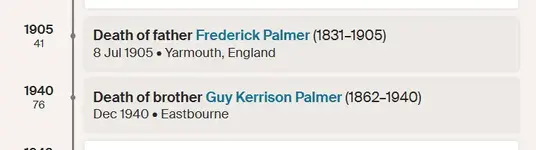
His father, Frederick Palmer, was from Norfolk, who married Barbara (also from Norfolk) and had five children. However, all the children were born in Southtown, Suffolk. Hubert therefore had four siblings: Walter (brother), Guy (brother) and two sisters, Alice and Frederica. This information is provided by the 1871 census. According to this census (based on written ages):

Frederick Palmer was born 1831.
Barbara Palmer was born 1837.
Walter Palmer was born 1856.
Guy Palmer was born 1863.
Alice Palmer was born 1861.
Hubert Palmer was born 1865.
Frederica Palmer was born 1859.

[However, these years might be not exact but approximate.]

In the 1870s, the family was living in Great Yarmouth, Norfolk. Frederick Palmer, was a landowner and presumably wealthy since aside from owning land he had two servants and a cook reside on the house premises.


1754762386029.webp


The 1891 census had the Palmer family still living in Great Yarmouth, Norfolk:

1754763849186.webp


By this time, Hubert Palmer was a solicitor (the other siblings did not work):

1754764174729.webp

The ages do not make sense based on the previous census, however note the strikethrough; possibly the ages were errors.

Around 1900-1910, Frederick and Barbara died leaving a lot of wealth to their children. It appears, Guy Palmer bought a large house with his money inheritance; the house with 15 or more rooms was at the address: Staincliff 22 Granville Road, Eastbourne. Three siblings moved to stay with him in the house i.e., Hubert, Alice and Frederica (Walter Palmer did not move to Eastbourne).

Edit: Frederick Palmer died in 1905.

1754784713985.webp


The 1911 census lists the following occupants of 22 Granville Road and a visitor:

[Again, the ages do not make sense in relation to the previous censuses].

1754756207788.webp


So the four Palmer's, two servants and a visitor were residing at the house; the oldest sibling was Guy Palmer.

1754756375060.webp


Guy Palmer's occupation and his two sisters is not mentioned; rather his income (and one sister) is stated as "private means". Presumably they were living off the money they inherited from their wealthy father and did not work (only Hubert did). The servants included a housemaid and cook. Hubert Palmer's occupation is described as a solicitor and the young visitor was his clerk.

Information summarised by ancestry.co.uk:
Hubert Palmer
Based on information from the 1911 England Census
In 1911, Hubert Palmer, a 38-year-old male solicitor, resided at 22 Granville Road, Eastbourne, Sussex, England. He was listed as the brother of the head of the household, Guy Kerrison Palmer, along with two other siblings, Frederica and Alice Palmer. The household consisted of seven members, including two servants, Mary Welsh and Elizabeth Crawford Noble, as well as a visitor named Hubert-Sinclair Martin.

I could not find the 1921 census but found the 1939 register which served as a census substitute because the 1941 census was cancelled due to World War II and the loss of the 1931 census data (records were destroyed in a fire).

1754757388987.webp

One of the siblings had left between 1912 and 1938 (Alice Palmer) leaving Guy Palmer, Hubert Palmer and Frederica Palmer; one servant also remained. However, it seems their ages are again contradictory. I have no clue why.

1927-1928 electoral register has Guy, Hubert, Frederica, Alice and Mary Welsh (22 Granville Road):

1754760640860.webp


1934-1935 electoral register has the same:

1754760920857.webp


Guy Palmer died in 1940.

1754761669636.webp


Hubert Palmer died in 1949.

England & Wales, National Probate Calendar (1949)
Hubert Palmer

1754758433459.webp


1754758395182.webp

Principal Probate Registry; London, England; Calendar of the Grants of Probate and Letters of Administration made in the Probate Registries of the High Court of Justice in England

Can anyone dig up Hubert Palmer's birth records? His date of birth might have been 25 July 1865, or he was born in 1864.

Hubert Palmer's family tree:

1754784285350.webp
 

Attachments

  • 1754763993755.webp
    1754763993755.webp
    25.9 KB · Views: 40
  • 1754756925876.webp
    1754756925876.webp
    25.5 KB · Views: 48
  • 1754784675343.webp
    1754784675343.webp
    11.8 KB · Views: 44
Last edited:
Here are several maps that resemble your island, from The Great Lost Treasure website.

View attachment 2179752
View attachment 2179753
View attachment 2179754
View attachment 2179755
View attachment 2179756

View attachment 2179757
View attachment 2179758
View attachment 2179764
View attachment 2179759
View attachment 2179760


View attachment 2179761
View attachment 2179765
View attachment 2179762
I could sit for hours analyzing these with real world data. Then I would spend three weeks tearing through the countryside like Viking on a mission. I am hungry and my plate isn't big enough for just one.
 
I have not seen proof that Wilkins was a forger, conman or unscrupulous.

I thought that was common knowledge?
Didn't you write: "It is [also] obvious that Wilkins drew the "Mar Del" map"? You posted those words on post #596. And an interesting tidbit, I never called Wilkins a "conman". But I think it speaks volumes that you did!..
 
I thought that was common knowledge?
Didn't you write: "It is [also] obvious that Wilkins drew the "Mar Del" map"? You posted those words on post #596. And an interesting tidbit, I never called Wilkins a "conman". But I think it speaks volumes that you did!..
His name is on the Mar Del map as a copyright notice (see bottom left). I am not sure why you think because he drew the Mar Del map (there are two variants) this makes him a liar, a "forger", being unscrupulous, etc. :dontknow: Wilkins the year his book Captain Kidd and His Skeleton Island was published admitted the Mar Del map was not a copy of the island depicted on the so-called Kidd-Palmer maps (see below). This has already been explained to you multiple times: Palmer did not give him permission to closely copy the map. He was only allowed permission to copy limited details, and he was open about this. The shape of the island, the map legend, and so on, he made up.

1754873191487.webp

- Harold T. Wilkins, The Listener (3 July 1935)

1754872425962.webp
 
This has already been explained to you multiple times: Palmer did not give him permission to closely copy the map. He was only allowed permission to copy limited details
No arguments here. I wrote the same comment way back on page 1, post #5 of this thread. And didn't honest Mr Wilkins also claim:

1755503194759.webp

(Your post #707).
..and he was open about this. The shape of the island, the map legend, and so on, he made up.
In his book, Wilkins implied that the charts were drawn by Captain Kidd.
A great many people missed the July 3rd 'Listener' newspaper article and thought the Mar-del charts were authentic documents.
Since everyone seems to agree that Wilkins was a fraud, why do you continue to reference his fake charts and frivolous writings?
 
Last edited:

Users who are viewing this thread

Back
Top Bottom