What's new

Oak Island Treasure Revelations

Agreed.
Here's more...
The Lawrencetown till on the eastern side of Oak Island is present in layers, rather than being a single, uniform mass.

  • Thickness: On the eastern end of the island, these drumlin deposits are at their thickest, lying on top of bedrock (anhydrite/gypsum/limestone).
IOW, the Lawrencetown till is also very deep.
Reports of two layers found in the MP were at depths of 100 and 154ft.

On the other hand, the presence of those layers could mean that if they were very lucky in an uncribbed shaft to that depth, they could get a few more feet at slightly less risk.

--GT
 
You're right! Conish miners knew how to dig deep vertical shafts without cribbing...IN ROCK!

Google AI
Yes, Cornish miners in the 18th and 19th centuries possessed the skill to sink vertical shafts without immediate or continuous timber cribbing (or "setting") by exploiting the strength of solid, competentr ROCK.
 
Hi chalkoutline, I asked Google AI the relevant question and I received the following reply.

Overview.
Yes, Cornish tin miners (and early clay miners in the region) did use methods involving log platforms and timber supports set into the sides of shafts, often without full, continuous "cribbing" (or lining) in certain ground conditions, particularly when accessing shallow deposits or through firmer, cohesive,, or clay-rich overburdon.
Methods in Clay/Soft Ground:
Early mining often involved sinking vertical shafts through softer overburden (including clay) to reach bedrock. Instead of full-height wooden linings, miners horizontal timber supports (known as stemples) or log platforms set into niches or "hitchholes cut into the sides of the shaft to provide stability or create working platforms.

Please note that this has been copied for your benefit without any alterations by me.

I hope this helps you with your research project.
Oak Island Sage
 
Hi chalkoutline, I asked Google AI the relevant question and I received the following reply.

Overview.
Yes, Cornish tin miners (and early clay miners in the region) did use methods involving log platforms and timber supports set into the sides of shafts, often without full, continuous "cribbing" (or lining) in certain ground conditions, particularly when accessing shallow deposits or through firmer, cohesive,, or clay-rich overburdon.
Methods in Clay/Soft Ground:
Early mining often involved sinking vertical shafts through softer overburden (including clay) to reach bedrock. Instead of full-height wooden linings, miners horizontal timber supports (known as stemples) or log platforms set into niches or "hitchholes cut into the sides of the shaft to provide stability or create working platforms.

Please note that this has been copied for your benefit without any alterations by me.

I hope this helps you with your research project.
Oak Island Sage
Very good! You're finally getting there.
Now all you have to do is prove the soil on oak island is the same as that of the cornish miners.
 
Im a pro cribbing guy. Maybe Oak Island Sage should give it try since he's the one who thinks it's possible. ;)
Hi charkoutline I think you will find out soon that most people also think that cribbing was not used in the construction of the Money Pit, and that apparently you are the notable exception. Perhaps you may later wish later to revise your research findings.:-\
Oak Island Sage.
 
Hi charkoutline I think you will find out soon that most people also think that cribbing was not used in the construction of the Money Pit, and that apparently you are the notable exception. Perhaps you may later wish later to revise your research findings.:-\
Oak Island Sage.

Hi charkoutline I think you will find out soon that most people also think that cribbing was not used in the construction of the Money Pit, and that apparently you are the notable exception. Perhaps you may later wish later to revise your research findings.:-\
Oak Island Sage.
I can't wait.

If i am the notable exception, its only because i dared to challenge "group think" and asked the question ..."How could clayish till, noted by Dunfield, support log platforms to a depth of 100ft.

Until someone can provide evidence how that was accomplished withe clayish till on Oak Island and not Corwall, or Mesopotamia, etc., I will remain the exception.

BTW, have you proved the clay in Corwall is the same as Oak Island?

Maybe this will help...
Based on geological surveys, the earth, dirt, and bedrock on Oak Island, Nova Scotia, are not the same as those found in Cornwall, England.
 
Hi chalkoutline, I asked Google AI the relevant question and I received the following reply.

Overview.
Yes, Cornish tin miners (and early clay miners in the region) did use methods involving log platforms and timber supports set into the sides of shafts, often without full, continuous "cribbing" (or lining) in certain ground conditions, particularly when accessing shallow deposits or through firmer, cohesive,, or clay-rich overburdon.
Methods in Clay/Soft Ground:
Early mining often involved sinking vertical shafts through softer overburden (including clay) to reach bedrock. Instead of full-height wooden linings, miners horizontal timber supports (known as stemples) or log platforms set into niches or "hitchholes cut into the sides of the shaft to provide stability or create working platforms.

Please note that this has been copied for your benefit without any alterations by me.

I hope this helps you with your research project.
Oak Island Sage
[Corn·ish
[ˈkɔːnɪʃ]
adjective
noun
Cornish (adjective)
  1. relating to Cornwall or its people or language ]

[shal·low
[ˈʃaləʊ]
adjective
noun
verb
shallow (adjective)
shallower (comparative adjective)
shallowest (superlative adjective)
  1. of little depth:
    "serve the noodles in a shallow bowl"
    "being fairly shallow, the water was warm"
    • situated at no great depth:
      "the shallow bed of the North Sea"
    • varying only slightly from a specified or understood line or direction, especially the horizontal:]
 
Very good! You're finally getting there.
Now all you have to do is prove the soil on oak island is the same as that of the cornish miners.
Hi chalkoutline, ignoring you patronizing comment that I am finally getting there I would like to make my position clear to you. The indisputable fact is (as I have shown) that Cornish miners did use log platforms let into niches into even unstable walls of a vertical shaft, it is now proven. I have politely responded to your disparaging remarks and proved conclusively that you were/are totally wrong. ;D I don't have to prove anything else to you, since most people already agree with me, you are apparently the one with all the doubts.
In the film "A few good men" Jack Nicholas said to lawyer Tom Cruise quote: "You want the truth - you can't handle the truth" 😄
Oak Island Sage
 
Hi chalkoutline, ignoring you patronizing comment that I am finally getting there I would like to make my position clear to you. The indisputable fact is (as I have shown) that Cornish miners did use log platforms let into niches into even unstable walls of a vertical shaft, it is now proven. I have politely responded to your disparaging remarks and proved conclusively that you were/are totally wrong. ;D I don't have to prove anything else to you, since most people already agree with me, you are apparently the one with all the doubts.
In the film "A few good men" Jack Nicholas said to lawyer Tom Cruise quote: "You want the truth - you can't handle the truth" 😄
Oak Island Sage
https://www.bing.com/ck/a?!&&p=9930...vbitvYWsraXNsYW5kJTNmJmZvcm09Q1NCUkFORA&ntb=1
Stating something may have happened doesn't mean it did.


[Cornish miners have been linked to Oak Island in several fringe historical theories, though there is no verified evidence that they actually worked there.

One popular theory comes from local researcher Paul Speed, who suggests that in the 1500s Sir Francis Drake — a Plymouth native — may have hired Cornish miners to tunnel underground on Oak Island to hide treasure captured in Panama Mysteries of Canada. Cornish miners were renowned in Europe for their expertise in deep tunneling, especially undersea coal mines, and were often employed by the British Navy and Army for similar tasks TreasureNet. Speed’s theory ties into the island’s long-standing legends of buried wealth, including connections to the Knights Templar and other secret repositories
Another related idea is that Cornish miners were involved in earlier 16th-century Arctic expeditions, such as Martin Frobisher’s 1578 voyage, which brought back 1,100 tons of ore — later revealed to be worthless “fool’s gold” www.houseofvere.com. While this expedition did not take place on Oak Island, it shows the historical role of Cornish miners in large-scale, secretive mining operations.

Some speculative accounts also connect Cornish miners to the discovery of the “Money Pit” in the 18th century, suggesting they may have been part of the original diggers Wikipedia. However, these claims are based on oral tradition and unverified records rather than documented evidence.

In short, while Cornish miners are frequently mentioned in Oak Island lore — from Drake-era treasure hiding to 18th-century digging — there is no confirmed historical proof that they worked on the island. Their association stems from their reputation as skilled tunnelers and the island’s own mysterious past.]
 
Hi chalkoutline, ignoring you patronizing comment that I am finally getting there I would like to make my position clear to you. The indisputable fact is (as I have shown) that Cornish miners did use log platforms let into niches into even unstable walls of a vertical shaft, it is now proven. I have politely responded to your disparaging remarks and proved conclusively that you were/are totally wrong. ;D I don't have to prove anything else to you, since most people already agree with me, you are apparently the one with all the doubts.
In the film "A few good men" Jack Nicholas said to lawyer Tom Cruise quote: "You want the truth - you can't handle the truth" 😄
Oak Island Sage
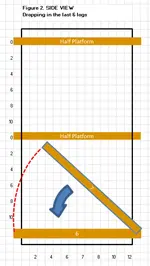
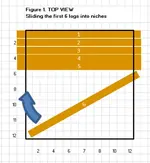
If you look at my previous posts on the thread "Can you dig a vault below the MP SHAFT?" starting with post #18 which posted on Jan 22nd, i provided diagrams and a detailed explanation how log platforms up to 6' x12' could be used to dig a vertical shaft. I then explained, when complete, it could filled in with dirt and more logs to completely close off the 12'x12' shaft.
Conclusion: this would explain the story of log platforms every 10ft.

I also stating that this is just a theory and that i had no evidence that this method was used.

Your post about Cornish miners is evidence that my theory and analysis were indeed correct. Thank you.

But as i also stated, although it appears the log platforms could be true, that doesn't mean the soil/till on Oak Island will support the use of just log platforms without cribbing.

So until then, i reiterate, you need cribbing to dig a 100ft vertical shaft even if im the only one.
 

Attachments

  • Figure 2 Side view.webp
    Figure 2 Side view.webp
    18.3 KB · Views: 39
  • Figure 1 Top view.webp
    Figure 1 Top view.webp
    12.5 KB · Views: 36
Last edited:
https://www.bing.com/ck/a?!&&p=9930...vbitvYWsraXNsYW5kJTNmJmZvcm09Q1NCUkFORA&ntb=1
Stating something may have happened doesn't mean it did.


[Cornish miners have been linked to Oak Island in several fringe historical theories, though there is no verified evidence that they actually worked there.

One popular theory comes from local researcher Paul Speed, who suggests that in the 1500s Sir Francis Drake — a Plymouth native — may have hired Cornish miners to tunnel underground on Oak Island to hide treasure captured in Panama Mysteries of Canada. Cornish miners were renowned in Europe for their expertise in deep tunneling, especially undersea coal mines, and were often employed by the British Navy and Army for similar tasks TreasureNet. Speed’s theory ties into the island’s long-standing legends of buried wealth, including connections to the Knights Templar and other secret repositories
Another related idea is that Cornish miners were involved in earlier 16th-century Arctic expeditions, such as Martin Frobisher’s 1578 voyage, which brought back 1,100 tons of ore — later revealed to be worthless “fool’s gold” www.houseofvere.com. While this expedition did not take place on Oak Island, it shows the historical role of Cornish miners in large-scale, secretive mining operations.

Some speculative accounts also connect Cornish miners to the discovery of the “Money Pit” in the 18th century, suggesting they may have been part of the original diggers Wikipedia. However, these claims are based on oral tradition and unverified records rather than documented evidence.

In short, while Cornish miners are frequently mentioned in Oak Island lore — from Drake-era treasure hiding to 18th-century digging — there is no confirmed historical proof that they worked on the island. Their association stems from their reputation as skilled tunnelers and the island’s own mysterious past.]
Great information.
I am not challenging that Cornish miners were good at what they did. Im just asking how would they have dug the 100ft vertical shaft in the clayish till identified by Dunfield.

Cornish miners didn't use log platforms exclusively. They also used cribbing when the soil conditions wouldn't support the use of log platforms.

Google AI says...
Yes, Cornish miners in the 1600s utilized heavy timbering and structural support, including methods that evolved into "cribbing" (or "stull" support), to line and stabilize vertical shafts and underground workings. While formal, industrialized "cribbing" as a standard engineering term became more prominent later, the 17th-century Cornish, influenced by technical knowledge from German miners, were skilled at using timber to secure shafts against collapsing, particularly as mining deepened.
 
Last edited:
Great information.
I am not challenging that Cornish miners were good at what they did. Im just asking how would they have dug the 100ft vertical shaft in the clayish till identified by Dunfield.

Google AI says...
Yes, Cornish miners in the 1600s utilized heavy timbering and structural support, including methods that evolved into "cribbing" (or "stull" support), to line and stabilize vertical shafts and underground workings. While formal, industrialized "cribbing" as a standard engineering term became more prominent later, the 17th-century Cornish, influenced by technical knowledge from German miners, were skilled at using timber to secure shafts against collapsing, particularly as mining deepened.

Aye.
And what confirms any Cornish miner set foot on oak island , let alone dug as much as an outhouse hole?
 
Great information.
I am not challenging that Cornish miners were good at what they did. Im just asking how would they have dug the 100ft vertical shaft in the clayish till identified by Dunfield.

I like how this thread is making me think about the step-by-step mechanical aspects of the possibilities. Let's imagine this scenario, similar to a prior posted theory: they dig ten feet down and insert a couple of horizontal "stemple" logs on either side of the shaft. In the space between, they dig the next ten feet down and do the same. They now have a partial platform at 10' and 20'. They use more logs cut to exactly 10'-and-a-sliver and force them between the two platforms, creating a vertical brace against the clayish wall (or longer than 10' and placed in an X configuration), a rudimentary cribbing pattern that can continue down as far as they want to go. To avoid stressors in a single vector they can alternate which two sides have the stemple shelves every 10', as someone else suggested. Once they reach target depth and do whatever they needed to do, they can fill in the rest of the floor of each platform with more logs and remove (for whatever reason) the vertical braces on the way back up. As each 10' is back-filled, they'd be redundant anyway. In this way there would only ever be 10' (or the first 20' at the top) of unbraced wall to worry about, and only for a limited period of time each.

--GT

P.S. about three episodes ago they uncovered honest to goodness flagstones (thin flat stones placed horizontally) at the giant boulder on Lot 8. To my knowledge that's the first time searchers have uncovered any since the apocryphal MP discovery story.
 
They use more logs cut to exactly 10'-and-a-sliver and force them between the two platforms, creating a vertical brace against the clayish wall (
Knowing what i know about the clayish till, that would make total sense. So do you call that log platforms, cribbing or or log platforms with wall support?
 
Last edited:
Knowing what i know about the clayish till, that would make total sense. So do you call that log platforms, cribbing or or log platforms with wall support?

Since many derivations of the word crib ("crib bridge", "crib dam"), and most of the pictures of historical mine cribbing are mostly horizontal logs or beams, maybe vertical stuff is just posts, or supports.

--GT
 
Since many derivations of the word crib ("crib bridge", "crib dam"), and most of the pictures of historical mine cribbing are mostly horizontal logs or beams, maybe vertical stuff is just posts, or supports.

--GT
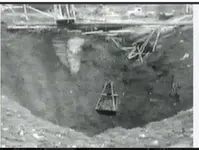
Here is a picture of Dunfield’s big dig. To the left you will see the cribbing of the Chapel shaft. It is constructed of heavy timber dovetailed frames stacked on top of each other providing wall support.

This method has been used well before the 1700s. The size of timber size and joining methods have evolved over time but the basic concept remains the same.

Your idea of vertical logs providing wall support would fall into the cribbing category...At least my definition of cribbing.
 

Attachments

  • Screenshot_20250707_152258_Chrome~2.webp
    Screenshot_20250707_152258_Chrome~2.webp
    52 KB · Views: 44
Here is a picture of Dunfield’s big dig. To the left you will see the cribbing of the Chapel shaft. It is constructed of heavy timber dovetailed frames stacked on top of each other providing wall support.

This method has been used well before the 1700s. The size of timber size and joining methods have evolved over time but the basic concept remains the same.

Your idea of vertical logs providing wall support would fall into the cribbing category...At least my definition of cribbing.
BTW, it was this picture, provided by truthbetold, that made me start thinking about cribbing.
I noticed the clayish till was just falling away and down into the crater. If it were what i now know as stiff clay, it would be clinging to the Chapel shaft, falling down in clumps and you would see straighter clay walls in various places where it could stand on its own. But it is all falling in creating a crater with 60 degree sloped walls.
 
BTW, it was this picture, provided by truthbetold, that made me start thinking about cribbing.
I noticed the clayish till was just falling away and down into the crater. If it were what i now know as stiff clay, it would be clinging to the Chapel shaft, falling down in clumps and you would see straighter clay walls in various places where it could stand on its own. But it is all falling in creating a crater with 60 degree sloped walls.

The Chappell Shaft side of the crater would definitely qualify as a zone of previously worked earth, though. As Dunfield got below tide level (~30' depth), he would have been intersecting searcher works which had flooded over and over, making the till into mud, essentially. I think we may have touched on the permeability of clayish till when the topic of sinkholes was debated last year, and may have established that slumping occurs easier in non-virgin ground. I'll see if I can find the exchange.

Also, there's apparently some types of clay which expand when exposed to air, as in the Ophir Mine section of the wiki on Philip Deidesheimer. No reason to think that applies to Oak Island necessarily, but interesting nonetheless.

--GT
 
The Chappell Shaft side of the crater would definitely qualify as a zone of previously worked earth, though. As Dunfield got below tide level (~30' depth), he would have been intersecting searcher works which had flooded over and over, making the till into mud, essentially. I think we may have touched on the permeability of clayish till when the topic of sinkholes was debated last year, and may have established that slumping occurs easier in non-virgin ground. I'll see if I can find the exchange.

Also, there's apparently some types of clay which expand when exposed to air, as in the Ophir Mine section of the wiki on Philip Deidesheimer. No reason to think that applies to Oak Island necessarily, but interesting nonetheless.

--GT
The Dunfield dig was not in the MP but rather 50 yards [CORRECION...the crater was about 100ft across and 100ft deep so the certer would have 50ft from th Chapel shaft]. You can see in the upper right all the previous shafts and cassons rick and marty sunk.

Dunfield centered his dig on the Restall shaft where the Restalls were looking for a flood tunnel before they died. Dunfield promised Restall"s wife he would finish where her husband left off.

So Dunfield was not digging in previously worked earth except for the Restall shaft.

From my research...as Dunfield dug all sides of the hole kept siding down causing numerous setbacks until he ran out of money.
 

Attachments

  • Screenshot_20250707_152541_Chrome~2.webp
    Screenshot_20250707_152541_Chrome~2.webp
    104.2 KB · Views: 46
Last edited:

Users who are viewing this thread

Back
Top Bottom