What's new

Oak Island Treasure Revelations

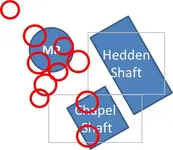
The Dunfield dig was not in the MP but rather 50 yards sw of the MP shown by the green crurved line. The center of the dig is off the screen in the lower left corner.

You can see in the upper right all the previous shafts and cassons rick and marty sunk.

Dunfield centered his dig on the Restall shaft where the Restalls were looking for a flood tunnel before they died. Dunfield promised Restall"s wife he would finish where her husband left off.

So Dunfield was not digging in previously worked earth except for the Restall shaft.

From my research...as Dunfield dug all sides of the hole kept siding down causing numerous setbacks until he ran out of money.
BTW, after my Dunfield dig thread, i was done posting on treasurenet and oak island when Oak Island Sage started promoting his book and stated in a post that Dunfield dug in the MP.
Since i had studied Dunfield extensively, i felt i needed to correct the misinformation.

Ive been fact checking statements made ever since. I apologize to everyone on this thread for repeating over and over that you can't dig a 100ft deep vertical shaft in CLAYISH TILL without cribbing.

I hope some finds evidence to the contrary please post the evidence and sources so i can update my research.

Finally, when Google AI gives answers they also provide the sources. Its important to read those sources and not just settle for the quick AI answers.
 
Last edited:
BTW, i was done with treasurenet and oak island when Oak Island Sage started promoting his book and stated in a post that Dunfield dug in the MP.
Since i had studied Dunfield extensively, i felt i needed to correct the misinformation.

Ive been fact checking statements made ever since. I apologize to everyone on this thread for repeating over and over that you can't dig a 100ft deep vertical shaft in CLAYISH TILL without cribbing.

I hope some finds evidence to the contrary please post the evidence and sources so i can update my research.

Finally, when Google AI gives answers they also provide the sources. Its important to read those sources and not just settle for the quick AI answers.
My Dunfield research is in a separate thread called "where was Dunfields dig on oak island?".

At the end of the thread you will find this drawing. Ir shows the MP and all the cassons dropped up to 2016.
You can see they covered the MP extensively Since they found nothing, they switched to an offset chamber, the blob, the baby blob, the garden shaft so they are just manipulating the viewers.
 

Attachments

  • Hedden-Chapel wirh Can Locations.webp
    Hedden-Chapel wirh Can Locations.webp
    18.8 KB · Views: 57
I noticed the clayish till was just falling away and down into the crater. If it were what i now know as stiff clay, it would be clinging to the Chapel shaft, falling down in clumps
Don't take my word for it here's Google AI...
When stiff clay falls into a hole, it typically fails by falling in chunks or blocks rather than sliding like a fluid or sand
 
The Dunfield dig was not in the MP but rather 50 yards sw of the MP shown by the green crurved line. The center of the dig is off the screen in the lower left corner.

Something doesn't quite jibe with these measurements. If the photo shows a corner of Chappell, which was only a few feet away from the MP (supposedly), then a Dunfield crater centered 50 yards (150 feet) away shouldn't have exposed it, since it maxed out at ~ 100 feet diameter, according to the accounts I've read. That's like 75' short, give or take. Either the reported diameter is wrong, or the center of his crater must have been closer to MP.

I will take your word for it that the crater was collapsing on all sides. I think I have seen grainy video of his big dig, and it was a huge sloppy mess. And not to belabor the point (possibly too late, ha), but there could be other variables involved that predisposed his crater to collapse. For one thing, the equipment he was using was enormous. By one account -- I tried to grab the citation, but when I did I lost the search -- his excavator was 70 tons! That's 70 tons maneuvering around the circumference and potentially venturing part way into the crater. Talk about downward forces! If they encountered a spate of rain, then the till they were exposing was bound to start loosening up, exacerbating these trends.

I found the previous sinkhole discussion, wherein I cited this article (scroll to Does Science Support a Man-Made Flood Tunnel?) interviewing John Wonnacott. I've no idea who, if anyone, bothered to follow and read it but I'll quote another interesting passage:
"
JW: Glacial till is a type of soil that is common in Canada. It consists of an unsorted mixture of sand, gravel, cobbles, boulders, silt and clay, that was deposited by glaciers. In many cases, including at Oak Island, thick glaciers lay on top of the till for many centuries, causing the soil to be heavily compressed. Because till has so many different size pieces of soil, the voids between pieces are filled with smaller and smaller pieces and because it is often very heavily compressed, it is a dense, impervious material that water cannot even seep through, except in very small quantities over very long time periods.
DC: So the weight of the glaciers, sitting on top of the soil for a long, long time, compacts that soil so tightly that it is water tight?
JW: Yes. Glacial till is so reliably impermeable, that engineers often use natural till deposits as water-tight barriers when designing dams etc.

"

So I present this as another way of saying that disturbed earth, which Dunfield's crater at least partly (from the photo evidence) intersected, would have lost some of its compressed features and been more likely to conduct water and therefore collapse. This distinction between pre-worked earth and the more solid virgin till is duplicated in the 1894 excavation of the Cave-In Pit, as I cited in this post. I do not recall cribbing being mentioned in that work, and they got down 52 feet.

Finally, when Google AI gives answers they also provide the sources. Its important to read those sources and not just settle for the quick AI answers.

Absolutely. What's more, AI tools are only as good as their training data. We know that Google is probably king when it comes to archived web content, which is what they built the brand on. They have the additional advantage of the Google Books project. But even these sources will have limitations and biases. Google Books, for example, will slant heavily toward English-language volumes that were available in academic collections when their scanning project was in full swing. Esoteric topics by obscure authors may be missed entirely. If the AI agent's training data didn't contain it, it won't know about it to tell you, even when it makes definitive-sounding proclamations. Not to mention the well-documented cases of just plain hallucinations and errors that an AI can make. As an example, Perplexity (my favored AI tool), when asked for a complete list of books about AI from the nineties, kept completely neglecting the one title I was looking for. Only when I remembered a specific quote from the volume was I able to track down the name of the work, which Perplexity then magically "remembered", even though it had failed multiple times to list it. These tools are fun and often useful, but not exhaustively correct enough to rely on except as a starting place.

Thank you for the good discussion.

--GT
 
https://www.bing.com/ck/a?!&&p=9930...vbitvYWsraXNsYW5kJTNmJmZvcm09Q1NCUkFORA&ntb=1
Stating something may have happened doesn't mean it did.


[Cornish miners have been linked to Oak Island in several fringe historical theories, though there is no verified evidence that they actually worked there.

One popular theory comes from local researcher Paul Speed, who suggests that in the 1500s Sir Francis Drake — a Plymouth native — may have hired Cornish miners to tunnel underground on Oak Island to hide treasure captured in Panama Mysteries of Canada. Cornish miners were renowned in Europe for their expertise in deep tunneling, especially undersea coal mines, and were often employed by the British Navy and Army for similar tasks TreasureNet. Speed’s theory ties into the island’s long-standing legends of buried wealth, including connections to the Knights Templar and other secret repositories
Another related idea is that Cornish miners were involved in earlier 16th-century Arctic expeditions, such as Martin Frobisher’s 1578 voyage, which brought back 1,100 tons of ore — later revealed to be worthless “fool’s gold” www.houseofvere.com. While this expedition did not take place on Oak Island, it shows the historical role of Cornish miners in large-scale, secretive mining operations.

Some speculative accounts also connect Cornish miners to the discovery of the “Money Pit” in the 18th century, suggesting they may have been part of the original diggers Wikipedia. However, these claims are based on oral tradition and unverified records rather than documented evidence.

In short, while Cornish miners are frequently mentioned in Oak Island lore — from Drake-era treasure hiding to 18th-century digging — there is no confirmed historical proof that they worked on the island. Their association stems from their reputation as skilled tunnelers and the island’s own mysterious past.]
Hi relevantchair, would you consider the Cornish mining pick axe discovered in the Money Pit (and on display in the Oak Island museum with a new shaft) constitutes some evidence of their possible connection?

My own theory is that many west country Cornish miners took to the sea, some of these men actually served under Captain Henry Every, at sea he selected them from his crew for their previous mining skills. In my view they excavate the great subterranean net work tunnels and shafts beneath Oak Island. This system included an under sea level repository designed to hold accumulated Treasure awaiting conversion into coinage or bars. Because this facility provided an impregnable kind of protection it could also hold in storage anyone's treasure, including that of the Templar Knights.
Oak Island Sage
 
Hi relevantchair, would you consider the Cornish mining pick axe discovered in the Money Pit (and on display in the Oak Island museum with a new shaft) constitutes some evidence of their possible connection?

My own theory is that many west country Cornish miners took to the sea, some of these men actually served under Captain Henry Every, at sea he selected them from his crew for their previous mining skills. In my view they excavate the great subterranean net work tunnels and shafts beneath Oak Island. This system included an under sea level repository designed to hold accumulated Treasure awaiting conversion into coinage or bars. Because this facility provided an impregnable kind of protection it could also hold in storage anyone's treasure, including that of the Templar Knights.
Oak Island Sage

Is a tool in the money pit enough context to make a call on the prior users ethnicity?

Let me backtrack to picture posted earlier of a mine.
I suspect tothe right side into the floor is the hole being worked. Everything else is in support of extracting what is being dug below.
Note the pipes. Multiple purpose pipes. One for air perhaps. And the slot in the square post near the hole begs the question of if it's a wooden hand pump minus the lever.

Bring us/me back to the pick found in hole.
For the sake of argument we are under sail. A long journey waits and we are to earn our keep aboard. It's not an option.
Examples exist of wooden pipes. Video exists somewhere of a guy with a family heirloom bit he demonstrates.
Select timber. A big stack in the bilge. Let's not work knots if we don't have to.
Amount of seasoning depends on purpose and how to work it. But it wouldn't take long to have "pipes' ready to go. It's an art but quite doable with a basic process.
Plenty of other work while underway to. As in the ships blacksmith.
Better yet one like the carpenter with an apprentice for redundancy's sake.

Picks?
A pick can be the smiths design. Or the smiths recollection of a design. Or a customers design. Within logical reason.
Salt mines in Poland and mines around the world had quite a mix of tools. Ships shuffled nationalities of workers based on skills more than ethnicity at times. It's more efficient to haul specialties than those trying to figure a skill or process out.
Which would encourage Cornish miners for mining purposes. But would that be worth the expense? And number of bowls at meal times?
IF the miners were versed in other disciplines perhaps. As opposed to lounging about the ship underway.

We have fun looking at axe designs over time and across regions as they surface in recoveries.
Some are easier than others to figure out their origin despite the context they were found in.
But axes traveled. Still do.
An American axe in another country is no shocker. That it arrived by ship is a strong possibility. But doesn't mean if one is recovered in an Australian mines yard that an American was directly responsible

Given the culture of mining communities in my area I can't suspect a pick would be left in a secretive works.
A broken one returned to the smith or tool crib/version of a crib. But more likely to be discarded.
You have a pick. Marking a rock would be a simple matter to leave an indicator for someone who is supposed to find it and confuse anyone else. Vs leaving evidence of possible ethnicity and purpose.

In the natural shuffle of goods and services a pick might be more generic in availability than a Cornish miner. It might.
If you were to have an axe forged for yourself what size and design would you prefer ; and why?
You'd warm it in bitter cold before striking with it to try to avoid breaking it.
The odds of losing it even in snow due to it being a valuable tool would be low.
Would you sacrifice it exposed to the elements for unknown years to come to indicate where your chopping block is?
Putting a tool in sand can control the humidity to some extent. Keep a handle through an eye from drying and shrinking.
Mix oil with sand and shove a tool in to reduce rusting.
Even under steps to address superstition? Or just for relocating's sake. I didn't get to ask.
But a Cornish miner would more likely wear a pick out than leave it rot. It's weight would mean little to a departing ship/boat. And a miner could improvise much in terms of survival beyond mining with one.
You hauled it as if it was valuable to arrive. Unless cargo taken on(and the pit is alleged to be a cargo deposit) water and fuel demands less weight tools go back aboard.
The art of working iron was highly skilled and even then failures happened. The mysteries of steel weren't quite sorted out yet. And each swing of a hammer cost someone. Or more than one person.
A piece of steel was costly. Inserted into a folded piece of iron and forge welded an axe was more economical. That doesn't mean decent iron was casually discarded.
A worn pick of iron would still be decent or better quality to recycle. Rocks were far cheaper as signals.

Why was the museum pick rehandled? How long was the original? How long did it's user(s) shorten it to?
Reminds me of single bevel broad axes with straight handles instead of curved per user dominant hand.. Purpose gone right out the window. Well, at least context gone .
Despite being straight handled(?) this axe is lefthanded? It being rehandled has what to do with original context and orientation? We don't know. The last actual user may or may not have been left handed.
What nationality would the user have been?
1769793029728.webp
 
That might have been enough to take him out of the pre-worked zone, but difficult to say for sure. OITCo was venturing at least as far as 25 feet from the MP proper with their shafts, along with Cave-In Pit excavations and shafts along the purported flood tunnel route, all before 1899. It's possible that Dunfield's crater did not collapse evenly all round the circle, but had weak spots where it intersected prior digs.

--GT
Hi GravelTeeth, when at his invitation I visited Dan Blankenship on Oak Island Island in 2002 we discussed many things, some of which at the time I wrote down in my note pad, and when I just found it I thought they might interest you. He also felt that the Money Pit was an empty shaft but he didn't know what its its actual intended purpose was. He personally pinned his hopes on Bore Hole 10X which later almost cost him his life.
In the cellar of his house on Oak Island there were filing cabinets filled with dusty old records of previous excavation projects, he said there were many more old searchers shafts, tunnels, and bore hole done around the Money Pit area and their locations were never recorded. To illustrate the truth of that point I later read that he found the Bore Hole 10X position by using divining rods, when he later drilled down he intercepted a previously unknown and abandoned - searcher tunnel.
He told me that the previously discovered flood tunnels were approximately 4ft by "2ft, and that was clearly too small to convey heavy treasure chest through.
I showed him my early illustration of what I perceived to be the real purpose of the Money Pit was and that it was designed as a sand sump. I said that is why there were filtered drains at Smiths Cove, he said keep working on that theory and let me know how you get on. Before we parted I told him that if my theory is correct then there were three concealed shafts along side the beach road located at the South Shore that were similar to the Cave in Pit, he just laughed. A big storm came during the next winter and the wave damage washed away part of the road and exposed - the three shafts.
If you want my take on things like The Cryptic Message Stone, the drilled stones, etc, I will give you an honest answer GT but please no more questions regarding the construction of the Money Pit. I'm personally content that Cornish Miners used log platforms because that virgin ground they encountered there was firm enough not to require cribbing.
The important thing to ponder is why go to all that trouble just to construct an empty shaft, you know where to find the answer.:read2:
Oak Island Sage
 
Is a tool in the money pit enough context to make a call on the prior users ethnicity?

Let me backtrack to picture posted earlier of a mine.
I suspect tothe right side into the floor is the hole being worked. Everything else is in support of extracting what is being dug below.
Note the pipes. Multiple purpose pipes. One for air perhaps. And the slot in the square post near the hole begs the question of if it's a wooden hand pump minus the lever.

Bring us/me back to the pick found in hole.
For the sake of argument we are under sail. A long journey waits and we are to earn our keep aboard. It's not an option.
Examples exist of wooden pipes. Video exists somewhere of a guy with a family heirloom bit he demonstrates.
Select timber. A big stack in the bilge. Let's not work knots if we don't have to.
Amount of seasoning depends on purpose and how to work it. But it wouldn't take long to have "pipes' ready to go. It's an art but quite doable with a basic process.
Plenty of other work while underway to. As in the ships blacksmith.
Better yet one like the carpenter with an apprentice for redundancy's sake.

Picks?
A pick can be the smiths design. Or the smiths recollection of a design. Or a customers design. Within logical reason.
Salt mines in Poland and mines around the world had quite a mix of tools. Ships shuffled nationalities of workers based on skills more than ethnicity at times. It's more efficient to haul specialties than those trying to figure a skill or process out.
Which would encourage Cornish miners for mining purposes. But would that be worth the expense? And number of bowls at meal times?
IF the miners were versed in other disciplines perhaps. As opposed to lounging about the ship underway.

We have fun looking at axe designs over time and across regions as they surface in recoveries.
Some are easier than others to figure out their origin despite the context they were found in.
But axes traveled. Still do.
An American axe in another country is no shocker. That it arrived by ship is a strong possibility. But doesn't mean if one is recovered in an Australian mines yard that an American was directly responsible

Given the culture of mining communities in my area I can't suspect a pick would be left in a secretive works.
A broken one returned to the smith or tool crib/version of a crib. But more likely to be discarded.
You have a pick. Marking a rock would be a simple matter to leave an indicator for someone who is supposed to find it and confuse anyone else. Vs leaving evidence of possible ethnicity and purpose.

In the natural shuffle of goods and services a pick might be more generic in availability than a Cornish miner. It might.
If you were to have an axe forged for yourself what size and design would you prefer ; and why?
You'd warm it in bitter cold before striking with it to try to avoid breaking it.
The odds of losing it even in snow due to it being a valuable tool would be low.
Would you sacrifice it exposed to the elements for unknown years to come to indicate where your chopping block is?
Putting a tool in sand can control the humidity to some extent. Keep a handle through an eye from drying and shrinking.
Mix oil with sand and shove a tool in to reduce rusting.
Even under steps to address superstition? Or just for relocating's sake. I didn't get to ask.
But a Cornish miner would more likely wear a pick out than leave it rot. It's weight would mean little to a departing ship/boat. And a miner could improvise much in terms of survival beyond mining with one.
You hauled it as if it was valuable to arrive. Unless cargo taken on(and the pit is alleged to be a cargo deposit) water and fuel demands less weight tools go back aboard.
The art of working iron was highly skilled and even then failures happened. The mysteries of steel weren't quite sorted out yet. And each swing of a hammer cost someone. Or more than one person.
A piece of steel was costly. Inserted into a folded piece of iron and forge welded an axe was more economical. That doesn't mean decent iron was casually discarded.
A worn pick of iron would still be decent or better quality to recycle. Rocks were far cheaper as signals.

Why was the museum pick rehandled? How long was the original? How long did it's user(s) shorten it to?
Reminds me of single bevel broad axes with straight handles instead of curved per user dominant hand.. Purpose gone right out the window. Well, at least context gone .
Despite being straight handled(?) this axe is lefthanded? It being rehandled has what to do with original context and orientation? We don't know. The last actual user may or may not have been left handed.
What nationality would the user have been?
View attachment 2242788
Hi
Is a tool in the money pit enough context to make a call on the prior users ethnicity?

Let me backtrack to picture posted earlier of a mine.
I suspect tothe right side into the floor is the hole being worked. Everything else is in support of extracting what is being dug below.
Note the pipes. Multiple purpose pipes. One for air perhaps. And the slot in the square post near the hole begs the question of if it's a wooden hand pump minus the lever.

Bring us/me back to the pick found in hole.
For the sake of argument we are under sail. A long journey waits and we are to earn our keep aboard. It's not an option.
Examples exist of wooden pipes. Video exists somewhere of a guy with a family heirloom bit he demonstrates.
Select timber. A big stack in the bilge. Let's not work knots if we don't have to.
Amount of seasoning depends on purpose and how to work it. But it wouldn't take long to have "pipes' ready to go. It's an art but quite doable with a basic process.
Plenty of other work while underway to. As in the ships blacksmith.
Better yet one like the carpenter with an apprentice for redundancy's sake.

Picks?
A pick can be the smiths design. Or the smiths recollection of a design. Or a customers design. Within logical reason.
Salt mines in Poland and mines around the world had quite a mix of tools. Ships shuffled nationalities of workers based on skills more than ethnicity at times. It's more efficient to haul specialties than those trying to figure a skill or process out.
Which would encourage Cornish miners for mining purposes. But would that be worth the expense? And number of bowls at meal times?
IF the miners were versed in other disciplines perhaps. As opposed to lounging about the ship underway.

We have fun looking at axe designs over time and across regions as they surface in recoveries.
Some are easier than others to figure out their origin despite the context they were found in.
But axes traveled. Still do.
An American axe in another country is no shocker. That it arrived by ship is a strong possibility. But doesn't mean if one is recovered in an Australian mines yard that an American was directly responsible

Given the culture of mining communities in my area I can't suspect a pick would be left in a secretive works.
A broken one returned to the smith or tool crib/version of a crib. But more likely to be discarded.
You have a pick. Marking a rock would be a simple matter to leave an indicator for someone who is supposed to find it and confuse anyone else. Vs leaving evidence of possible ethnicity and purpose.

In the natural shuffle of goods and services a pick might be more generic in availability than a Cornish miner. It might.
If you were to have an axe forged for yourself what size and design would you prefer ; and why?
You'd warm it in bitter cold before striking with it to try to avoid breaking it.
The odds of losing it even in snow due to it being a valuable tool would be low.
Would you sacrifice it exposed to the elements for unknown years to come to indicate where your chopping block is?
Putting a tool in sand can control the humidity to some extent. Keep a handle through an eye from drying and shrinking.
Mix oil with sand and shove a tool in to reduce rusting.
Even under steps to address superstition? Or just for relocating's sake. I didn't get to ask.
But a Cornish miner would more likely wear a pick out than leave it rot. It's weight would mean little to a departing ship/boat. And a miner could improvise much in terms of survival beyond mining with one.
You hauled it as if it was valuable to arrive. Unless cargo taken on(and the pit is alleged to be a cargo deposit) water and fuel demands less weight tools go back aboard.
The art of working iron was highly skilled and even then failures happened. The mysteries of steel weren't quite sorted out yet. And each swing of a hammer cost someone. Or more than one person.
A piece of steel was costly. Inserted into a folded piece of iron and forge welded an axe was more economical. That doesn't mean decent iron was casually discarded.
A worn pick of iron would still be decent or better quality to recycle. Rocks were far cheaper as signals.

Why was the museum pick rehandled? How long was the original? How long did it's user(s) shorten it to?
Reminds me of single bevel broad axes with straight handles instead of curved per user dominant hand.. Purpose gone right out the window. Well, at least context gone .
Despite being straight handled(?) this axe is lefthanded? It being rehandled has what to do with original context and orientation? We don't know. The last actual user may or may not have been left handed.
What nationality would the user have been?
View attachment 2242788
Hi releventchair, I don't know if it's the same in the USA but in the UK we call a pick "a pick axe" and it does not have a chopping blade. The Cornish mining pick head discovered had no shaft which may have rotted away. As the discovered pick axe head had no shaft, and the tunnels were said to have approximately 4ft high by 2ft wide, we can reasonable assume that that original shaft was very short, unlike the new fitted one and now on display to tourist. I haven't seen personally it so I can't elaborate more than this. Is this Cornish pick axe head sufficient to identify the users ethenicity, it's a moot point, but hey it works for me.:icon_thumright:
Oak Island Sage
 
Hi

Hi releventchair, I don't know if it's the same in the USA but in the UK we call a pick "a pick axe" and it does not have a chopping blade. The Cornish mining pick head discovered had no shaft which may have rotted away. As the discovered pick axe head had no shaft, and the tunnels were said to have approximately 4ft high by 2ft wide, we can reasonable assume that that original shaft was very short, unlike the new fitted one and now on display to tourist. I haven't seen personally it so I can't elaborate more than this. Is this Cornish pick axe head sufficient to identify the users ethenicity, it's a moot point, but hey it works for me.:icon_thumright:
Oak Island Sage

2'x4' is Dwarf stuff.

A mattock has a flat on one side and a pick on the other. Military surplus has allowed small ones in civilian hands. I've one in the barn that sees use at times. a 2 foot handle maybe.
1769804870925.webp


A pick can be single or double sided. In tight quarters I wouldn't really want to swing a double sided anything.
A double bitted axe could have very different contours for varied purposes. Felling with one side and notching with another. i still wouldn't crowd it in tight quarters.
 
Oak island sage's story continues to change while adding facts brought up by members here to their evolving tale.

With all the quack experts the laginas have had on the show to date, oak island sage's tale must be even beyond the lagina's gullible limit.
 
Last edited:
Oak island sage's story continues to change while adding facts brought up by members here to their evolving tale.

With all the quack experts the laginas have had on the show to date, oak island sage's tale must be even beyond the lagina's gullible limit.
 
Hi TruthbeTold, for your information sir, the Laginas were prepared to except my offer of help in return for getting my book published, but by the time they got around to informing me of their decision (six weeks), I had it published myself by an American publisher.
Also if you are inferring that I am a quack expert can you explain this? Why is it I am the only one who has ever been offered a great deal of money by the Prometheus Company to fly to Nova Scotia, with two friends and to stay in a four star hotel all flight and accommodation expenses paid to assist the Lagina's?
Oak Island Sage
 
A big storm came during the next winter and the wave damage washed away part of the road and exposed - the three shafts.

That's fascinating. I don't think I've seen that reported in any of the books I've read to date. Did they correspond at all with the three purported flood tunnel outlets inlets in the waters off south shore?

--GT
 
Hi relevantchair, would you consider the Cornish mining pick axe discovered in the Money Pit (and on display in the Oak Island museum with a new shaft) constitutes some evidence of their possible connection?
It was found along with several other items, all presumed to be remnants of a prior excavation. There is nothing anyone can pull out of the ground on OI (short of a buried treasure) that should be presumed linked to anything other than past excavations, unless there is overwhelming evidence to the contrary.
 
That's fascinating. I don't think I've seen that reported in any of the books I've read to date. Did they correspond at all with the three purported flood tunnel outlets inlets in the waters off south shore?

--GT
Hi GravelTeeth, because I like you I will answer your polite questions. I'm not surprised you haven't seen the three air shafts mentioned in any other books, or even the west bound tunnel that left the Money Pit at a depth of 133ft, neither were considered important by searchers at the time, never mind you are coming to the right store now. 😉
Regarding the inlets that were located about 300ft off the South Shore, well during one very harsh winter they became noticeable when they appeared as weird holes in the ice when sea froze over. Bubbles that constantly rose from the deep flood tunnels prevented the water from freezing. When dye was once put down the different shafts in the Money Pit area it showed up at Smiths Cove and at those off shore inlets.
The corresponding shafts to each inlet is located just inside the detour road, each one had four different purposes,1/ To provide fresh air for the miners. 2/ To start a long dead end tunnel that ran out under the sea bed. 3/ The place from where to run a long fuse that ran out to the end of each tunnel where gunpower was stored. This was to only be lit to quickly flood the mine for protection if danger threatened, and it later did. 4/ These air vents on land were to be filled in solid to prevent the sea from entering again. The perpetrators would have wished to recover the treasure at a later safe time, it never came and that is why the treasure remains just as they abandoned it in abject panic.
With all the work that has done by searchers the Money Pit sand sump has been destroyed, as a result the perpetually incoming sand has backed right up to the inlets off the South Shore and gradually solidified. In recent years more dye was put down but this time nothing showed and there was no sign of the inlets anymore. This means that the under sea level repository filled with about a billion pounds worth of treasure is no longer protected by sea water, possibly fresh water but that can be pumped out.

If you want my opinion on anything appertaining to Oak Island it will be my pleasure to answer you.
Oak Island Sage
 
It was found along with several other items, all presumed to be remnants of a prior excavation. There is nothing anyone can pull out of the ground on OI (short of a buried treasure) that should be presumed linked to anything other than past excavations, unless there is overwhelming evidence to the contrary.
Hi Carl-NC when in 2002 I talked at length strolling with the late Dan Blankenship around Oak Island we talked about who could have been the miners. I mentioned my theory and that I shared the opinion of a writer of several books on Oak Island that it was done by Cornish Miners. Dan knew him well and then he said "Did you know that the early searchers discovered the head of a Cornish pick in the Money Pit?" I said "No I didn't, but I am delighted to hear that because it lends credence to my own theory".

I would agree with you that the miscellaneous items found on or near the surface of Oak Island only represent clues, and there are hundreds of them. The head of a Cornish Pick Axe discovered in the Money Pit is considered by some people to be pretty conclusive evidence, that Cornish miners were involved, they certainly were considerably famed for their expertise.
Perhaps it does not constitute the overwhelming evidence that you require but all we really have now are clues, and we each have to rely on our individual intuitive perception and our personal interpretation of them.

If this contradicts your own theory regarding who constructed the Money Pit then perhaps you can offer us your own hypothesis, and together with your overwhelming evidence to support it please.
Oak Island Sage
 
Last edited:
Hi Carl-NC when in 200 I talked at length strolling with the late Dan Blankenship around Oak Island we talked about who could have been the miners. I mentioned my theory and that I shared the opinion of a writer of several books on Oak Island that it was done by Cornish Miners. Dan knew him well and then he said "Did you know that the early searchers discovered the head of a Cornish pick in the Money Pit?" I said "No I didn't, but I am delighted to hear that because it lends credence to my own theory".

I would agree with you that the miscellaneous items found on or near the surface of Oak Island only represent clues, and there are hundreds of them. The head of a Cornish Pick Axe discovered in the Money Pit is considered by some people to be pretty conclusive evidence, that Cornish miners were involved, they certainly were considerably famed for their expertise.
Perhaps it does not constitute the overwhelming evidence that you require but all we really have now are clues, and we each have to rely on our individual intuitive perception and our personal interpretation of them.

If this contradicts your own theory regarding who constructed the Money Pit then perhaps you can offer us your own hypothesis, and together with your overwhelming evidence to support it please.
Oak Island Sage

To be nonest sir, I've seen no "overwhelming evidence" from you on your theory, or anyone for that matter, only conjecture, the pick could have come from anywhere, and lost anytime in the many failed digs.
 
To be nonest sir, I've seen no "overwhelming evidence" from you on your theory, or anyone for that matter, only conjecture, the pick could have come from anywhere, and lost anytime in the many failed digs.
Hi Treasure Hunter, I am not sure what specific theory you are referring to, or what you and Carl-NC consider constitutes "overwhelming evidence". If you are referring the construction of the Money Pit, you could perhaps contact the Cerca Trova company and they might give you the standard of evidence you require but there is no guarantee it will change your opinion.
1/The Cornish Pick Axe is still on display for tourist with details of where it was discovered in the Money Pit, that's is sufficient evidence for many tourist and myself not to doubt.
2/The Secret Jetty of boulders is still there for anyone to see in Joudary Cove next to Tom Nolan's modern Jetty.
3/ The Memorial stone carved for Captain Kidd is still there on Cape Breton Island.
4/ The air vent shafts located by the south shore near the Detour Road are still there.
Short of going to Oak Island and/or Cape Breton Island yourself to see these things with your own eyes I can't see what else would satisfy you, clearly not old records or photo's.
Oak Island Sage
 
Last edited:
Oak island sage:

Your ever changing word salad replies mirrors many others here who have claimed to "know" where the fictional oak island treasure was buried.

Also, please post your correspondence from the Prometheus Company where they offered you actual money to come and become one of the "experts" who have appeared on the show.

That would at least show that the laginas are running out of tall tales from their script writers and need new fiction.

I would have surmised that offer would have been more than what was possible to be earned from a non-selling book on an internet store.

Then again, maybe your book is outselling the exponential number of other oak island fairy tale books?

If that was the case however, why would you still be promoting the book here?
 

Users who are viewing this thread

Latest Discussions

Back
Top Bottom