What's new

Oak Island Treasure Revelations

I'm fine, got 20/20 vision. Sage, I approach all treasure legends the same way: I assume they are fabricated unless I see strong evidence otherwise. OI is one of those legends that has never managed to muster even the slightest amount of evidence. It's all built on a single observation: a depression in the ground. That's all there is to it, everything after that is just conjecture piled on top of supposition. Then you come along, proposing a tale even more outlandish than the original, an almost certainly impossible scenario, and lacking any evidence at all. I suggest it's you who should get their eyesight checked.
Hi Carl-NC, I don't blame you at all for wanting solid evidence before accepting someone's unproven theory, the Lagina's don't believe me (enough to make a deal) so why should you. After twenty or more years which has past with no recovered treasure every body is fed up with hearing unproven theories. Over sixty books have written about Oak Island, by the law of average the right person who could really recover the treasure to had to turn up sometime, to face constant abuse and demands for proof, only time will tell if that's me.
Now without submitting a shred of evidence will tell you the truth, and I only ask that you remember. At a 2025 Zoom meeting with the current Oak Island treasure hunters of the Cerca Trova company the conversation turned to how sure I was of my theory, and what would cost, and how long would it take, and who's property was the treasure on. My reply was basically this, I won't require any percentage of recovered treasure only that they agree to get my book published, however, by the time they made up their minds (six weeks) I got p..t and withdrew my offer and got it published myself in the USA.
My offer was based on a no win- no pay kind of deal. Also that the project would cost them around $2,000 to undertake and it would take less than two weeks to complete. They asked me I was how sure I was of my theory I said 95%, but as I said that particular deal fell through. They are spending a lot of money on a very deep excavation in the Money Pit area, it will fail again. you'll see.

If my golfing innovation and business interest fly internationally as I am reliably assured they will. I just might decide to help the current searchers for nothing. Not just for the searchers sake but to do something for the nice people of Nova Scotia who once made me so welcome when I went to Oak Island. And to finally end the saga for all the frustrated people who have waited so long for the treasure to be recovered.
Oak Island Sage
 
Last edited:
Also that the project would cost them around $2,000 to undertake and it would take less than two weeks to complete.
How would you propose they do it?
 
I'm fine, got 20/20 vision. Sage, I approach all treasure legends the same way: I assume they are fabricated unless I see strong evidence otherwise. OI is one of those legends that has never managed to muster even the slightest amount of evidence. It's all built on a single observation: a depression in the ground. That's all there is to it, everything after that is just conjecture piled on top of supposition. Then you come along, proposing a tale even more outlandish than the original, an almost certainly impossible scenario, and lacking any evidence at all. I suggest it's you who should get their eyesight checked.
most treasure legends seem outlandish. Yet here you are on treasurenetcom.
 
most treasure legends seem outlandish. Yet here you are on treasurenetcom.
How would you propose they do it?
Hi Carl-NC
How would you propose they do it?
Sorry but I will not reveal locations and put precise details in the public domain. If you look at the CAD which I submitted for GT you will note a reference to a "Loading Shaft", that is the real concealed secret entrance that the original perpetrators used, similar to the Money Pit. That is what I would help the current searchers to locate, and if the mine is flooded with fresh water down below then it has to be pumped out. If however it contains sea water it has to be first stemmed by a difficult method that would cost a lot more, but by that time the Lagina's would be so excited they would not mind that one bit. Providing the bottom of the "Loading Shaft" is dry the rest is relatively simple, they just have to follow the railed "Access Tunnel" to reach the "Repository" filled with Treasure"
By the way I too have 20/20 vision but that remark was not specifically aimed at you. The old proverb "There are none so blind as those that will not see" refers to those kind of people who will refuse to change their opinion, even if they secretly know that they are wrong.

Oak Island Sage
 
Last edited:
Here is my schematic drawing of the shaft and linked tunnels beneath Oak Island based on my own hypothesis as illustrated in my book.

Oak Island Sage
View attachment 2243439
OIS,
How exactly did the depositors create the air lock furthest to the right identified by the arrow 27?

Did they use log platforms and then fill the shaft above with dirt?

If so, at what depth were the log platform?
 
Hi Carl-NC, I don't blame you at all for wanting solid evidence before accepting someone's unproven theory, the Lagina's don't believe me (enough to make a deal) so why should you. After twenty or more years which has past with no recovered treasure every body is fed up with hearing unproven theories. Over sixty books have written about Oak Island, by the law of average the right person who could really recover the treasure to had to turn up sometime, to face constant abuse and demands for proof, only time will tell if that's me.
Now without submitting a shred of evidence will tell you the truth, and I only ask that you remember. At a 2025 Zoom meeting with the current Oak Island treasure hunters of the Cerca Trova company the conversation turned to how sure I was of my theory, and what would cost, and how long would it take, and who's property was the treasure on. My reply was basically this, I won't require any percentage of recovered treasure only that they agree to get my book published, however, by the time they made up their minds (six weeks) I got p..t and withdrew my offer and got it published myself in the USA.
My offer was based on a no win- no pay kind of deal. Also that the project would cost them around $2,000 to undertake and it would take less than two weeks to complete. They asked me I was how sure I was of my theory I said 95%, but as I said that particular deal fell through. They are spending a lot of money on a very deep excavation in the Money Pit area, it will fail again. you'll see.

If my golfing innovation and business interest fly internationally as I am reliably assured they will. I just might decide to help the current searchers for nothing. Not just for the searchers sake but to do something for the nice people of Nova Scotia who once made me so welcome when I went to Oak Island. And to finally end the saga for all the frustrated people who have waited so long for the treasure to be recovered.
Oak Island Sage
We have a few friends that have published books.
One was even a cook book on Italian recipes from the old country.
So self publishing a book-BFD
 
OIS,
How exactly did the depositors create the air lock furthest to the right identified by the arrow 27?

Did they use log platforms and then fill the shaft above with dirt?

If so, at what depth were the log platform?
The best way to answer your polite question is to first explain the principal involved. If you place your thumb on top of a drinking straw and plunge it into a class of water you have created a bubble of air that holds back the water, but if you lift your thumb the water fills the straw.
At the illustrated stage 3/ all of the shafts had log platforms and were filled or at least sufficiently filled. Because the water contained the ascending West Tunnel rises to a stagnant level at the point 25, then the extensive air locked section begins. This is shown as continuous white sections right along to the dry Repository. This ingenious design means that any attempt to enter the "Loading Shaft" to reach the "Repository" via the "Access Tunnel" will be like lifting your thumb off of the top of the drinking straw, in short they left a deadly booby trap because the treasure is stored below sea level. The deepest sand sump shaft was the Money Pit at approximately 180 ft, the other shafts would been gradually have gotten shallower whilst heading west in that long ascending tunnel, but every shaft had sand sumps at the bottom. I have already explained to GT stage 2/ and stage 4/ is at the moment confidential, which is how to first deactivate the flood tunnel protection system in order to safely recover the treasure.
I came here to promoted my book and to answer questions, but please remember this everyone, I don't have to tell you Jack so if you keep your post to me polite, that's how I will respond, but if I don't get more support and respect soon then I'm out of here.
Oak Island Sage
 
At the illustrated stage 3/ all of the shafts had log platforms and were filled or at least sufficiently filled.
Im assuming you mean the shaft above the all platfors are sufficiently filled with dirt.

All of the platforms have airlocks so i also assume the shaft below the log platforms is empty.

Are my assumptions correct?
 
Im assuming you mean the shaft above the all platfors are sufficiently filled with dirt.

All of the platforms have airlocks so i also assume the shaft below the log platforms is empty.

Are my assumptions correct?
There is no way of knowing if they back filled more than three upper level shafts, to back fill the very lowest platforms would require unnecessary work which would be superfluous to requirements and waste a lot of logs that could be removed and used elsewhere.

No, all the platforms do not have individual air locks. The one extensive trapped air bubble (or air lock) starts at 25/ (which is the stagnant water level) and continues some distance away then ends at the treasure Repository 30/.

Let me make this clear to you, at stage 3/ if a searcher drill hole or even a rabbit borough ever pierced anywhere in the long air bubble effect (white on the CAD) then then trapped air would rapidly escape, then the whole mine would then flood in a few minutes. This would cause the sea water level in any in open shaft connected to the sea to rise and fall with each tide, it's because the repository is located below sea level.

I have included the index for the Oak Island subterranean system with further information on it in my book.

Oak Island sage
 
There is no way of knowing if they back filled more than three upper level shafts, to back fill the very lowest platforms would require unnecessary work which would be superfluous to requirements and waste a lot of logs that could be removed and used elsewhere.

No, all the platforms do not have individual air locks. The one extensive trapped air bubble (or air lock) starts at 25/ (which is the stagnant water level) and continues some distance away then ends at the treasure Repository 30/.

Let me make this clear to you, at stage 3/ if a searcher drill hole or even a rabbit borough ever pierced anywhere in the long air bubble effect (white on the CAD) then then trapped air would rapidly escape, then the whole mine would then flood in a few minutes. This would cause the sea water level in any in open shaft connected to the sea to rise and fall with each tide, it's because the repository is located below sea level.

I have included the index for the Oak Island subterranean system with further information on it in my book.

Oak Island sage
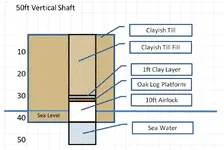
I have attached a simple diagram to help explain...
Your schematic of the tunnel network shows every vertical shaft with an air lock and not every platform in a given shaft.
Is this correct?

What im trying to understand is how the air lock is constructed before the system is activated and stagnation occurs.

In my diagram i theorized a log platform is placed at a specific height in each shaft in order for the stagnation to occur at the correct levels. To help seal the air lock i added a layer of clay above these air lock platforms

Then they filled about the air lock platform to the surface. I used a different cross hatch in the shaft to indicate worked soil.

Although not shown, they probably added log platforms every 10ft so the sealed airlock platform doesn't carry all the weight.

If this isn't how you theorized it, please explain where i got it wrong.

I am not criticizing but just trying to understand.
 

Attachments

  • 50ft Vertical Shaft.webp
    50ft Vertical Shaft.webp
    85.2 KB · Views: 48
I have attached a simple diagram to help explain...
Your schematic of the tunnel network shows every vertical shaft with an air lock and not every platform in a given shaft.
Is this correct?

What im trying to understand is how the air lock is constructed before the system is activated and stagnation occurs.

In my diagram i theorized a log platform is placed at a specific height in each shaft in order for the stagnation to occur at the correct levels. To help seal the air lock i added a layer of clay above these air lock platforms

Then they filled about the air lock platform to the surface. I used a different cross hatch in the shaft to indicate worked soil.

Although not shown, they probably added log platforms every 10ft so the sealed airlock platform doesn't carry all the weight.

If this isn't how you theorized it, please explain where i got it wrong.

I am not criticizing but just trying to understand.
One more point...
When the system is activated,sea water would rush through tunnels as planned and push up under each shaft creating the air lock. So the blue sea water shown in my diagram would only be there after stagnation or as i call it...equibration
 
One more point...
When the system is activated,sea water would rush through tunnels as planned and push up under each shaft creating the air lock. So the blue sea water shown in my diagram would only be there after stagnation or as i call it...equibration
Hi chalkoutline, I have not added log platforms to the CAD because the amount of platforms below the uppermost three is superfluous for the system to work, whether or not lower platforms were actually back filled in lower platforms or completely removed does not matter. The sea water in any flood tunnel would rise in any shaft to a point where trapped air would halt its ascension. The amount of trapped air in a shaft would only depend on the position of the lowest backfilled platform, for instance a two hundred foot deep shaft with three 10ft filled platforms would have a 70ft deep air bubble below. When the sea water was eventually let in, the air lock effect stopped its rise in the shaft
. To explain further if you plunged a dry glass down vertically into an aquarium full of water the inside of the glass remains dry because of the trapped air. The size of the glass does not matter, the effect will always be the same. Similarly providing the shafts are solidly blocked at the surface the height or length of the trapped air will vary. The air locked dry section that runs from point 25/ to the Repository 30/ can be any length, even several miles because the effect will always be the same providing the air bubble is not pierced.
In conclusion it does not matter how many filled platforms were used, trapped air would always keeps the logs dry. This trapped air effect was employed in deep sea diving bells.
As illustrated in the CAD, this "Activation" stage 3/ was left as a deadly booby trap, any attempt to get to the treasure would release air and rapidly flood the undersea level repository in a few minutes. After all the searcher work that has been done on Oak Island the original network system has probably been destroyed, and the air lock breached, if this is the case the treasure is underwater, but it's not irretrievable.
Oak Island Sage
 
Last edited:
Hi chalkoutline, I have not added log platforms to the CAD because the amount of platforms below the uppermost three is superfluous for the system to work, whether or not lower platforms were actually back filled in lower platforms or completely removed does not matter. The sea water in any flood tunnel would rise in any shaft to a point where trapped air would halt its ascension. The amount of trapped air in a shaft would only depend on the position of the lowest backfilled platform, for instance a two hundred foot deep shaft with three 10ft filled platforms have a 70ft deep air bubble below. When the sea water was eventually let in, the air lock effect stopped its rise in the shaft
. To explain further if you plunged a dry glass down vertically into an aquarium the inside of the glass remains dry because of the trapped air. The size of the glass does not matter, the effect will always be the same. Similarly providing the shafts are solidly blocked at the surface the height or length of the trapped air will vary. The air locked dry section that runs from point 25/ to the Repository 30/ can be any length, even several miles because the effect will always be the same providing the air bubble is not pierced.
In conclusion it does not matter how many filled platforms were used, trapped air would always keeps the logs dry. This trapped air effect was employed in deep sea diving bells.
As illustrated in the CAD, this "Activation" stage 3/ was left as a deadly booby trap, any attempt to get to the treasure would release air and rapidly flood the undersea level repository in a few minutes. After all the searcher work that has been done on Oak Island the original network system has probably been destroyed, and the air lock breached, if this is the case the treasure is underwater, but it's not irretrievable.
Oak Island Sage
Since i was making a genieric shaft in my diagram i only showed the platform that is needed to create the air lock.

This gets back to our earlier back and forth...
The horizontal flood tunnels had to use timbers, ceiling and wall support up to the point where it intersected the vertical shaft.

When the system is activated the flood tunnels would be well supported; however, as the sea water fills the vertical shaft to create the air lock the vertical walls are not protected exposing the clayish till to the seawater directly.

According to gravelteeth's geologist friend, this exposure would compromise, the shaft walls causing them to collapse.

It seems to me you need to show the airlock platform and wall support from the tunnels up to the airlock platform.
 
Since i was making a genieric shaft in my diagram i only showed the platform that is needed to create the air lock.

This gets back to our earlier back and forth...
The horizontal flood tunnels had to use timbers, ceiling and wall support up to the point where it intersected the vertical shaft.

When the system is activated the flood tunnels would be well supported; however, as the sea water fills the vertical shaft to create the air lock the vertical walls are not protected exposing the clayish till to the seawater directly.

According to gravelteeth's geologist friend, this exposure would compromise, the shaft walls causing them to collapse.

It seems to me you need to show the airlock platform and wall support from the tunnels up to the airlock platform.
This only works if the depoitors could complete the non supported vertical shaft during the hot summer months avoiding the rainy fall and harsh winters.
 
I also had quick look at how they would activate the flood system....
Assuming they created a circular cofferdam 700ft off South Shore at a depth o 50ft it would have taken almost a year times 4. This would be a huge engineering effort of driving piles and using barges to transport logs and clay and for a work platform.

Im Assuming they would tunnel from the cofferdam to South Shore which indicates the cofferdams would need to be kept in place and somewhat dry until the tunneling was complete. dry Then they had to tunnel across the west side of the island and under swamp to the money pit.

Activating the system would require the removal of the cofferdams.

How did the miners get air while under the ocean?

I have enough doubts about your theory that im not pursuing it any more but feel free to explain how they actvated the system.
 
I also had quick look at how they would activate the flood system....
Assuming they created a circular cofferdam 700ft off South Shore at a depth o 50ft it would have taken almost a year times 4. This would be a huge engineering effort of driving piles and using barges to transport logs and clay and for a work platform.

Im Assuming they would tunnel from the cofferdam to South Shore which indicates the cofferdams would need to be kept in place and somewhat dry until the tunneling was complete. dry Then they had to tunnel across the west side of the island and under swamp to the money pit.

Activating the system would require the removal of the cofferdams.

How did the miners get air while under the ocean?

I have enough doubts about your theory that im not pursuing it any more but feel free to explain how they actvated the system.

The key trick to it all of course is to employ a Cornish pick. (Obviously ; the pick found in a filled in hole explains that well enough.)
Use the pick to poke a hole (s) through the water to breath.
Swing it like a pendulum to accelerate time to reduce labor and supply requirements in order to reduce construction of a three year project into a mere couple of days.
 
Hello, as an 85 year old English researcher on Oak Island I have completed a twenty five year old in-depth study of the historic aspects of the enigmatic Oak Island, and my discoveries which are included in my book "Oak Island Treasure Revelations" by Cerris Francis are based on a mixture of fact and probability, I have disclosed some of my findings and theories in my book which is available in various formats and which is being distributed word wide

If I can answer your questions regarding various subjects appertaining to the Oak Island Saga, I will always give you an honest reply. I have been on the island and talked at length in person with Dan Blankenship and I have his signed agreement to work with Fred Nolan ( who also agreed) on my proposed joint treasure recovery project directed by me, unfortunately at the time David Tobias who was the President of the Triton Alliance refused to agree so sadly the very rare deal fell through.

For many years I have been in touch with the old and now deceased Oak Island searchers, and now with the new treasure hunters. I've had a 2025 zoom meeting with Craig and Rick, they have copies of my long awaited book now so maybe this year they might seek my help.
The book contains, the CAD of the great subterranean flood tunnel system beneath Oak Island , Captain Kidd's last signed treasure that depicts Oak Island, the Secret Jetty where treasure laden ship actually anchored, and the real vital function of the empty Money Pit. these are just some of the revelations enclosed that you will not find in other books.

I you want my honest opinion on anything appertaining to Oak Island I will give it to you, but maybe you should read my book first.

Oak Island Sage
I bet back in the day the islander's saw people digging out a ship that got stuck in the triangle swamp
 
...that is the real concealed secret entrance that the original perpetrators used, similar to the Money Pit. That is what I would help the current searchers to locate...
My question is, how would you locate it? Satellite imagery? Geophysical instrument? Dowsing?
 

Users who are viewing this thread

Latest Discussions

Back
Top Bottom